


Kill Your Darlings: Investigating the Beat Generation murder

“Kill your darlings”. That’s the literary advice left by the original Beat Generation. For writers, it means accepting that sometimes the bits you love best have to be cut loose. It’s a reminder that editing, just like artistry, is ruthless and sometimes you have to murder your own creation to make something better. But for the original writers in 1940s New York, the phrase was a lot more literal as the Beat crowd were wrapped up in a real-life murder.
The origin of the Beat movement, which went on to be one of the most influential moments in literary history and still has a profound impact on not only writing but art and music, is little more than a friendship group. A core group of writers – Allen Ginsberg, William S. Burroughs, Lucien Carr, Jack Kerouac and more – met around the Columbia campus in New York. Among others, Kerouac, Ginsberg and Carr met in class there, all sharing the same anti-academic streak but a deep love for literature as an art form. However, it’s the connection between them and Burroughs where things get dark and messy, tangled up in a traumatic tale for Carr.
It goes back way further than his New York days. When he was 12, back in his hometown of St. Louis, Carr met David Kammerer. He was already interested in books but had a clear boyish streak as he kicked about with the Boy Scouts and played sports. Kammerer combined the two as an English and physical education teacher who led the Scout troupe that young Carr happened to join. Their meeting would change not only Carr’s life forever but the lives of an entire circle of friends that he’d yet to meet, too.
Kammerer became infatuated with Carr. He’d show up at his school, stalking him and hounding him with predatory remarks and behaviours, forcing Carr to move from school to school in an attempt to shake the man off and be safe from his obsession. The stress was so great that Carr even attempted suicide, which his family chalked up to the impact of Kammerer’s unending harassment and terrifying fixation. After that, his mother moved him to New York and enrolled him in Columbia, where she thought he’d be safe. He made friends as he found other passionate writers on campus and fell into their crowd.
But who did William S. Burroughs happen to grow up with? David Kammerer. After finding out the new location of his obsession, the stalker moved to New York, into an apartment only blocks away from Carr’s new friend.

Carr tried to focus on his work. Within the Beat ground, he found purpose and a calling that he wouldn’t be forced to run from. But no matter what, Kammerer lurked around him. Sometimes, Carr would hide, and sometimes, he’d indulge his obsession just to get on with his life, but as time wore on, the situation worsened. Kammerer was losing it. His behaviour was getting even scarier as he was caught trying to hang Kerouac’s cat, breaking into Carr’s house and watching him sleep or levelling up his desperate attempts for his attention. In 1944, when he heard of Kerouac and Carr’s plans to leave New York and travel, it all boiled over at the thought of losing sight of his obsession.
On August 13, 1944, Kerouac and Carr tried and failed to board a merchant ship out of the city while Kammerer was watching on. He followed Carr to Riverside Park, where the writer claims he made further sexual advances before getting violent and attacking him. Ironically, it was the boy scout knife Carr had kept hold of that dealt the fatal wound as he stabbed his stalker.
Carr then went to Burrough’s apartment, handing him a pack of bloodied cigarettes as the poetic symbol of what had just happened. Then he found Kerouac, and the two allegedly went back to the murder site to bury Kammerer’s glasses and the knife. By the end of the night, the beat crowd had blood on their hands.
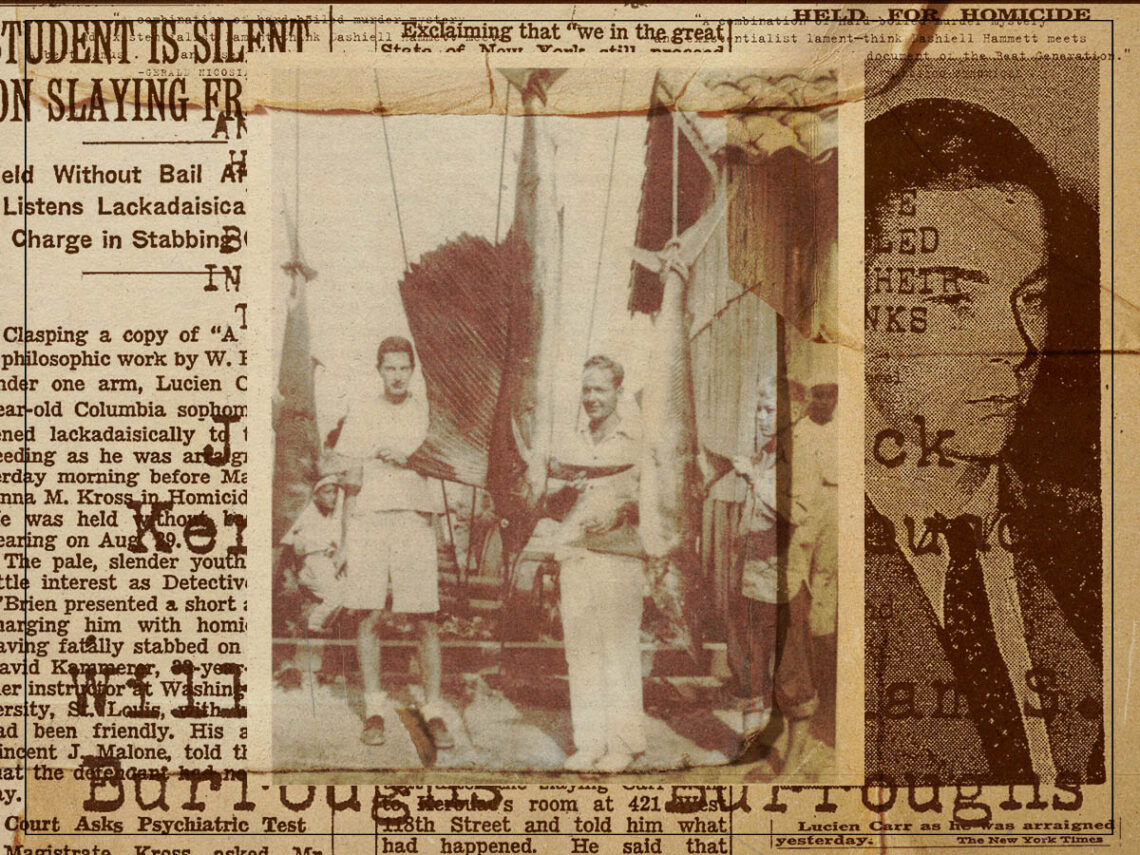
But in the end, Carr turned himself in as the guilt ate him up. He was charged with second-degree murder, while Kerouac and Burroughs were also arrested accessories. For a time, the killing had the entire scene shaken as they reeled from this act of violence and the way they’d watched it all play out as Kammerer lingered in the fringes of all their lives.
The ordeal found its way into their writing. As the two main witnesses, Kerouac and Burroughs collaborated on a novel about the events called And The Hippos Were Boiled In Their Tanks. Kerouac visited it twice again in The Town and the City and Vanity of Duluoz. Ginsberg also started a manuscript on the topic, but out of respect for Carr and an attempt to stop some of the bad press surrounding his name, he killed it.
The one person who didn’t seem to put the events down in art was Carr himself. Perhaps that was purely because it was all too real. In a world where everything could be fuel for inspiration, it would be easy to forget quite how traumatic this would have been. “But you’re an artist. You don’t believe in decency and honesty and gratitude,” Burroughs said in his novel on the topic, mocking the suggestion that artists would be immune to the horror of this act. But they’re all human at heart, and even the hardest would be shaken by all this.
However, there are some who still doubt the whole tale. Some claim that this was nothing more than a melodrama, as Carr was writing a plot about his own life. After all, after his suicide attempt, he’d chalked the whole thing up to being a piece of “performance art”, with some wondering whether this murder was merely the next act to give them all something to write about.
