


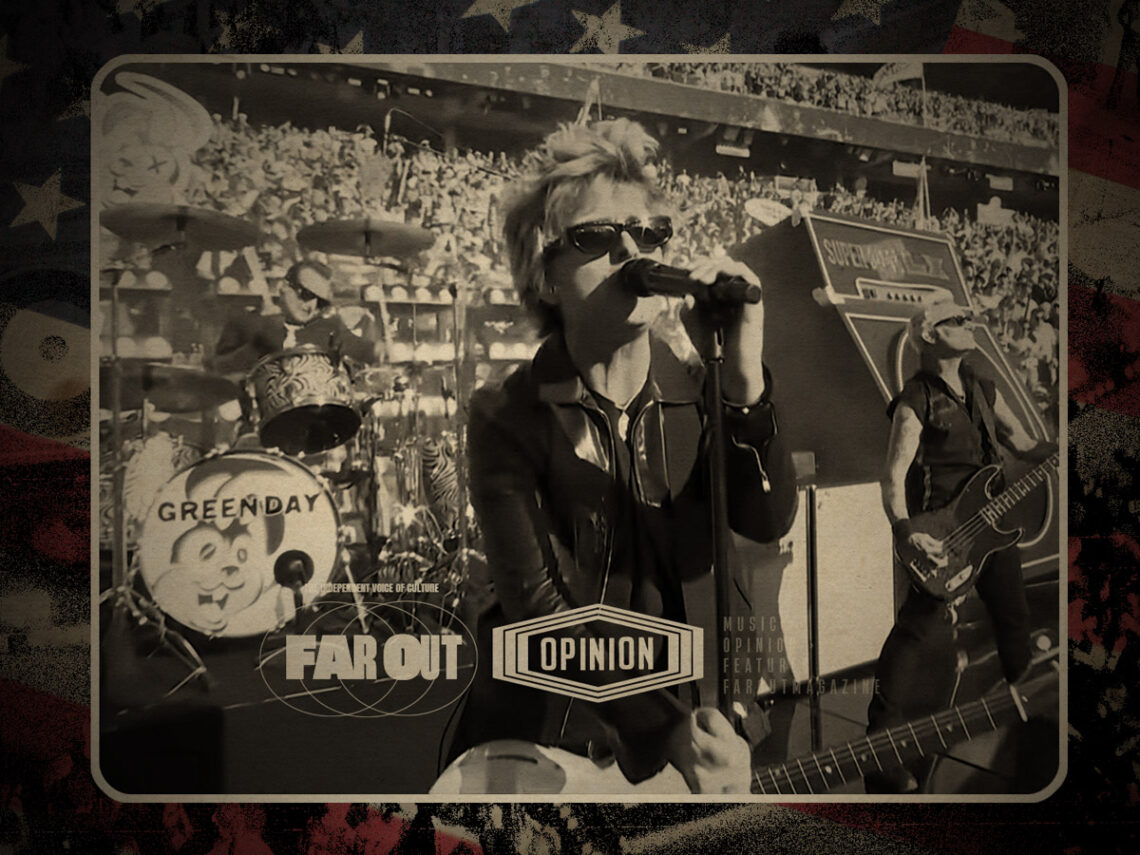
Green Day abandoned their inner Fugazi at the Super Bowl

“People shouldn’t expect anything,” Billie Joe Armstrong said. “I write songs and that’s it. I don’t consider myself anything else. I’m not a politician; I’m a musician.”
No, the Green Day frontman wasn’t trying to ease media concerns about what he might say or do during his band’s set at the opening festivities of the 2026 Super Bowl. That was actually a quote from way back in 1995, when a 23-year-old Armstrong was still coming to terms with his new role as an unwitting “voice of a generation” following the massive success of the album Dookie.
For as much as Nirvana’s rise to mainstream superstardom is remembered as the parting of the proverbial Red Sea in ‘90s rock, it could easily be argued that Green Day’s crossover from scrappy Gilman Street punk outfit to stadium-fillers had even bigger ramifications, including the level of blowback fired at the band themselves from their own community.
“When we first started playing this kind of music,” Armstrong told the Sun-News in 1995, “We never thought there would be a lot of people into it, you know? When we started playing gigs in October 1988, the last thing we ever thought is that we were going to get famous from doing it. We thought we would be able to tour and have some fun and meet people—interesting people, creative people that come out of places like Gilman Street. That was pretty much the extent of it.”
Even though Nirvana’s success had opened the door to bands like Green Day potentially getting offered a major label record deal, it was still seen as a sort of blood pact with the devil among punk purists, and for a little while, Green Day were loyal to that worldview.
“At the time, we were like, ‘there’s no way’,” a much older Armstrong recalled to Variety last year. “We were hoping to get as big as maybe Fugazi or something like that, but especially in the Bay Area, coming from the Maximum Rocknroll and Gilman Street scene, people were really uptight about major labels and corporations and who they’re affiliated with and people coming in and infiltrating a scene.”
The Washington DC hardcore band Fugazi was the gold standard, to use a not-very-punky term, for thousands of garage bands in the ‘80s and ‘90s. The group bled authenticity, and were the flagship band of frontman Ian MacKaye’s own record label, the legendary Dischord, making any thought of them jumping ship to the big leagues a veritable impossibility.
Wanting to get “as big as” Fugazi certainly didn’t equate to getting rich and famous, as Green Day ultimately did. It was about quality, respect, and meaningful art. To their credit, though, once Green Day had survived their ex-communication from Gilman Street, they did their best to use their comparatively gigantic new platform to say some of the same things Fugazi were saying to like-minded audiences in smaller clubs. Armstrong got over his aversion to politics in the 2000s and launched the second era of Green Day’s career with American Idiot.
Now, as one of the old standard-bearers of, dare we say, the new “classic rock” in America, the band had an opportunity to make a statement on the stupidly huge stage of the Super Bowl, held in a stadium less than an hour away from Green Day’s Gilman Street roots. But rather than re-discovering their inner Fugazi, it appears as though they chose the safer route typical of a stadium act, leaving out some of the most charged political lyrics of their songs ‘Holiday’ and ‘American Idiot’ and opting for a neutral, and ultimately demoralising, message of passivity.
I guess Armstrong was right back in 1995. People shouldn’t expect anything.

Never Miss A Beat
The Far Out Punk Newsletter
All the latest Punk content from the independent voice of culture.
Straight to your inbox.