


Hear Me Out: ‘Do They Know It’s Christmas?’ was actually pivotal to the rebirth of protest music

‘Do They Know It’s Christmas‘ is a cultural oddity that proves hard to fully reconcile.
It’s the song that reduced the world’s second-largest continent to a single narrative, but it also raised millions in aid for Ethiopia. It reinforced outdated colonial-era stereotypes, while also exceeding fundraising goals. It showed celebrity stars falling foul of embodying capitalist saviour tropes, but it also helped launch a new era of musical charity. So, how guilty should you feel when your aunt plays it on repeat every Christmas?
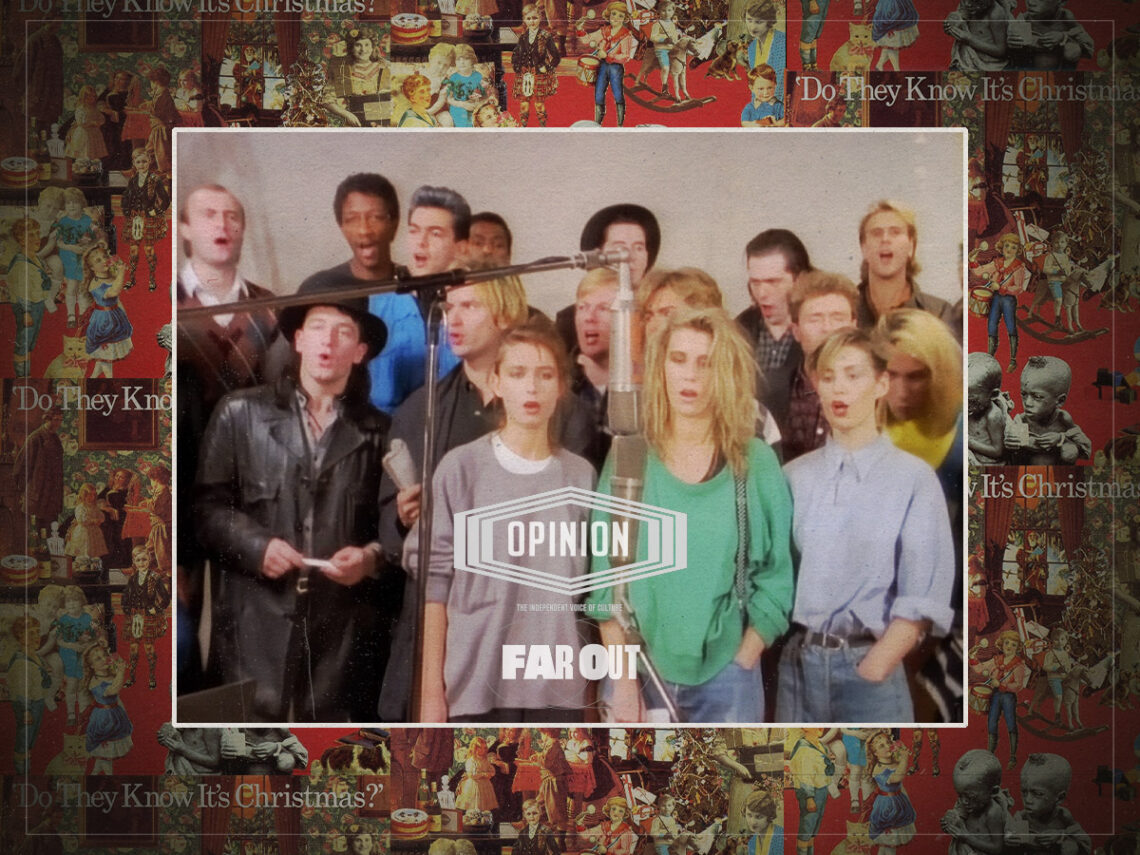
The Band Aid crew was assembled by songwriters Bob Geldof and Midge Ure in 1984, bringing dozens of artists from Phil Collins to Paul Young into a glamorous Notting Hill studio.
All but one artist – Robert Bell from Kool & the Gang – were white, with Stevie Wonder famously declining to be the show’s token Black act. Participation in singing for the generic concept of ‘Africa’ would be lauded with PR points and attention from the charts, the song being the fastest-selling single in UK history until Elton John took the spot in 1997.
It’s certainly easy to argue that the attention that was being brought to the subject was not necessarily the right tone, with irksome lines like, “And there won’t be snow in Africa this Christmas time, The greatest gift they’ll get this year is life”, feeling politically flimsy. And the catchy tune has continued to patronise audiences for decades as it enters the repeat Christmas canon.
But with £8million raised in its first year alone, is it ok to patronise African nations with glittery, commercially safe Western frivolity? The answer is always no. However, the story doesn’t stop there. Sometimes even clouds of shame have silver linings, as the effort had a trickling-down effect. Once the Ethiopian famine was on the world stage, efforts like ‘Starvation’ and ‘Let’s Make Africa Green Again’ by Black artists gave the cause the direction and narrative it deserved.
The song, inadvertently or otherwise, prompted protest music to be prised from the clutch of reductive chart sentimentality. “This effort is more low-key [than Band Aid], but we hope to make money,” London keyboardist Jerry Dammers told the Manchester Evening News when his charity single ‘Starvation’ was released in March 1985. His record was the first UK top-40 fundraiser for Africa to be sung by actual African artists.
In this regard, the Band Aid project reached far beyond its first song. The initiative invited a trend of activist music to unfold, from Artists United Against Apartheid to today’s Together for Palestine. Bono’s RED efforts engaged the private sector and countless musicians to affiliate their products with the organisation to raise awareness in battling HIV/AIDS, successfully raising hundreds of millions of dollars.
And of course, Band Aid’s effort was well-intentioned and resulted in a continuous radio output, the Live Aid Concerts and the ongoing Band Aid Trust, raising over £290m. Overall, the supergroup changed public perceptions of charity, and invited fans to start looking into what values sat rotting at the bottom of their musical heroes’ wallets.
For the length of its existence, rock has stood as a beacon of dissatisfaction with the state of the world. There was a lot of power sitting unused between the lines of legendary anthems, but no one harnessed that power to action. At least Band Aid used their influence to start something with the money that had piled up from all that restless rocking.
It was far from perfect, and perhaps it was even problematic in parts, but it stirred protest music back into action. From the funds it raised to the counter-arguments it provoked and the many more sincere songs that followed in its wake, at the very least, this soppy song represented a pivotal moment in pop culture that has since unfurled for the best.
In its own troubled way, it ensured that humanitarianism returned to be part of the remit of culture in an age when that seemed to be on the slide. Its problems would soon be pointed out and addressed by the likes of Fuse ODG, whose own anthems were now given a greater platform and found an audience to resonate with.
