


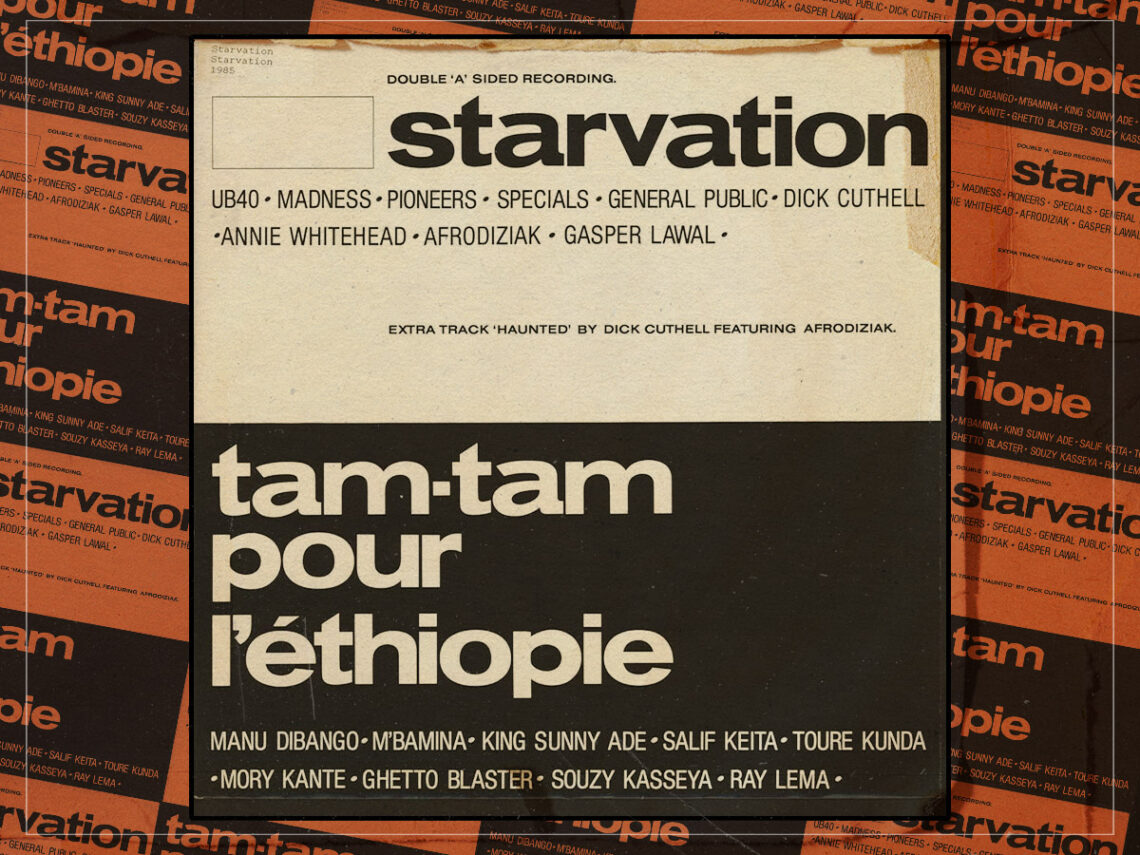
‘Starvation’: The 1985 charity single that offered a more diverse take on Band Aid

Following the 40th anniversary of ‘Do They Know It’s Christmas?’ last December and the Live Aid concerts earlier this summer, there has been a fresh batch of hindsight aimed at Bob Geldof’s ambitious charity projects.
Was the money raised handled properly and delivered to the people who needed it? Were the lyrics to that Christmas tune actually a tad tone deaf and offensive? And then there’s that whole issue of Band Aid featuring almost entirely white, and primarily male, artists.
For the most part, no matter your feelings on Geldof as a person, it’s hard to make any sort of argument against the genuine intent of his undertaking 40 years ago and the important, measurable difference it made. Mistakes also happened, and some flaws were glaring—as one would expect with something at this sort of epic scale—but the aim was consistently noble.
One aspect of Band Aid that also tends to get overlooked is the way it inspired countless other artists to consider the charitable potential of their work, no matter how small the scale or publicity might have been by comparison.
In December of 1984, for example, when ‘Do They Know It’s Christmas’ was racing up the charts, another charity single was recorded in London, organised by keyboardist Jerry Dammers of The Specials. Featuring various members of bands from the venerated ska-punk record label 2 Tone, including The Specials, Madness, UB40, and General Public, the single’s A-side featured a cover of the song ‘Starvation’ by the influential Jamaican reggae group The Pioneers, who also made a guest appearance on the track themselves.
The B-side, ‘Tam Tam Pour L’Ethiopie’, was perhaps even more noteworthy, in that it was produced by Cameroonian musician Manu Dibango and brought together an all-African line-up of guest performers, including singers King Sunny Adé, Hugh Masekela, and Youssou N’Dour. Vocals were also performed in a range of African languages, from Swahili and Douala to Wolof, Lingala, and Malinke.
“This effort is more low-key [than Band Aid] but we hope to make money,” Dammers told the Manchester Evening News when the ‘Starvation’ single was released in March 1985. “The hunger and poverty is going to be around for some time, maybe many years, and we must not forget it. The danger with anything that makes the news is that it ceases to be newsworthy after a while, and people think things have become OK.”
In 1985, the 2 Tone label – and the ska sound in general – were on a bit of a downswing in mainstream popularity. Nonetheless, ‘Starvation’ performed quite well on the charts, reaching the Top 40 in the UK and faring even better in France, raising another influx of important funds to address the famine in Ethiopia. Unlike Band Aid and the ‘We Are the World’ record in America, it was also a rare example of an African charity single featuring actual African artists.
Dammers didn’t credit the single’s success to its diversity, however. For him, the best way to ensure that money was raised for the cause was simply to see to it that the music connected with the public.
“I think charity records have to be good records,” he said, adding, “After all, the people who appear [on them] are musicians first and foremost, and people have the right to get the goods.”
