


Thylacine: The artist collecting passport stamps like they’re sound samples

The stage is set at Maison de la Radio in Paris, and buried amongst a wood panel auditorium, surrounded by a stringed orchestra, an organ and a teen choir, is the last place you’d expect to find an electronic musician.
But in Thylacine’s words, “I’m not a DJ. I’ve never been a DJ”, for his work can simply not be contained in so narrow a category. Ever moving, even while on stage, the French artist who shares his stage name with a striped Tasmanian wolf extinct since the 1930s, but whom his circle know as William Rezé, has been composing music from anywhere that isn’t his home of Angers. He’s brought his listeners on board the Trans-Siberian train, through the windy Faroe Islands, even into an Alpine glacier, much to his team’s dispirit.
“I don’t really enjoy travelling without a goal…it feels weird to just be enjoying the view, just for myself,” he says. He takes himself on these expeditions as part of his “artistic process”, he tells Far Out; the adventure is a hunt for sound, for inspiration, resulting in a plethora of samples from the tribal to the animal. The travelling music man brought his findings to the stage, mixing them into sophisticated cinematic dance electronica, which is subtle and melodic, backed by landscapes that inspired them, shown on video.
He explains that this is one of the ways through which he whisks his sold-out crowds abroad with him: “For the normal tour, so not tonight, we have a video setup, so we use all the images we shot in all the different journeys that I did”. His videographer and now partner, Cécile Chabert, is an integral part of Rezé’s creation, shooting night and day, across deserts and islands, to capture the perfect visual detail for his music, “So it helps, I hope, the audience to go a bit deeper into the track”.
The resulting balance is a cinematographic soundscape backing Chabert’s movie, while she, in turn, illustrates what Rezé’s music is trying to encapsulate, about which he says, “We use [the footage] also more as artistic material, not like a documentary or a movie, it’s more using all of that to make an art installation.” But on a night like tonight, the artist relies on another mode of tele-transportation.

His primary method is, well, “with instruments…My favourite instrument right now is the duruk”. Like many in Rezé’s collection, they’re hardly ever heard of in the West. “It’s a small flute from Armenia and it’s very warm, very beautiful, there’s a lot of emotion in it, and it’s pretty hard to play, you have to have a very big mouth, like that,” he says, proceeding to fill his cheeks with air to maximum capacity “like a frog, and all the best players look like very big frogs.” He passionately dedicated a whole track to the instrument, eponymously named ‘Duduk’, composed around a track by Armenian duduk master Yeghshe Manukyan, named ‘Where is she’.
This visionary artist captured many travel and music lovers alike because of the way in which he correctly manages the line between inspiration and appropriation. Unlike musicians who ‘honour’ a culture that is not their own without rightfully crediting them, Rezé awards credit where it’s due. Everywhere he’s been, he recognises and compensates the efforts of any community lending their sounds and ideas to the making of his music. In a time where daylight sample robbery is just another Tuesday in electronic music, his exemplary ethics are not a guarantee.
Not only is he firm on paying and crediting the collaborators he encounters in islands or mountains, but his work has also given back to the people whose voices echo in his latest album. Released last October, Roads 3 took Thylacine and Chabert on a cathartic road trip across Namibia, where their 12 square metre Airstream encountered what seemed like just another campsite. Their beloved caravan, which Rezé converted into a mobile studio to facilitate recording while on the move, produced the voices of the Nama people, a people who suffered persecution alongside the Herero at the hands of the German Empire. The campsite had once been the sight of a concentration camp, on what is now known as Shark Island.
Theirs was the first genocide of the 20th century, and it still remains dusty beneath piles of forgotten history. Crossing the caravan’s path was a Nama chief, who asked the duo to shed light on their untold trauma; the tribe needed a platform, and Thylacine was the right voice to ask. “It was not planned, it happened because of [the] people we met. I got touched by that, and it was very interesting to work on that subject, especially right now,” he said.
The land of the indigenous Nama had fallen into colonial hands, but “[they’re] fighting, speaking of Shark Island, which is also the name of the track we worked on together, to get that land back to be a memorial”. This episode summarises the musician’s approach to his music: privy to whatever should be happening around him.
Wherever the artist took inspiration, his music also left a mark on those who inspired it, which was especially true in a country he returns to every year to play: “There was a very strong connection in Turkey,” he says, which is where he learned to play a deep-stringed instrument that’s now a key player in his repertoire, “I had this great feedback from people that are so happy that somebody like me played the bağlama on stage, and there’s this connection in both directions.”
Although he attended a conservatory for the study of the saxophone, it’s unsurprising to find Rezé surrounded by at least five different instruments on an average concert, with a shifting set-up according to the occasion. “There’s a pianist with me, and I’ve got different instruments, so it’s really a concert. There’s some aspects that I love with electronic music, but also some that I love about instruments and about real performance,” he relayed.
His pianist and composing collaborator, Bravinsan, has been working alongside him on stage for so many years that it gives Rezé the space he needs to improvise: “It’s important to not play the same concert every evening, or else I get bored, and probably the audience as well… with my pianist that plays with me on stage we have some signals, that I can send to him and he knows if we are looping, if we move forwards or backwards.”
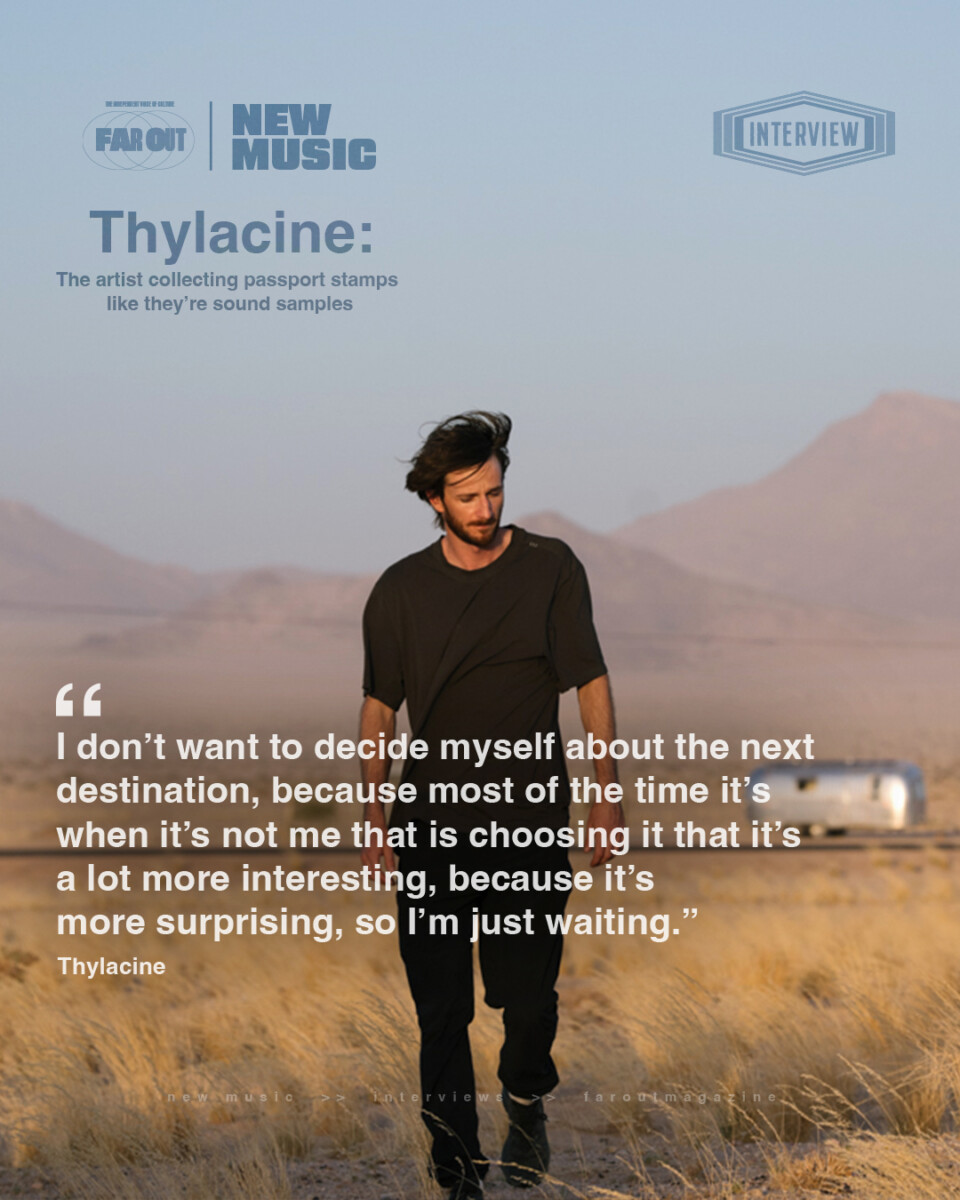
So with such wealth of experiences collected, it’s natural to ask where wanderlust will bring them next, to which he says, “Right now, I don’t want to decide myself about the next destination, because most of the time it’s when it’s not me that is choosing it that it’s a lot more interesting, because it’s more surprising, so I’m just waiting.” If someone has any suggestions for a place Thylacine has never thought about, shoot your shot: it might be the set for a new album.
Although his work makes music a more human experience, his last few terrains were quite remote, with Namibia having one of the weakest population densities in the world. “I think the best combo is when you have both, you know, it’s very isolated, and then you meet some people, and then it’s super powerful because [they’re] very disconnected to the world… For example, I worked with the Himbas, which is still a nomadic tribe that doesn’t have any electricity, any cell phone or anything, so musically to work with them was extremely interesting because they are not influenced by all the Western culture and music,” he recalled fondly.
Although rhinos and giraffes were a fantastic source of inspiration during Roads 3, the human narration in Rezé’s work is part of its unique fabric. “The first album that I composed, in the Trans-Siberian train, at first it was just because I realised I was more productive in a train than in a studio because I was always moving, seeing different landscapes, so I said, ‘OK, let’s take the longest train ever and let’s see what’s gonna happen’, and then I’ve met a lot of people on the way, I’ve recorded a lot of different people, from an old woman in the taiga [a region in Eastern Siberia], a shaman, very different people, and the core of the album was those voices, those encounters, so in the end, the human aspect is very strong in music and, I think it’s the more powerful aspect,” Rezé mused as he concluded.
