


The 1980 song that became Genesis’ most complex single: “It sounds simple”

During the psychedelic era, The Beatles set the “controls for the heart of” prog-rock, providing a blueprint for experimentalism from which bands like Pink Floyd, Yes, Genesis and Led Zeppelin grew impressively.
As the 1970s dawned, we faced a post-hippie era without The Beatles, where rock music split into several factions, including glam-rock, prog-rock, heavy metal and blues-rock.
Among those emerging movements, progressive rock became the natural home for musicians who wanted to push beyond conventional songwriting structures. Rather than focusing on chart success, bands embraced ambitious arrangements, extended compositions and technical musicianship that challenged audiences and performers alike.
Phil Collins, who had provided some ultimately discarded drum tracks during George Harrison’s All Things Must Pass sessions, joined Genesis in 1970. Between then and bandleader Peter Gabriel’s departure in 1974, Collins helped establish the band as one of Britain’s foremost prog-rock sensations with enduring albums like Nursery Cryme, Foxtrot and The Lamb Lies Down on Broadway.
Following Gabriel’s departure from the band and Steve Hackett’s following in 1977, Genesis was left increasingly in the hands of Collins. Creative leadership is rare among drummers, but Collins proved himself to be a jack of all trades, offering vocal, songwriting and instrumental expertise.
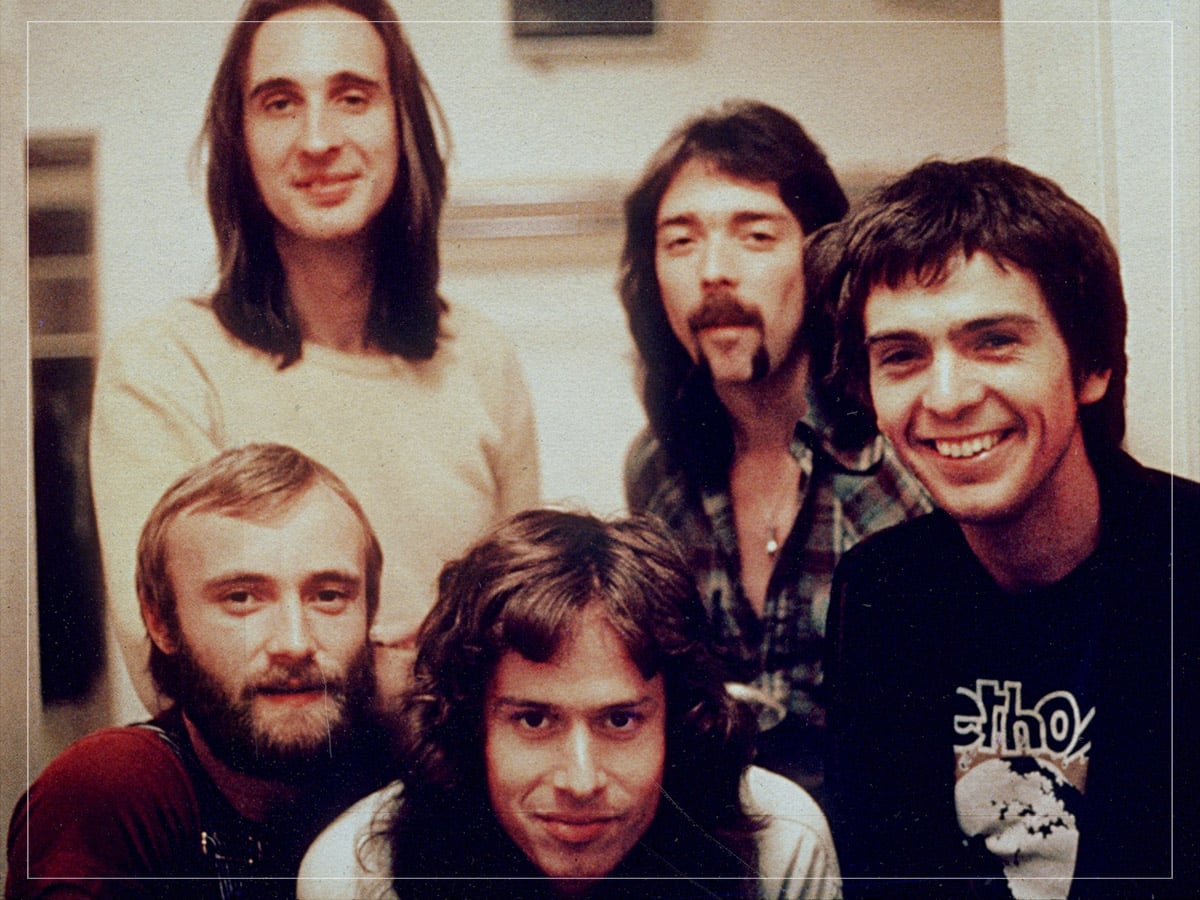
His rise was unusual in rock music, where drummers rarely become the focal point of a band’s creative direction. Collins’ ability to move seamlessly between rhythmic precision and melodic songwriting helped redefine what a frontman could look like in the progressive rock world.
Impressively, Collins embarked on a concurrent solo career in the early 1980s, prospering with his first two albums, Face Value and Hello, I Must Be Going, mainly thanks to the success of his hit single from the former, ‘In the Air Tonight’. Despite the song’s eventual popularity, Genesis allegedly passed up the opportunity to record the track. Speaking to Melody Maker in 1981, Collins claimed that he had played a demo to his bandmates Mike Rutherford and Tony Banks, but it was dismissed for being “too simple”. However, Banks has since denied that Collins ever showed the band the song before recording it.
Either way, Genesis held a penchant for complexity at its heart that began to subside heading into the 1980s. Collins’ successful solo work explored a passion for soul and pop, which began to permeate the Genesis catalogue as the decade progressed. While frontman Collins preferred simple, punchy lyrical motifs like those in ‘Invisible Touch’, Banks and Rutherford retained a propensity for complex themes and compositions.
Famously, Collins raised his concerns about ‘Domino’, Banks’ two-part epic on Invisible Touch. “I found it tricky,” Collins admitted of the song’s seemingly nonsensical lyrics. “I used to think, ‘How do I sing this thing about double glazing? How do I sing this and convince an audience?’ I found it awkward because I was getting more personal in my songwriting, and here I was singing things I didn’t understand – just syllables.”
‘Domino’ was certainly not the first time the band quenched a thirst for complexity. In 1980, Genesis released Duke, an album known for its pioneering use of drum machines, which allowed Collins to focus on singing and songwriting. The album’s lead single, ‘Turn It On Again’, is known as one of Genesis’ most complex compositions despite its pop inclination.
Most of the track’ complexity lies in its unconventional time signature. “Musically, it’s quite a complicated piece,” Banks noted in The Way We Walk documentary. “For starters, it’s in a funny time signature, 13/8 or something. Not that you’d really notice that – it seemed more natural to do that than it was to make it 12, which would have been more normal.”
Banks also noted that the song rifles through an unusually vast sequence of chords. “It goes through loads and loads of chords,” he added. “It’s a very unlikely single, in a way. The reason I think it works is because it sounds simple, even though it isn’t. I’ve always quite liked that.”
Concluding his point, Banks compared the song to some of Brian Wilson’s groundbreaking work for The Beach Boys. “The Beach Boys were good at that – things that sound deceptively simple, but when you actually look at them, they’re really quite complicated,” he said. For example, ‘God Only Knows’ dazzles with a West Coast sheen and twee lyrics, but under the surface, Wilson presents a production masterclass of contrapuntal harmonies and unconventional chord progression.
The success of ‘Turn It On Again’ demonstrates why Genesis remained such a compelling force throughout the 1980s. Beneath its radio-friendly surface lies the kind of musical sophistication that defined the band’s progressive roots, proving that complexity and accessibility do not have to be mutually exclusive. It is precisely this balance that allowed Genesis to evolve with the times while retaining the adventurous spirit that had first earned them acclaim.
