


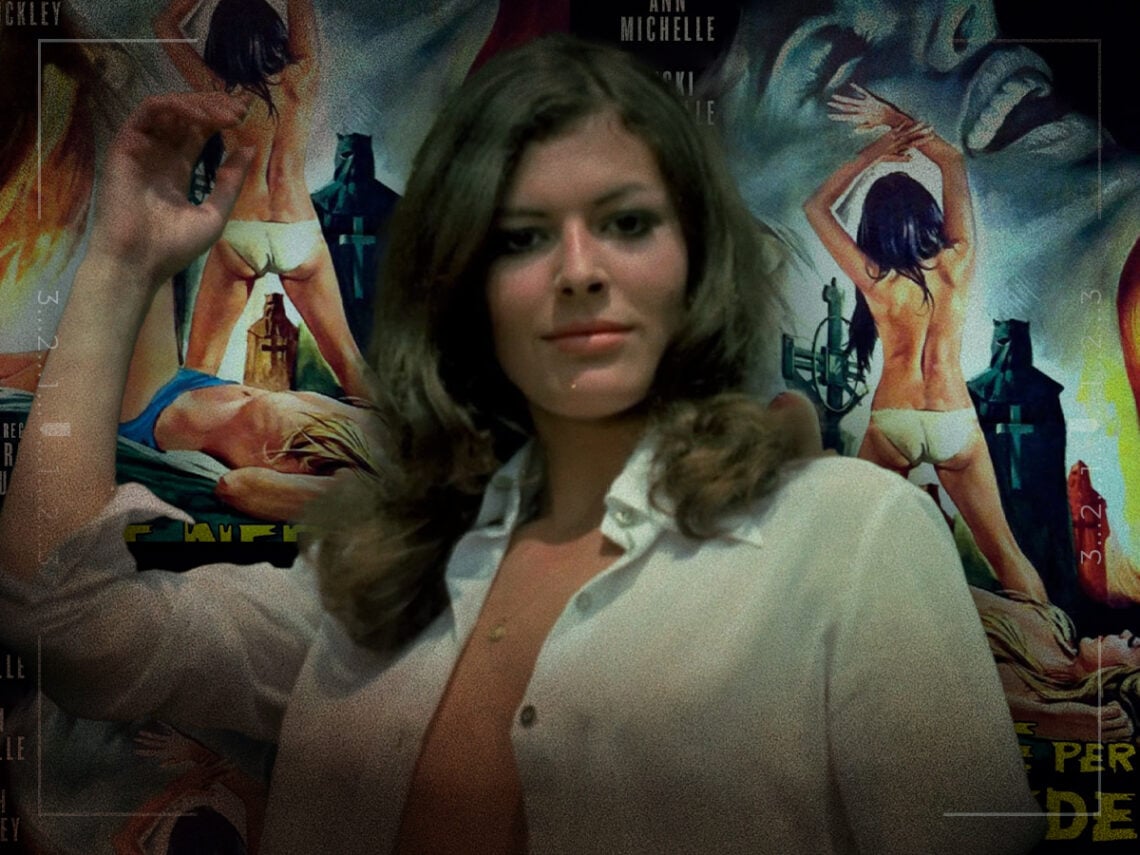
‘Virgin Witch’: why was this 1971 British horny horror movie initially rejected by the BBFC?

Virgin Witch is not a particularly memorable film; it’s not been long since I watched it, and for me, the thing I find most unforgettable is not the plot, but the outfits, the set design, and of course, the copious amounts of nudity.
Plot became a secondary concern during this era of British horror-themed sexploitation, which was thriving during the early 1970s as late-night audiences longed to watch the occult and the erotic collide. Virgin Witch does have a somewhat intriguing plot of young hopeful models taken to a mysterious country house, only to discover that the modelling agent is actually a witch looking for her newest coven member, but that takes a backseat as we witness the girls undressing for the camera, getting initiated into this strange and sleazy world.
Released in 1971, it emerged around the same time as Hammer’s popular lesbian vampire flicks, like The Vampire Lovers and Twins of Evil, as well as similarly sexually-charged supernatural-themed horrors, from Vampyros Lesbos to Daughters of Darkness. While Virgin Witch explores a coven of witches (with lesbian undertones, no less) rather than busty neck-biting heroines, the same sentiment is there: nudity, rituals, supernatural goings-on.
You have to go into Virgin Witch with the knowledge that you’re not going to be watching something like The Devils, which came out the same year. Ken Russell’s film might be awash with nudity and transgression, but his is a real artful piece of filmmaking with a strong underlying political message. Virgin Witch, judging by its endless lingering shots of fully nude women, with most of these images feeling woefully gratuitous, was made with one thing in mind: selling sex, selling a fantasy.
There’s one scene in which Christine is photographed by a man who quickly encourages her to take more and more of her clothes off, until what she assumes is a fashion shoot descends into something out of Playboy. Then we see them rolling about naked together, of course.
It would be reductive to say that there isn’t some hidden social meaning to be gleaned from the film, however, because its post-swinging sixties setting, paired with the young girls’ desperation to make it as models, says a lot about where Britain was at in the early 1970s. It’s a time capsule, above anything really, from the clothes to their attitudes towards sex to the obsession with capturing a cheap slice of cinematic sleaze.
When the BBFC were given the film for review, it rejected it on the grounds of its frequent depictions of sex and nudity. You’d think it might’ve just been given an 18, but the censorship board were clearly keen on having it banned outright. Deemed “unsuitable”, the movie luckily managed to bypass this censorship to a certain degree, receiving an X rating from the Greater London Council.


Since the BBFC’s decision can be overruled by local councils, the film’s success in London led them to reconsider its age certification, so, in 1972, two years after the movie had first begun production, it was finally released in cinemas as an X, albeit with a few cuts.
But why was Virgin Witch treated so strictly when similarly explicit sexploitation movies like 1969’s Her Private Hell and 1974’s Vampyres were released (with cuts) in cinemas? Perhaps it’s the sheer level of gratuitous, sexualised nudity that forms the bulk of the film that caused such an uproar. To be fair, if you watch the movie, you’ll see what all the fuss was about, because the first shot in the movie is literally a bare breast.
