


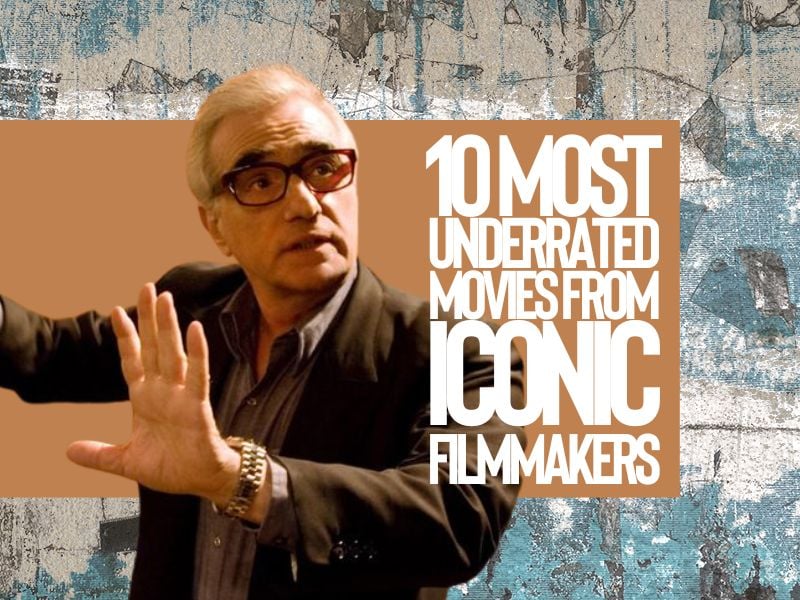
The 10 most underrated movies from iconic filmmakers

Some of the best filmmakers of all time, including the likes of Quentin Tarantino, Martin Scorsese, Akira Kurosawa and Steven Spielberg, are only known for a handful of their movies, despite their vast filmography. For Tarantino, it’s Pulp Fiction, Scorsese’s is Goodfellas, Kurosawa’s is Seven Samurai, and for Spielberg, you’re actually spoiled for choice, with the likes of Jaws, Jurassic Park and E.T to pick from.
Dig deeper into the filmographies of some of the best directors in the world, however, and you’ll find some true cinematic gems that are wrongfully critically judged or simply don’t get the attention they deserve in comparison to other more popular releases.
Compiling our list of ten underrated movies from iconic filmmakers was no easy task. In our investigation into the topic, in fact, we found a mountain of under-appreciated classics, including Harmony Korine’s Beach Bum, the Wachowski sisters’ Speed Racer, Christopher Nolan’s Insomnia and much more, with none of these aforementioned films making our exclusive list of hidden gems.
The ten most underrated movies from iconic filmmakers
10. Unstoppable (Tony Scott, 2010)
Known for his iconic patriotic American flick Top Gun, among several other classics, it’s rare that people mention Tony Scott’s 2010 movie Unstoppable when talking about his best movies. A corny, melodramatic action movie, Unstoppable follows the story of an unmanned half-mile-long freight train that is hurtling toward a city and the veteran engineer and young conductor who are tasked with bringing it to a halt.
Starring Chris Pine, Denzel Washington and Rosario Dawson, Scott’s 2010 movie is a tremendous amount of fun that stays within the limits of its 12A certificate whilst still being a rip-roaring blast.
9. In the Mouth of Madness (John Carpenter, 1994)
As underappreciated at the time as it is now, John Carpenter’s 1994 film In the Mouth of Madness deserves a lot more respect, with the film presenting a narrative both terrifying and strangely believable. It all follows Sam Neill, who plays a private investigator hired to find the missing novelist Sutter Crane (Jürgen Prochnow) and help deliver his final manuscripts to his publishers.
The book in subject, however, contains horrors so horrific and unfathomable that it sends any reader insane. It’s an awesome concept, well pulled off by Carpenter with some bizarre, occasionally terrifying imagery.
8. Sorcerer (William Friedkin, 1977)
Best known for his 1973 horror masterpiece The Exorcist, the American filmmaker has made many modern classics that deserve an equal amount of praise. Just one of these movies is the 1977 film Sorcerer, starring Roy Scheider, Peter Capell and Friedrich von Ledebur, a thrilling drama that tells the story of four unfortunate men from across the world who risk their lives to transport gallons of nitroglycerin across the Latin American jungle.
Strange, bizarre and highly enjoyable, Sorcerer may not carry the sheer cinematic impact of The Exorcist, but it’s a classic movie of the 1970s for many different reasons.
7. The Last Duel (Ridley Scott, 2021)
Released in recent years to poor commercial fanfare (largely due to a misjudged marketing campaign), The Last Duel is one of Ridley Scott’s greatest modern movies, even if reporters didn’t realise it at the time. Telling the story of King Charles VI, who declares that Knight Jean de Carrouges should settle his dispute with his squire by challenging him to a duel, the movie stars Ben Affleck, Matt Damon, Adam Driver and Jodie Comer.
A riveting action drama with several fantastic performances, particularly from Comer, The Last Duel is certainly worth a watch if it slipped from your grasp in 2021.
6. Thief (Michael Mann, 1981)
James Caan named his role in Michael Mann’s 1981 classic, Thief, as his all-time favourite, beating out the likely winner, Francis Ford Coppola’s The Godfather. There’s good reason why Caan chose the Mann classic too, with the crime thriller following an ace safecracker who wants to do one more big heist before going straight, being a tense, highly enjoyable crime movie that differs from Mann’s popular Heat and Collateral.
Whilst Caan stars in the movie, he is joined by Tuesday Weld, Willie Nelson and Dennis Farina in this frenetic classic that is well worth your time.
5. After Hours (Martin Scorsese, 1985)
Though it was nominated for a Palme d’Or shortly after its release, Scorsese’s excellent comedy romp that follows a man’s spiralling exploration of New York City, remains one of his most undiscovered masterpieces. A Kafkaesque nightmare, the movie shines thanks to some incredible performances from the likes of Rosanna Arquette and Griffin Dunne, who help to make the dark comedy a true classic.
Undoubtedly one of the most iconic filmmakers of the era, Scorsese’s film was overshadowed by other releases from the decade, including Raging Bull, The King of Comedy and The Last Temptation of Christ.
4. The Godfather: Part III (Francis Ford Coppola, 1990)
The final film in Francis Ford Coppola’s Godfather trilogy is not bad at all, even though some fans consider the film to be a catastrophic failure. Whilst the film couldn’t live up to the enormous critical and commercial success of the previous two instalments, it remains a great crime drama in its own right, merely speaking to how highly Coppola is respected as a filmmaker working at the height of his game.
With Al Pacino at the helm alongside Sofia Coppola, Andy Garcia and Diane Keaton, the cast do a decent effort to match the stunning work of such previous stars as Robert De Niro and Marlon Brando.
3. Safe (Todd Haynes, 1995)
Todd Haynes’ 1995 film Safe may be rated by critics, but we don’t think it gets the attention that it well and truly deserves. Playing a woman who develops multiple chemical sensitivities and is forced to leave her world of comforts behind, Julianne Moore is this film’s beating heart, providing an eerie performance that makes Haynes’ film a masterpiece of dramatic tension and narrative mystery.
Featuring alongside an impressive cast including Xander Berkeley, Dean Norris and Jodie Markell, Moore delivers a standout performance in Haynes’ extraordinary film that explores themes of modern consumerism and the contemporary obsession with beauty and wellness.
2. The Straight Story (David Lynch, 1999)
David Lynch’s 1999 Disney movie is something of a double entendre, with the title referring both to the literal straight journey of the film’s protagonist as well as the narrative linearity that the filmmaker adopts. By far the most accessible drama of the director’s filmography, The Straight Story follows Alvin Straight, a man who decides to set out across the country on his lawnmower to visit his dying brother.
Understandably overshadowed by the director’s more experimental movies, including Blue Velvet, Mulholland Drive and Lost Highway, Lynch’s heart-wrenching drama is an epic voyage of self-discovery that shows a brand new edge to the iconic filmmaker.
1. The Killing (Stanley Kubrick, 1956)
The first of Kubrick’s major cinematic releases, 1956 classic The Killing, is a frantic heist film showcasing many subversive plot devices that would later become commonplace in blockbuster cinema.
Peppered with flashbacks and jump-forwards, the film follows a veteran criminal who masterminds a heist to steal millions of dollars from a racetrack, a plan hampered by the foolishness of the unruly gang he employs. Characterised in part by Kubrick’s soon-to-be established cinematic dynamism, the film might be one of his simplest in terms of narrative, but it certainly remains one of his most enjoyable.
Whilst it may not contain all of the accomplished flair of 2001: A Space Odyssey or The Shining, The Killing deserves to be considered as one of the director’s very best movies.
