


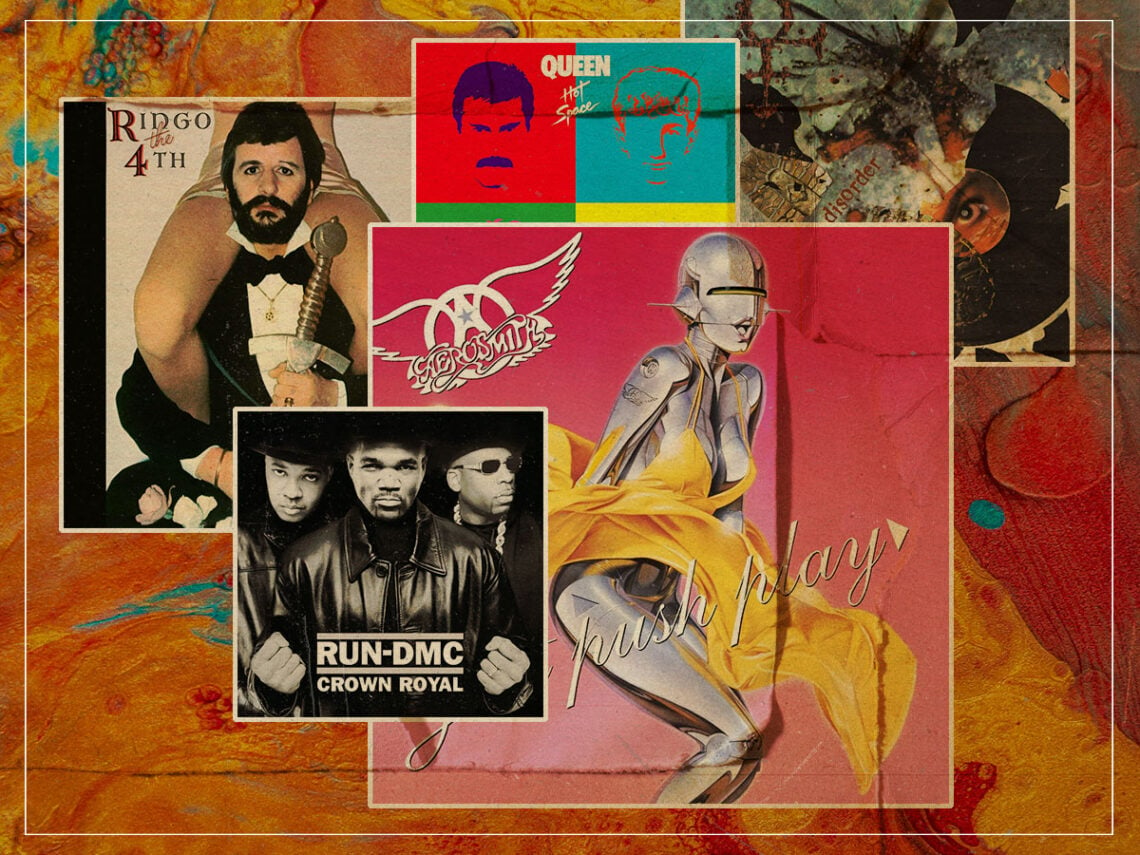
The 10 biggest trend-riding albums of all time

Every artist has to keep up with the times in music. One sound can’t build a career forever unless your name is AC/DC or Motörhead, so some of the greatest musicians in the world have different periods where they try on different sounds to see how they fit. It’s completely natural for people to switch it up, but artists like Aerosmith clung to trends a lot tighter than others were willing to go.
Then again, is riding trends necessarily bad? Sure, there are people who cry “sell out” whenever someone decides to make a bold new reinvention in their sound, but artists like Van Halen and Queen have proved time and time again that just because something is mainstream doesn’t necessarily mean that it’s terrible.
It’s all about how it’s presented, but many of these artists had no grip on what they were doing half the time. There would be a few hints that they listened to the genre in question now and then, but the further you dig into the record, it feels less like they’re wearing a different sonic hat and more like they’re just stretching their sound so much that any random passive listener might bother to hear what they have to say.
While some of them managed to get hits out of the deal, it wasn’t exactly shocking when many fell by the wayside or went through a rough stretch of their career once the album cycle was done. It’s one thing to be able to shapeshift like a chameleon, but not every artist is David Bowie, and where most people ride trends like waves, these records ended up wiping out so hard they left a crater in their wake.
10 biggest trend-riding albums:
10. Hot Space – Queen
Remember in that intro blurb where we talked about Queen being the one example of how to go pop correctly? After becoming one of the biggest acts in stadium rock, The Game was the kind of gamble that shouldn’t have been nearly as good as it was, giving us the rockabilly ‘Crazy Little Thing Called Love’ and God’s curse to bass shops everywhere, ‘Another One Bites the Dust’. Once the latter started doing major numbers, though, Freddie Mercury had a bit of a different idea for the follow-up.
Thinking that Queen’s future was in the world of dance music, half of Hot Space is all about making some of the cheesiest dance music of the modern age, complete with squelchy keyboards and blisteringly unsexy songs like ‘Body Language’ to carry it along. In fact, the only saving grace of the album is the fact that they tacked on their iconic duet ‘Under Pressure’ as a bonus track as if to cushion the blow for anyone still listening.
What’s even stranger is that Michael Jackson had taken inspiration from ‘Bites the Dust’ for his own album on the horizon during the time that Queen was working on this project. So, yes, there’s probably an alternative timeline where this album became the biggest pop album of all time instead of Thriller.
9. Simulation Theory – Muse
Every generation seems to have a weird sense of nostalgia for music decades before their time. We were already bringing back the 1960s by the tail end of the 1980s with The Traveling Wilburys, and it wasn’t a mistake to see Wayne’s World feature many references to the 1970s rockers of yesteryear. It took its sweet time getting there, but 1980s nostalgia kicked into overdrive in the 2010s, and Muse may have been one of the most notable culprits on Simulation Theory.
Then again, Muse never really had a set sound other than being over-the-top. Black Holes and Revelations had its hard rocking moments, and The 2nd Law saw them jumping on the dubstep bandwagon at the time and making it work. But even for their pedigree, this record is one of the least subtle genre hops in recent memory, down to the fact that the cover seems ripped straight out of the arcade in Stranger Things.
While a lot of the lyrics are just the standard Muse tropes of ‘us against the world’ and ‘we shall overcome’, it really doesn’t work coming out of Matt Bellamy’s mouth through 15 different layers of vocal effects. There’s something close to a decent Muse album in there, but no one really wanted to spend most of their time digging around to find it.
8. Honestly, Nevermind – Drake
You know, it’s really annoying when album titles finish my punchlines for me. Before Drake’s public assassination earlier this year by Kendrick Lamar, he was at least still a decent commodity on the charts, when he wasn’t cluttering the entire market with one mammoth album after the next. Even though he had a history of clogging the hit parade, Honestly, Nevermind is the kind of album that feels bored just for having to show up.
The entire basis of the album was meant to bring Drake back to Earth and chill out with some dance-infused bangers, so it’s not like the project didn’t have merit, given the climate of dance songs on the charts at the time. There was even a good shot that he could bring himself to that Michael Jackson level of standard that he was used to had Queen Bey herself not been cooking up her own momentum killer in his rearview.
As soon as Drake’s announcement came out, Beyoncé’s Renaissance seemed to destroy the charts and own the year in terms of dance-infused club tracks, leaving Drake with his tail between his legs. There’s still no word on whether his heart was actually in this change of pace, but looking at the numbers, Honestly, Nevermind is one of the biggest cases of ‘We have Beyonce at home’ that someone has made in recent memory.
7. Chaos and Disorder – Prince
The number-one rule with Prince was never to tell him what to do. He was one of the most prolific writers in music history, and no artist could hope to make as many records as he has while still being some degree of good. Even when he had to ride trends to keep with the times, leave it to ‘The Purple One’ to make it look easy when adopting the sounds of grunge and alternative rock.
Even though Prince himself hated Chaos and Disorder, hearing him try to be the next version of Stone Temple Pilots is fairly compelling throughout its runtime. There was no reason for it to exist outside of a cash-in, but at least a handful of tracks, like ‘Dinner With Delores’ or the title track, deserve to be among the best that Prince released that decade.
If anyone knew Prince, they knew that he wouldn’t be staying in that headspace for long, eventually leading to him releasing another massive album experience that tried to get him back in the good graces of the public. The sales didn’t seem to last as long as they would have hoped, but for those even marginally interested in alternative music, the songs hold up incredibly well.
6. X – Def Leppard
No band connected to the hair metal scene was necessarily safe when the 1990s came and went. The entire grunge revolution rendered every group with a shred of hairspray obsolete, so it would need to take a lot of changes for any of them to be taken seriously again. Def Leppard managed to get through it alright, but as soon as they got on firm ground on Euphoria, they went too far in the wrong direction on X.
Although the group’s “grunge” record, Slang, was far from a commercial album, X was almost too commercial for its own good. Compared to every other shimmering pop song that was on the radio in the 2000s, a handful of the tunes on this record could have been hits for people like Kelly Clarkson or Faith Hill had they decided to lower the pitch and tone down the massive vocal harmonies.
What’s even stranger is how well they fit into the genre, too. Yes, as weird as it sounds, their history of working with future Shania Twain producer Mutt Lange is evident the moment the record starts, including those harmonies giving equal time on the record as the guitar solos. No ‘Photograph’ is to be found on a record like this, but tracks like ‘Long Long Way To Go’ at least have the same punch as ‘Love Bites’ did.
5. Crown Royal – Run-DMC
If Run-DMC hadn’t done anything past the late 1980s, they would still be heralded as one of the greatest hip-hop acts of all time. Their way of hyping up themselves was one of the reasons why the braggadocious side of rap existed, and their collaboration with Aerosmith may have unintentionally birthed what we now know as nu-metal. While their version of the new jack swing didn’t work in the 1990s, it was far more embarrassing seeing them as elder statesmen of rap-rock a decade later.
Run-DMC were always proud of blending rock with rap, but hearing them work with supposed legends of rock like Fred Durst and Stephen Jenkins of Third Eye Blind makes for some of the most embarrassing moments in rap history. That’s before you get to the meme songs on the record, like when Kid Rock shows up for a track, and Sugar Ray performs a version of one of their older songs.
When they aren’t cowering to the nu-metal crowd, Run’s style of rapping feels like a carbon copy of Jay-Z, especially in the beat selection, which sounds like it’s taken directly from Vol. 2…Hard Knock Life. Given the fact that half of this record feels like it’s just trying to rechristen the group as a hard rock version of a hip-hop outfit, it’s no surprise why DMC bailed halfway through the sessions.
4. Scream – Chris Cornell
Chris Cornell was a man of many talents. Aside from being one of the greatest voices in rock and roll, his songwriting across Temple of the Dog and Audioslave gave him new avenues to work in that most artists can’t even fathom. He could play soft acoustic rock and some of the heaviest riffs of all time, but no one should have ever asked him if he knew how to make dance music.
Then again, Scream had its days numbered the minute Timbaland got involved. The hip-hop icon is also a man of many talents, but trying to turn this album into FutureSex/CornellSounds is the kind of orange juice and toothpaste combination that makes people instantly gag the minute that they hear about it.
While there is the occasional song where you start to see the experiment working, it doesn’t save it from being one of the more forgettable entries in a discography that looks like a damn fireworks show. Cornell should be remembered for everything he brought to music, but Scream still feels like a strange experiment gone awry rather than a genuine collaboration between two icons.
3. Ringo the 4th – Ringo Starr
Every Beatles fan has a certain level of expectations tampered with going into a Ringo Starr album. The drummer has released many phenomenal LPs in his lifetime, but everyone knew he was never trying to make something with the same writing skills as Paul McCartney or John Lennon. It’s an artist’s right to experiment, though, and when disco started looming its head, Starr got in early on the bandwagon and came off like an artist with no idea what he was doing.
Despite having some help in the songwriting department on a few songs, hearing Starr try his hand at boogie is one of the more painful things an ex-Beatle did in the public eye. Many disco tunes have stood the test of time for a good reason, but Starr makes a good case for why anything associated with the genre should be shot into space on tracks like ‘Drowning in the Sea of Love’.
No one wanted to hear Starr shake his booty, but they were probably even less enthused to hear him try to write tunes of his own, which come off as the kind of old country-leaning tunes that people are taught in their first music classes. Most people had made their peace with The Beatles not getting back together, but was it really worth it if it meant hearing and looking like the lonely drunkard musician years before The Weeknd did the same thing?
2. Generation Swine – Mötley Crüe
If there was any band that defined the 1980s, it was Mötley Crüe. Most hair metal groups would get their start well after they crashlanded on Sunset Strip, but no other act had that same punkish approach to their songs or the level of excessive behaviour behind the scenes. So, in a sane world, we should have never heard from them after Nirvana cleaned up the place, right? Wrong.
After the group reassembled with new singer Vince Neil, their attempt to reconnect with music involved stripping themselves bare and throwing as many industrial-style tracks onto their album as possible to make everything sound hip. So what we’re left with is a hard rock version of U2’s Achtung Baby with not nearly as many good hooks to go around.
There are still a handful of tunes that cut it out with the posing bullshit and sound finished, but it gets especially hard to listen to when hearing Neil try as hard as he can to sound like an alternative degenerate and can’t help but slide all the way back into his David Lee Roth-isms. The entire premise of Mötley Crüe was a kind of ratty punk band, so they should fit pretty well, but once you’ve done up your hair more than once, there’s no going back to all-natural music.
1. Just Push Play – Aerosmith
Of all the excessive rock bands that survived the 1990s, Aerosmith was one of the few that managed to walk out of the 1990s with dignity. They had already acquired most of their major hits concurrently with the grunge revolution, and even when that fell, their collaborations with Alanis Morrissette producer Glen Ballard at least had a semblance of credibility to them. Success was within their grasp, but Just Push Play is the biggest autocorrect failure that a group has ever done.
Although Aerosmith do have some decent pop songs in their back catalogue, hearing them add the same shimmery production that was reserved for Britney Spears and NSYNC just sounds wrong coming out of them. Joe Perry’s guitar tone was at its best when it sounded a little bit dirty, but hearing his licks on this record sounded like he just found the best clean tones he could find and hoped for the best.
While professional songwriters have worked for the group in the past, bringing in the top hitmakers of the day tends to just feel wrong, especially when they’re trying their hand at being hip with the kids on songs like ‘Trip Hoppin’. ‘Jaded’ did give them one hit, so everything wasn’t a complete wash, but when it comes to the first Aerosmith albums to try, this is a rough exposure to what they were known for.
