


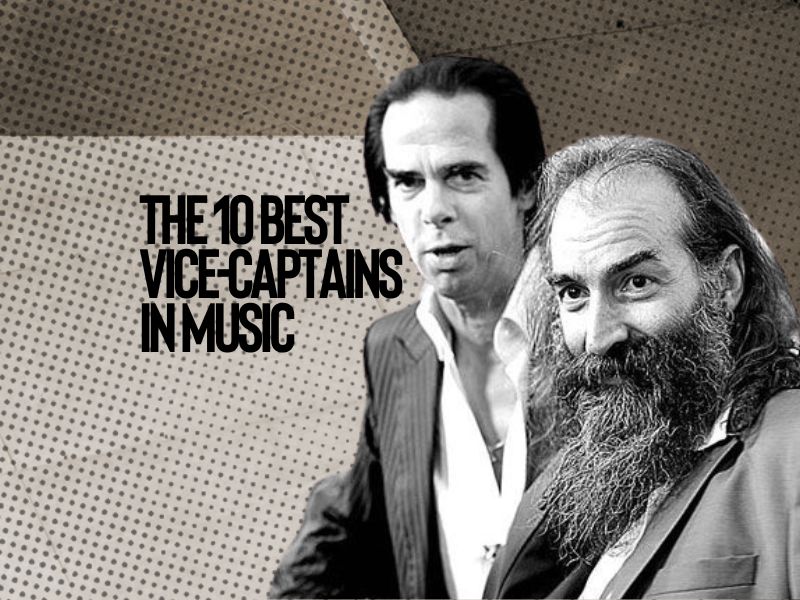
From Kim Deal to Warren Ellis: The 10 best vice-captains in music

The vice-captain role is not one that appeals to everyone. It’s the middle ground between Alexander the Great and his forgotten admin support. It’s a heap load of responsibility but a lesser share of the glory when things go swimmingly. However, whether it’s Charlie Dimmock subtly upholding the Ground Force team, Ron Weasley being the ginger glue to his daring gang of scarred stick yielding nerds or Piglet keeping spirits up in the Hundred Acre Wood, behind every great captain is a slugger not getting the credit they deserve and being totally fine with it.
As it happens, sometimes the spectator sees more of the game, and you need someone just on the outskirts of attention to rudder the ship. These musical vice-captains are stars in their own right, but they also exhibit an attribute that often goes underappreciated: knowing your place and how to get the best out of others from that position.
Below we are celebrating these humble figures and everything they have provided to some of the greatest musical excursions of our golden age. From Kim Deal to Warren Ellis and Brian Eno, let’s celebrate these bridesmaids and throw them a ball. For you might not have a poster of them on your wall, but they’re the nail on which Nick Cave hangs, so to speak.
The 10 best vice-captains in music:
Kim Deal
In a recent episode of Desert Island Discs, the writer Jon Ronson nailed the contribution to late 1980s alternative music that Kim Deal brought to the table when he said: “You can hear her smile in songs. She was the most smiley of all the grunge / post-punk people. She was just so warm and delightful.” You can add that she’s also a superb songwriter and could add wonderful, layered texture to a glass of bathroom tap water with her playing too.
This wasn’t only a valuable addition to the Pixies, but you’ve got a frontman who David Bowie described as “a mass of screaming flesh, a very imposing figure,” it pays to have a bit of lightness alongside that giant baby. Bowie would go on to describe the band as the “psychotic Beatles” and Deal is certainly the bubbly Paul McCartney in that mix, add rays of sunshine into the back catalogue without ever being incongruous with what they were all about.

Warren Ellis
The quintessential wingman, Ellis is forever pushing Cave forward then slinking behind his long shoulders at the last second. As Cave recently explained in a rather exasperated fashion, “Warren is nearly always on transmit… and never on receive.” However, that barrage of creative energy forces the frontman to find the nuggets that are worth keeping and turning into a sovereign of song.
Ellis recently stated, “I’m there for him, whatever he wants.” That support is not only a beautiful thing, but when you’re extolling the sort of profundity that Cave has turned towards, you need a confidence man to give you strength and coax the creative exorcism out of you. As Ellis added, “There’s something about the very nature of me and Nick getting into a room that leads to something.” That much is clear from how well The Bad Seeds house fell into order once the bearded madman arrived.

Bez
Sometimes a vice-captain proves to be a more definitive representation than whoever they serve—that is very much the case with Bez. The English dancer is the spirit guide behind the music. As he said himself: “In my mind, if anyone can save the world from destroying itself, it will be the creative minds: the thinkers, the artists and the avant-garde trailblazers that will ultimately bring down the whole matrix of untruth and set mankind on a lesser destructive and more spiritual path.” Yes, Bez really did use the phrase ‘the matrix of untruth’.
He set this veritable thinking in motion one maraca shake at a time. In truth, the legacy of the Happy Mondays is one of the most overlooked in music—they quite literally were one of the most pivotal bands in setting up the entire Madchester scene and all that entails. In some respects, this glossing over of that gargantuan feat is because of Bez—they’re an affable outfit, but that is also the beauty of them. They couldn’t care less that their legacy isn’t as venerated as it perhaps should be, they’re just out there for good vibes.

George Martin
You don’t have to like The Beatles, but you should admire their latter-day innovation. With Revolver and Sgt Pepper’s, they pushed stereo sound to new heights and George Martin, their producer, was central to that. The often touted fifth Beatle led from afar. And aside from the musical innovation, he was also a moral backbone too, as Paul McCartney famously declared, “He was like a second father to me.”
He nurtured their ideas and helped them take form. From crafting orchestral arrangements to making their post-modernist visions of pushing Pet Sounds to new heights a reality, he was a man who left an indelible mark on the soul and sound of the band.

Mick Ronson
Any collaboration that brought the world The Man Who Sold The World, Hunky Dory, Ziggy Stardust, and Alladin Sane is worth celebrating and then some. Bowie would detail their on-stage relationship in an interview shortly after Ronson’s death, fondly saying: “Mick was the perfect foil for the Ziggy character. He was very much a salt-of-the-earth type, the blunt northerner with a defiantly masculine personality so that what you got was the old-fashioned Yin and Yang thing.”
Adding: “As a rock duo, I thought we were every bit as good as Mick and Keith or Axl and Slash. Ziggy and Mick were the personification of that rock ‘n’ roll dualism. He provided this strong, earthy, simply-focussed idea of what a song was all about. And I would simply flutter all around him on the edges and decorate. I was sort of the interior decorator.” And on top of that and all his wondrous arrangements, Ronson had the look too.

Chaz Jankel
Ian Dury might have stood aside from the Blockheads as a poet with acerbic wit and a band to back him, but he needed their rhythm stick to make his wordplay soar and the legendary Jankel was the key crutch in that. His angular sound was much more than a mere platform, and it remains hugely influential amid the current wave of post-punk bands.
What’s more, his vice-captaincy was even more paramount when Ian Dury & The Blockheads hit the road. In fact, the Blockheads even now remain a superb live act and that is testimony to how easily Jankel seems to find musical connections. He is stunningly seamless at getting on the same page as someone. With Dury, that was a wild page, and Jankel translated it like the words were written as half notes.

Tina Weymouth
It wasn’t easy for Weymouth being in Talking Heads. She drove the bus, cut their hair, and shared her sandwiches. All the while, David Byrne – who made her audition thrice – expressed his caution over her being in the dangerous world of rock ‘n’ roll. But punk was made to be dangerous and her being there was an encapsulation of that.
While Byrne’s mind raced, Weymouth musically did a lot of the steering. Her bass playing keeps the jittery tracks on the straight and narrow. And cool in an effortless way, she offered a contrasting note of calm alongside the rather manic frontman. The band were all about a sense of schism and Weymouth’s steady and actualised interpretations helped to bring everything together in a creative flow.

Brian Jackson
Gil Scott-Heron was a poet who understood the power of music, and Jackson was a musician who understood the power of poetry: Together, they whisked in a marriage of words and melody that proved bliss doesn’t have to be ignorant. With his Rhodes electric piano and flute arrangements flourishing from the fertile meta of Scott-Heron’s considered rhymes, the fluid beauty of their pairing blossomed like wildflower.
A poet can’t be tied to rigidity and the fluidity of Jackson’s style was perfect. However, there was also a power to it too. He understood that the words were up against it and rather than simply lay down some filler, he beefed them up with beats that packed a punch of their own without ever muscling in the way.

Brian Eno
Bryan Ferry once said, “I wasn’t really trying to create one style of music. It was more about playing around with different styles and hoping that something which was unique, and was our own, would come out of it.” It did. And that new mix sounded like the future, which is why having a synth nerd like Eno was essential.
The interesting point here, however, is that both captain and vice complimented each other by way of vying contrast. “It’s very difficult to write songs when you’re only a singer because all you’ve got is the melody and it’s easy to forget,” Ferry once said. Thus, Eno became an almost reluctant soundboard and repository of Ferry’s ideas. However, he was determined to filter in his own colours this vivified everything therein. He’s done much the same with David Bowie and everywhere else he finds himself donning the VC armband.

Christine McVie
Fleetwood Mac is a soap opera drama too manic at times to function. However, if you ask any member who the calming influence and shoulder to cry on is, they’ll tell you the wonderful Christine McVie. She is the very definition of leading from the back. Musically her additions to the arrangements are subtle and motherly but indelibly exercising their casual refinement. Her spiritual role is much the same.
That is a magnificent feat in itself. However, when you throw into the mix that she also wrote ‘Don’t Stop’, ‘Everywhere’, ‘Hold Me’, ‘Songbird’, ‘Little Lies’ and a slew of other classics, you have yourself just about the finest spotlight shunner in music. And when she does bask in the limelight, she humbles everyone else with her excellence. Fleetwood Mac may well have fallen apart without her, and with her in their midst, they were bound to soar.

