


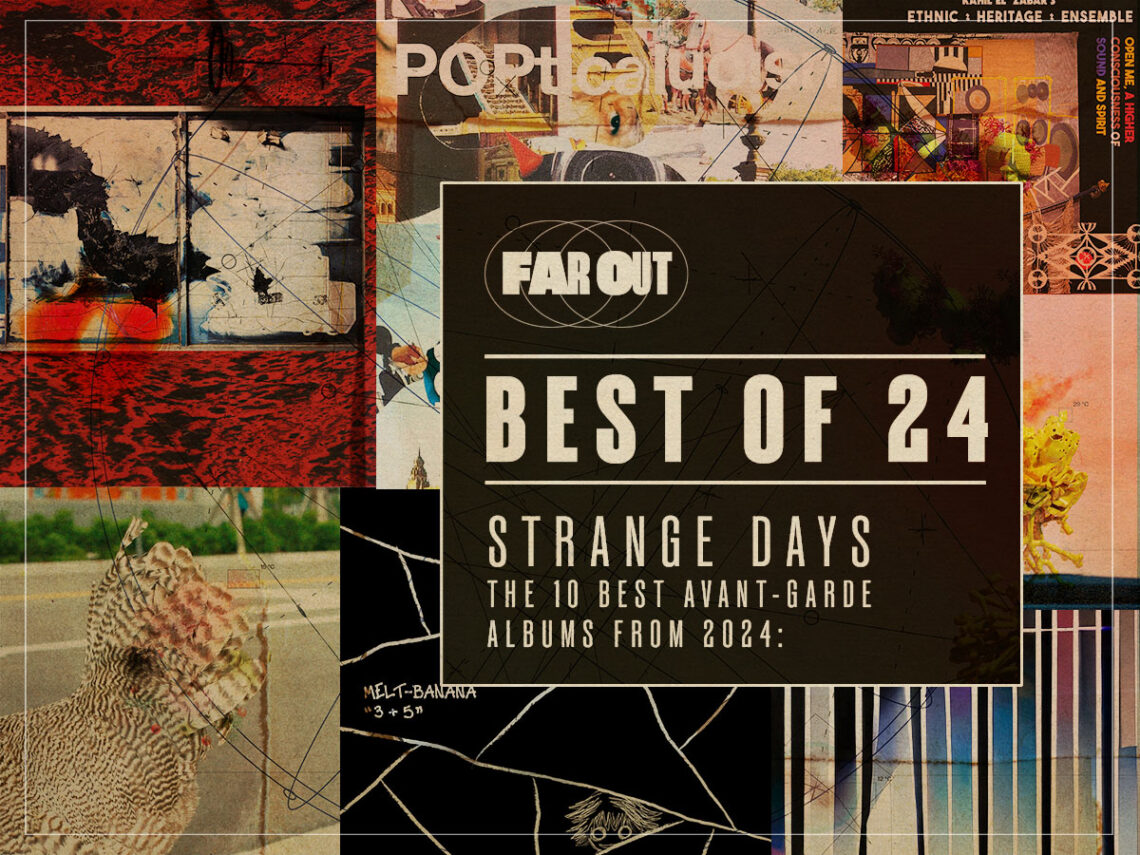
The 10 best avant-garde albums from 2024

The avant-garde world has never orbited closer to the mainstream—or, at the very least, the secondary alternative ring of the mainstream. As genres blend and ‘content’ becomes condensed, the appetite for something new grows keener, and an artist’s search for experimental freshness flourishes. Indie now seems like an age-old term, a belt that wraps around an expanding waistline of subcultures and emerging nuances.
In fact, it could be argued that ‘avant-garde’ was the leading genre of 2024. The explanation is the same boring yet inescapable one that has determined every trend since Adam and Eve first tried on Levi’s: society underpins the response of art. Even a castaway nihilist creating something that will never be released to the public reacts to society in some way. So, what straightforward factors are bolstering the burgeoning avant-garde advance?
1). A response to the oft-uttered notion that there is nothing new under the sun and we’re trapped in an echo of nostalgia. 2). Technology is making all kinds of experimentalism easily practicable. 3) The internet has blurred genres and merged subcultures; after all, it is the World Wide Web, not some underground club of old. 4). The world is turning weirder; why should music remain sane? 5). Kids know more about culture quicker—in the past, it would’ve taken a while to reach Sun Ra; now he’s just a TikTok trend away from influencing the musicians of tomorrow 6)…
In short, there are countless natural impulses unfurling in today’s society that have made experimental records much more open these days. So, with that in mind, ahead of the release of our big end-of-year lists, we figured we should dedicate some space to the weirder records that, in some ways, typified the strange days of 2024 and the blistering records that accompanied it.
The 10 best avant-garde albums from 2024:
Mabe Fratti – Sentir Que No Sabes
A gold standard for avant-pop, Guatemalan cellist Mabe Fratti treated audiences to 13 tracks of atmospheric melancholy back in June. Blending dark electronic beats and experimental sounds with the cinematic quality of Fratti’s soundscapes, the diverse instrumentalist proves that the world of avant-garde does not necessarily have to be unlistenable. Throughout the record, Fratti’s emotional, often melancholic offerings are bolstered by the flawless production stylings of I. La Católica.
When listening to this record for the first time, it is difficult to believe that so many diverse, captivating sounds can be built around the focal point of a cello. Indeed, on tracks like ‘Enfrente’, you would be hard-pushed to guess that a cello was involved in any way. Fratti’s commitment to creating boldly original compositions which are, in their purest essence, cello and vocals is as commendable as it is exciting to listen to.

Julián Mayorga – Chak Chak Chak Chak
Colombia boasts an incredible musical landscape that goes back hundreds of years to the days of early cumbia and traditional Latin folk. However, Julián Mayorga is perhaps the most original artist that the nation has witnessed in recent years, dedicating himself to creating works that are equal parts bizarre and compelling. His ninth studio album feels akin to a sonic assault on the senses, featuring blaring alarms, chanting vocal tracks, and high-energy soundscapes.
Mayorga is clearly indebted to the musical heritage of his home nation, with elements of cumbia and Latin jazz clearly present within the tracklisting of Chak Chak Chak Chak. Truthfully, though, his deeply layered tracks and diverse range of sounds and influences mean that it is often difficult to truly understand what exactly you are listening to. Nevertheless, the composer’s high-octane avant-garde stylings offer a welcome alternative to the growing world of dull and unimaginative albums.

Melt-Banana – 3+5
A triumphant return for Japan’s premier noise rock duo, this year saw Tokyo outfit Melt-Banana release their first studio album in over a decade. Featuring their usual blend of abrasive noise rock, hardcore punk, and infectious songwriting, Yasuko Onuki and Ichiro Agata certainly haven’t wasted the past decade. From the blistering opening track, ‘Code’, the pair drag audiences – willing or otherwise – through an endlessly diverse and always rapturous tracklisting.
Incorporating elements of experimental electronica alongside their arsenal of guitar fuzz pedals and thunderous drum tracks, 3+5 is certainly among the band’s most experimental efforts. As a result, the record ushers in a bold new era for the Japanese noise rockers, refusing to rehash the early 1990s hardcore noise sound that Melt-Banana first became synonymous with. Its endless inventiveness and originality mean that the album stands out as one of this year’s finest.

KMRU – Natur
In an effort to recapture the constant bustling noise of Nairobi, Kenyan experimental master KMRU (Joseph Kamaru) presents the stunning collection of electromagnetic soundscapes. Inspired by the change in sounds between his upbringing in Kenya and his current life as a Berlin-based artist, the record sees Kamaru at his most unconventional. Through the constant haze of fuzzy electronic sounds and feedback loops, you can almost make out the organic noises of busy streets and communities.
Crafting a deeply personal, emotive record from such unexpected sounds cannot have been an easy task, but Kamaru constructs Natur with effortless grace, juxtaposing these man-made electronic sounds with ideas of nature and being. His previous work already established the Kenyan artist as a titan of esoteric music, but this record is undoubtedly his most accomplished to date, perfectly blending worlds of ambient music and field recordings with experimental drone and noise.

Kelly Moran – Moves In The Field
Classical piano music is often afforded something of an untouchable reputation within musical circles, as though the instrument is too inherently high-class for mainstream audiences. Luckily, American composer Kelly Moran is on-hand to demolish those stereotypes, creating a wonderfully accessible yet unsuspectingly experimental world on Moves In The Field. Using the basis of her skilled piano playing to create an often dream-like world, Moran seems to strip back her sound to create something both understated and incredibly diverse.
Using the Yamaha Disklavier – an acoustic piano with electronic sensors and digital functions reminiscent of a player piano – as her weapon, Moran toes the line between her previous classical piano work and the electronic, avant-garde influences which clearly have an influence over the songwriter. As the album progresses, the intricacies of Moran’s playing style continue to reveal themselves, building an incredible sonic tapestry which, by the end of the record, feels colossal.

Avalanche Kaito – Talitakum
Welcome to the overwhelming world of Kaito Winse and his collaboration with Belgian noise punks Benjamin Chaval and Nico Gritto. Alongside Winse’s upbeat Burkinabe griot, their knack for a heady overture creates a sound unlike any other in the world. In fact, Talitakum might just be the most original album of the year with regard to the illustrious alloy of sound they create.
Each track is a journey, and the sequences are designed with movement in mind. Whistles and touting horns conjure the image of a swarming city at night, then another stab of bass from dataist Chaval suddenly plunges you someplace new—a bar where things are about to erupt or a backstreet in a spy movie. In short, you can tell from the roving imagination of this appraisal that Talitakum is certainly an evocative sound that proves hard to truly explain.

Ex-Easter Island Head – Norther
With their first record since 2016, Liverpool-based band Ex-Easter Island Head returned in style. The shimmering guitar-based record is remarkably hard to define. It flits somewhere between the ambience and the gritty days of Daydream Nation, which is rendered almost danceable. Yet, the ensemble clearly follows their own whims, creating a record that can only accurately be compared to itself. That’s one hell of a feat in today’s congested age.
There are moments when the album sounds like distorted club music, there are moments when it feels utterly exotic, and there are calming moments where you barely reconcile the fact you’re listening to a band. That is a mark of a group following ideas without pretence and seeing where they end up. In the end, you don’t really know where the record lingers or what it makes you feel—it is a roving, enigmatic marker of 2024’s experimentalism and the strange, nebulous nature of the modern age.

Ethnic Heritage Ensemble + Kahil El’Zabar – Open Me…
Chicagoan drummer Kahil El’Zabar brings his wickedly weird and wonderful beats to the table with his Ethnic Heritage Ensemble. After playing alongside the likes of Dizzy Gillespie, he liberates himself from that heritage while simultaneously honouring it with a record that is a vibrant oddity of modern experimentation, haunted by a beautiful past. Minimalism erupts into sudden grooves, summoning a sense of stuttered swing in sweet style.
Old standards are completely reinvented by new polyrhythmic stances that hail from West Africa, creating a sense of the past being lost in the happening present. But above all, El’Zabar’s sense of soul still reigns supreme. These might be odd little tracks, but all 12 are bolstered by the sense of musicians playing with a skip in their step and even the horn players are smiling.

Scions – To Cry Out in The Wilderness
Scions take themselves seriously and reap the rewards of that sincerity. The band consist of Nova Scotia’s minimalist chamber jazz quartet New Hermitage, Ontario’s drone-hymn duo Joyful Joyful, and producer/composer Michael Cloud Duguay. This colourful cacophony of minds results in a fittingly awe-inspiring sound. Their debut album roars like the Baffin Bay, swings like Pampas Grass Pamela from down the road, and thrills with more seamless originality than the Theory of Relativity.
There is a harrowing howl that kickstarts the record, a bellow that booms like a storm battering the coast. That sense of romanticised despair runs throughout. It instantly transports you to some rugged coast and begs you to reflect. However, this meditation is beset by music that bursts into the discussion with sweeping strings akin to Strauss and then serene ambience by various turns.

John Cale – POPtical Illusion
After all these years, John Cale‘s album titles are just getting worse. But aside from the pun that presides over this pristine work, the music shows that the former Velvet Underground legend has lost none of his uncanny knack for twisting the familiar in truly captivating ways. Cale’s 18th solo studio album sees the Welshman weave an absolute maelstrom of instruments into something that remarkably feels rather neat.
Working alongside Nita Scott, Cale has compiled a web of tracks that ensnare the listener. Keys in all their mounting forms are the mainstay of the record. Like a cathedral of old, he gathers gushing organ sounds and makes pop of the most gargantuan order. Along with the pulse of drums, Cale has perhaps embraced modernity and technology better than any of his peers, and his second new album in a year is another daring and trendy triumph.

