


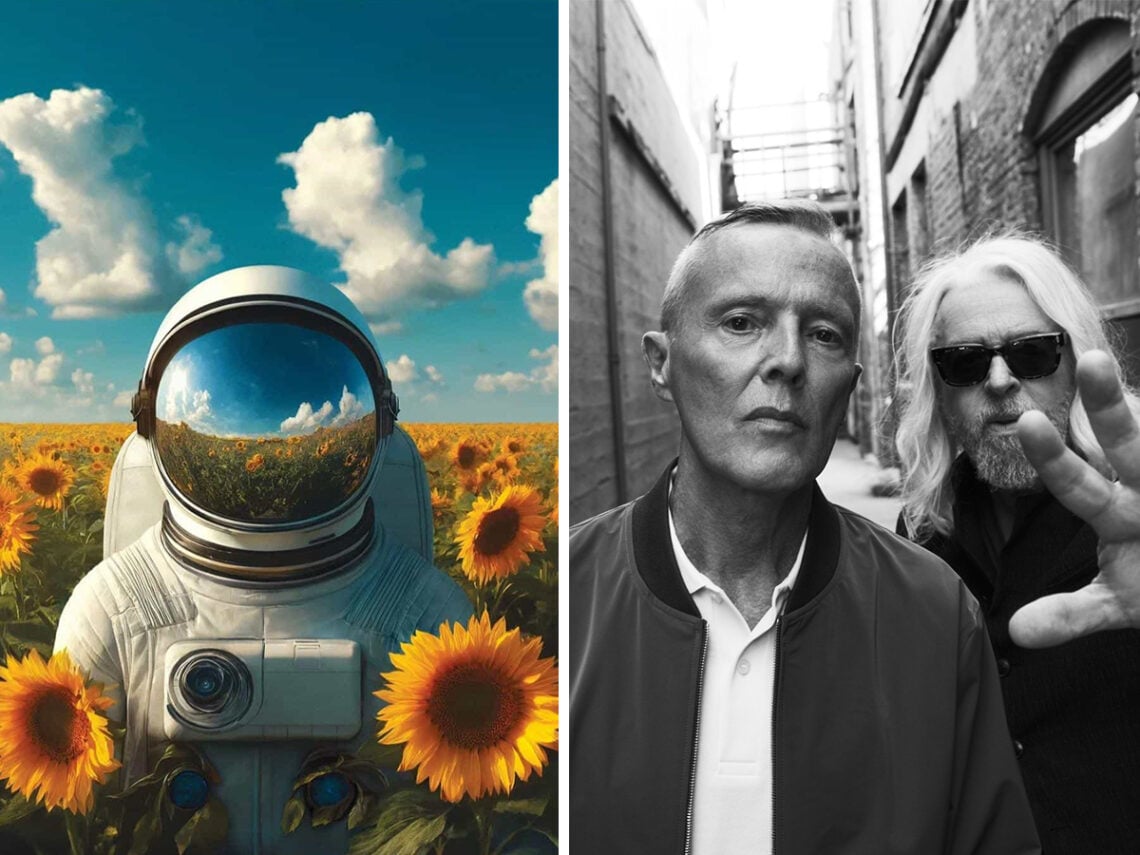
Tears for Fears defend using AI to create new album cover art

As the discourse surrounding artificial intelligence within the art world heats up, 1980s pop rock outfit Tears for Fears are the latest group to come under fire for their views on the subject. Despite a lot of criticism from artists and fans, the band recently unveiled plans for a brand-new live album, entitled Songs For A Nervous Planet, which features AI-generated art on its cover.
The album cover depicts an astronaut in a field of sunflowers beneath a clear blue sky. When the sleeve was revealed earlier this month, many fans were suspicious of the artwork. After all, the vast majority of AI-generated images have a certain look to them, which has become easy to spot for those who have encountered AI images on the internet multiple times. Now, the band have responded to the criticism, confirming that the artwork was created with the help of artificial intelligence.
On Instagram, the band defended the cover, writing, “The Songs For A Nervous Planet album artwork is a mixed media digital collage, with AI being just one of the many tools used in the creative process.”
According to the band, the person who created that digital collage was Vitalie Burcovschi – known online as Surrealistly – who describes their own work as “art created by AI using human imagination.”
Presumably, therefore, Burcovschi is using the common defence of AI, which is that the program still requires a human to input creative ideas as prompts. For many fans and fellow artists, however, it is a defence which simply does not wash. Nevertheless, Tears for Fears continued their explanation by saying, “We wanted vibrant artwork that evoked a sense of sci-fi, futuristic themes, and an escape from what is known.”
“The sunflowers are a joyful nod to classic Tears For Fears imagery,” the post continued, “while the juxtaposition of the astronaut is a link to our upcoming song, ‘Astronaut’, and a sense of alienation and not belonging. We have been fans of Surrealistly’s work for a long time and knew he would be the perfect artist to bring our vision to life.”
Aside from disappointing many of their fans and infuriating the countless artists who could have easily created a legitimate artwork of an astronaut among sunflowers, this decision could also cause Tears for Fears some legal difficulties. Given its relative youth, the laws – particularly copyright laws – surrounding artificial intelligence have not yet been rigorously tried and tested.
For instance, in the US, it is not possible to copyright an AI-generated image. So, in theory, another band could use this same image for their album cover, merchandise, or anything else without fear of legal action. In the UK, AI images are protected by copyright, but it is not clear who would own the intellectual property of this artwork.
What have other artists said about AI?
AI has come under fire from various different figures within the music industry, both new and old. The Who’s frontman Roger Daltrey, for instance, claimed that the rise of artificial intelligence could “destroy the music industry if we’re not careful.” However, he did also note that its potential to be used for songwriting is limited by its robotic lack of empathy and emotion.
Meanwhile, former Joy Division and New Order bassist Peter Hook seemed to concur with Daltrey’s view, sharing, “Songwriting is an art you cannot teach. AI is proof. Every AI song that has ever been written is shit.”
Nick Cave also weighed in on the debate, saying, “I find it all unbelievably disturbing. I’m not worried about my own job or something like that about being replaced or something. Just what it’s saying about us as human beings.”
Although the Bad Seeds frontman has previously used the AI program Chat GPT to write a song as an experiment. On the other side of the debate, Grimes has embraced AI, going so far as to create a programme called GrimesAI, which allows anybody to generate music using her own vocals.

Never Miss A Beat
The Far Out Music Newsletter
All the latest music news from the independent voice of culture.
Straight to your inbox.