


The surreal song Bob Dylan wrote that “stands alone”

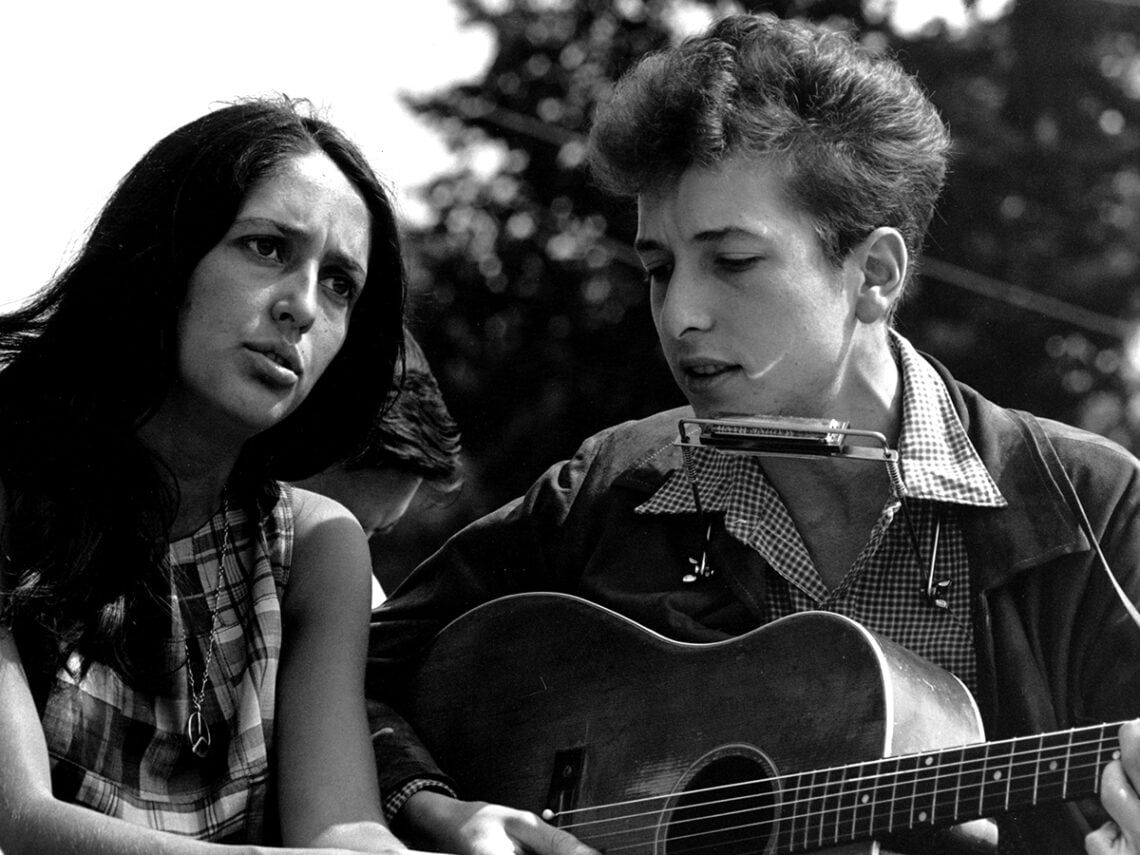
For almost 30 years, the song ‘Farewell, Angelina’ was known only as a lovely Joan Baez tune, penned by Bob Dylan and released as the title track to Baez’s fourth album in 1965. There was the occasional chatter among Dylan devotees that Bob had cut his own version during the earlier sessions for Bringing It All Back Home, but in the days before internet leaks, no such evidence was ever forthcoming. It wasn’t until 1991, when the first discs in Dylan’s Bootleg Series arrived in record shops, that the rumours were finally confirmed, and Dylan’s interpretation of his own song—a sneakily pivotal one at that—was finally heard.
When Baez’s version came out in October of 1965, Dylan was already promoting Highway 61 Revisited. In retrospect, this was a pop cultural sea change reaching its apex, as the ‘Voice of a Generation’ was taking his listeners into radical new territory. At the time, though, opinions were notoriously varied. One double-review of Baez’s Farewell, Angelina and Dylan’s Highway 61, published in the Berkeley Gazette in Berkeley, California, noted that “hearing [Baez] sing Dylan songs makes one wish she had sole rights to his properties,” further describing the Angelina album as “one of her best-recorded recitals”.
Dylan’s new LP, by comparison, was “generally a swinging collection. The only thing wrong with it is that Bob Dylan sings it. Dylan continues to have that annoying mannerism of dropping and slurring his pitch at the end of a phrase in every song he writes and sings, or rather, tries to sing.”
Yes, that old hot-take chestnut was already making the rounds 60 years ago. Suffice it to say, that particular reviewer wouldn’t have been very interested in hearing Dylan’s rendition of Baez’s already exceedingly adequate ‘Farewell, Angelina’. But, for listeners in 1991—by now able to fully contextualise the mid-1960s metamorphosis of Dylan as both a songwriter and singer—hearing his take on ‘Angelina’ was well worth the wait.
The song at first comes across like an ancient folk standard, and indeed, according to the book Bob Dylan: All the Songs, Bob initially pulled the melody “from an 1850s Scottish sailors’ song by George Scroggie titled ‘Farewell to Tarwathie’.”
The words, though, on closer inspection, are coming from somewhere else entirely, serving as a sort of stylistic bridge between Dylan’s earlier narrative folk songs and the deeper dives into pure surrealism that would soon be coming down the pike.
‘Farewell, Angelina’ introduced that surrealistic language “with a bang, in a new way for Dylan,” according to Michael Grey’s The Bob Dylan Encyclopedia, “Whereas by the time of Blonde on Blonde, he had adjusted that language almost out of recognition. In this sense, ‘Farewell, Angelina’ stands alone.”
The song mixes stark imagery right out of an Ingmar Bergman lens [“Just a table standing empty / by the edge of the sea“] with random 20th-century pop culture references (King King and Valentino) and some familiar playing card motifs that Bob would later revisit: “The jacks and the queens / Have forsaked the courtyard / Fifty-two gypsies / Now file past the guards / In the space where the deuce / And the ace once ran wild / Farewell Angelina / The sky is folding / I’ll see you in a while”.
Each verse ends with a different sky-based explanation for why the speaker has to part ways with poor Angelina: “The sky is on fire”, “the sky is trembling”, “the sky is embarrassed”, and “the sky is erupting”. What does it mean? There’s an industry built around asking this about a lot of mid-1960s Dylan works of far greater fame. One thing is for certain, though. Bob’s voice, while not as lovely as Baez’s by any measure, is better suited to evoking something desperate, resigned, and honest with these words.

Never Miss A Tale
The Far Out Bob Dylan Newsletter
All the latest stories about Bob Dylan from the independent voice of culture.
Straight to your inbox.