


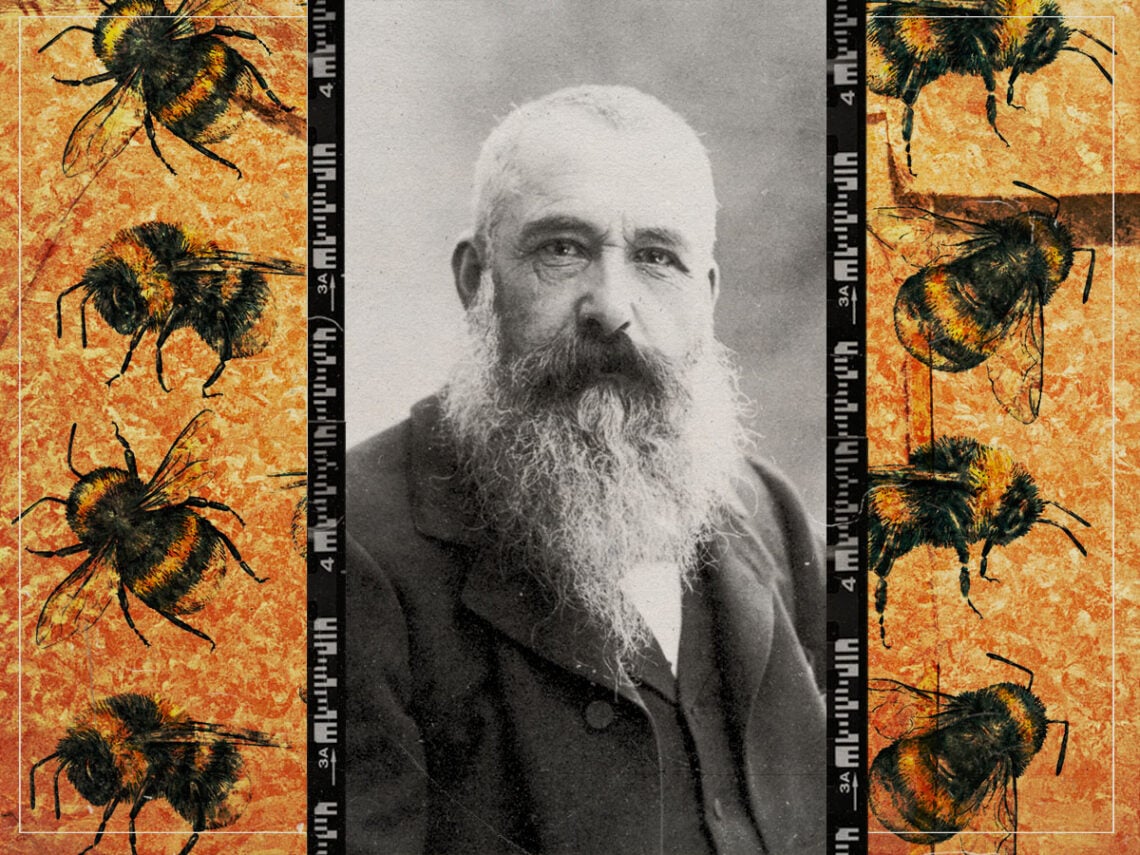
The surgery that changed Claude Monet

One of the hallmarks of a truly great artist, something that sets the greats apart from the merely great, is the distinctiveness and uniqueness of their style. A feel or a tone or some technique that they consistently exhibit, which lets you know who painted the piece you’re looking at, even if it’s the first time you’ve seen it. You know when you’re looking at a Botticelli or a Caravaggio; you can tell a flower painted by Van Gogh from one by Georgia O’Keeffe or a surreal scene by Picasso from a Dalí just as surely as you would know, without needing to look for a nameplate or signature, when you’re looking at a painting by Claude Monet.
Whether it’s in Bridge over a Pond of Water Lilies or Women with a Parasol—Madame Monet and Her Son, Haystack at the End of Summer or else in Rouen Cathedral, Façade (Sunset), Monet was a master when it came to utilising shape, light and shade in capturing a feeling and an atmosphere. Such was his skill at transferring the essence of a scene into his work, capturing a landscape at rest or the way that the fading sunlight fell through the leaves or else across the awnings of a building, that he was credited as the founder of the French Impressionist movement. Indeed, the movement even got its name from the 1874 exhibition of his piece Impression, Sunrise, and he has since become one of the most important figures in modern art.
Though it is always clear what his pieces are intended to be, a lot of his artworks look like a memory; they are hazy, shimmering and intangible but focused enough to depict what is happening in the scene, what could have happened, and even what is still to come. There is always an incredible depth to his paintings that allows you to see beyond your first impressions, and there is always an incredible warmth to the works, as well.
That warmth largely comes from the colours that Monet used so consistently and so well. With rich, textural brushwork, he stacked his pieces with washes of deep greens and blues, lighter yellows and reds and often built up his images from just a few colours at a time, crafting them out of the shadings and variations that he could find within a limited range, really proving that sometimes less is more, if not all.
However, as is the bane of any artist, Monet’s eyesight began to suffer increasingly with age. In 1912, he developed cataracts and was told by a doctor that his eyes were clouding, blocking the light from passing through, as they should.
For any painter, vision is key, but especially for an impressionist who paints an impression of what they see in the world around them. Although Monet’s work had never been as finely detailed and photorealistic as that of the more modern artists, like John Baeder or Leng Jun, his already hazy work descended into chaos as his vision left him. In his Le Pont Japonais, Monet returned to painting the bridge he had captured so many times before, but this time turned what had previously been a mainly green, soft focus facsimile into a raging, slashing scene which more closely resembles James Francis Danby’s Ship on Fire than his own earlier Water Lilies.
After continuing to struggle with his eyesight, he was eventually declared legally blind in one eye by his doctor and was judged to have only around 10% of his vision remaining in the other. Though he had been scared and reluctant to agree to a cataract removal surgery, Monet now felt like he had no choice but to relent and try to reverse some of the damage.
Then, in his 80s, Monet returned to his work and found that not only had the surgery been a success in returning some of his vision to him, but that it had had a surprising side effect as well. In the process of replacing the lens and removing the cataracts, his surgeon had also removed the filter, which, in a normally functioning eye, would block out the ability to see ultraviolet light. Now, in the September of his years, Monet had an entirely new palette to play with. For the rest of his life, you could see the addition of striking purple hues to his work, as well as more shocking blues and indigos.
Something to wonder about now is whether we would interpret his later paintings any differently ourselves, without our eyes blocking out the ultraviolet colours that he could see, and those we cannot.
