


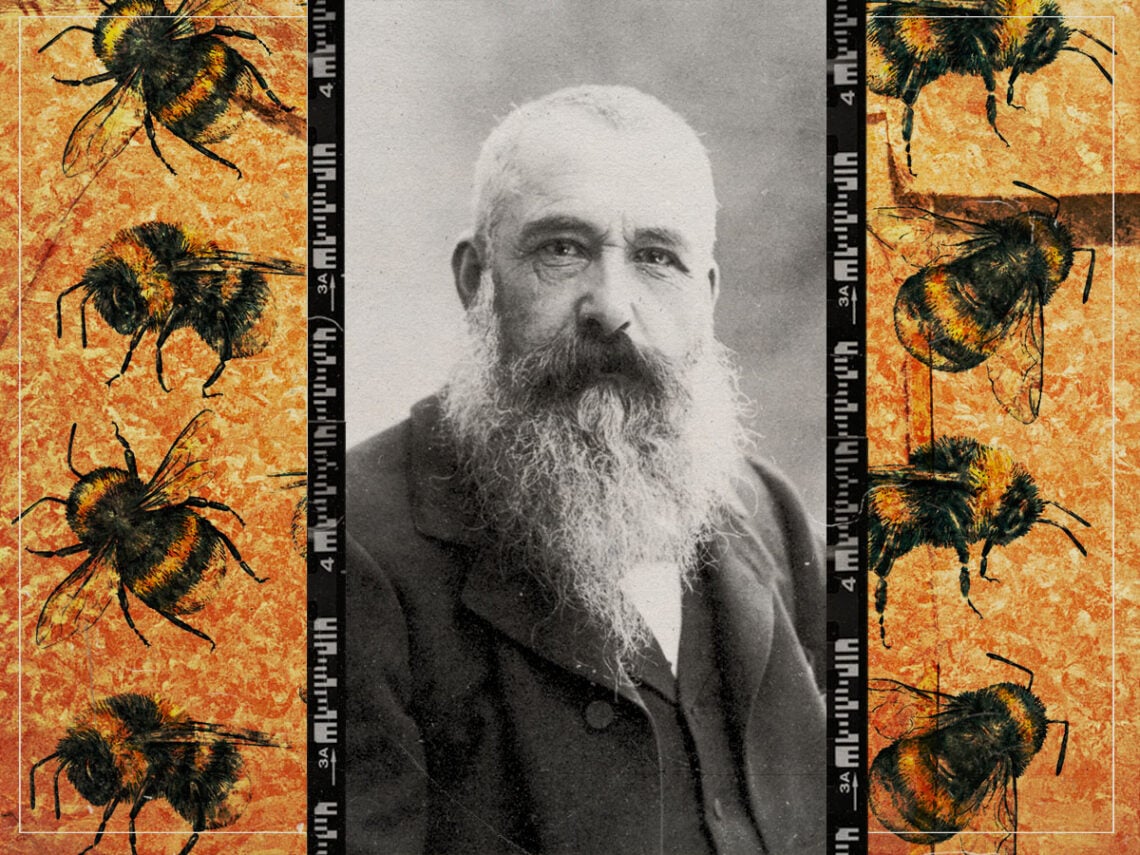
What do Claude Monet and bees have in common?

Amongst the vast achievements of Claude Monet, the impressionist painter behind the iconic Water Lillies series, is a strange scientific fact that profoundly altered the palette of the series. Monet could see like a bee. Before troubles with his eyesight plagued him, he was famed for his command of colour, which, after a successful surgery in later life, was somehow amplified to the point he could see it far beyond the normal human spectrum. He believed that the merit of an art piece lay in “having painted directly in front of nature,” and when he looked at it, it was ultraviolet.
In the mid-1910s, Monet’s eyesight started to worsen after developing cataracts. His friend Mary Cassatt shared his condition but went completely blind after a series of failed surgeries, which terrified him. He resigned himself to quitting painting, which crushed him. It stung so much that before his eyesight deteriorated, he received such high praise for his sharp attention to colour and detail. His predisposition to colour mastery might be the thing that saved his career.
Monet tried to continue painting, but everything seemed muddied and hazy. He was forced to work around his eyesight, painting from nature only at dusk and dawn, when the glare of the sun was less imposing, and his attempts to compensate for his ever-worsening sight are heartbreaking to look at.
He became painfully aware that colours were all blurring into one, so he hammed up the warm tones, turning sedate scenes like The Japanese Footbridge and The Rose Walk into frenzied swirls of reds and yellow.
By 1922, Monet could barely tell blue from brown and was making makeshift labels with giant letters on his paint tubes so he could see they were different. He felt he had no choice but to try surgery, but was so nervous it would make things worse that he only went through with it on one eye. His eye healed, and by 1924, he was effectively back to normal, one small detail aside.
Humans do not and cannot see ultraviolet light because the lenses in our eyes filter it out. But when Monet’s lens was removed, an entirely different spectrum opened up to him. Only animals and insects are capable of seeing what he saw, so he suddenly found himself with butterflies and bees.
In turn, nature adapts to ultraviolet light- and some flowers have intricate purple on them to attract bees. Scientists call the most recurring shade “bee purple”. If you look at Monet’s post-surgery work, you find that shade everywhere. Waterlillies, the flower that made him famous, look white to humans. But Monet saw what the insects did and painted them purple.
