


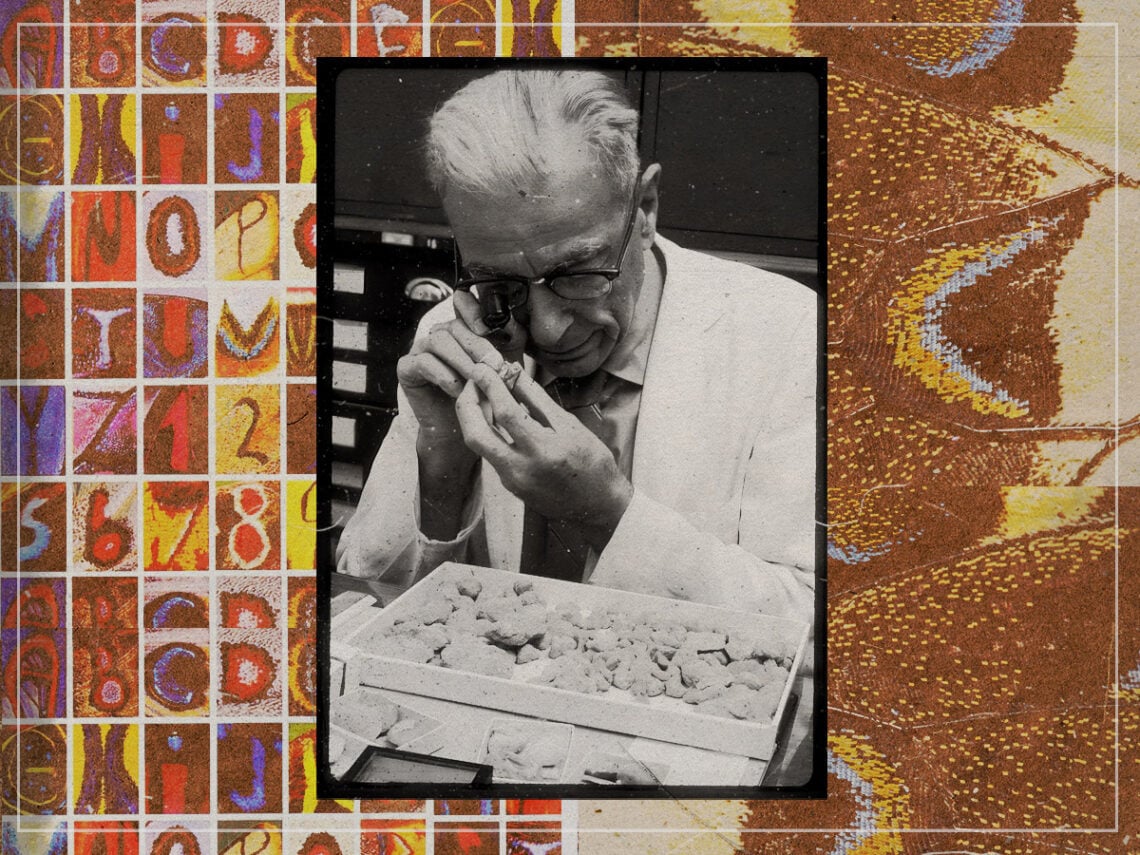
Kjell Bloch Sandved and the butterfly alphabet

Balanced precariously on a ladder in the National Museum of Natural History attic, Kjell Bloch Sandved made a discovery that would later shape a prolific photography series. He was surrounded by boxes of preserved exotic butterflies, but instead of looking at them, he found himself drawn to a small Havana cigar box squirreled away in a corner. Inside it was a blue Lepidoptera with an unmistakable letter “F” on one of its wings. Sandved was so struck by the silvery letter he took a picture of the wing it sat on and hung it above his desk. It was the start of the Butterfly Alphabet.
It suddenly dawned on him that others might exist if one butterfly carried a letter on its back. “As soon as the very thought sank in, my mind was made up,” he said. “I was going to be the first to try”.
In 1960, he immediately shelved plans to write a book about animal life to go on a photographic quest for lettered butterfly wings. The only slight snag was that the photo of the first butterfly he took wasn’t just the beginning of a series but of his photography in general.
Had his subject been more extensive and less prone to flitting through the air at high speed, that might not have been an issue. But, sensing the difficulty it demanded, Sandved enrolled in months-long courses of micro and macro photography until he felt he’d mastered it. That was the first challenge that was taken care of. The next involved a worldwide pursuit of butterflies with potentially non-existent patterns on their wings. Unperturbed, he set off, armed with rolls of film and holding onto the excitement of his first letter discovery.
In 1964, he was on an early morning walk through West Manaus and stumbled across a pig enclosure. On its far side, Sandved noticed a stream of water had mixed with pig urine and was weaving its way downstream into a nearby pond. As is explained in horrendous detail on the late photographer’s website, this was the butterfly jackpot: “Swarms of thirsty butterflies had discovered the seepage and settled down to the feast, uncurling their proboscis to suck up the aromatic nutritional pig-cocktails.”
Sandved was soon splayed on his stomach, spending almost an entire day perched in the muddy cocktail studying the butterflies. Despite them periodically resting on his lens and blocking his shot, it was one of his most productive days. The collective noun for a group of butterflies is “kaleidoscope” because when masses of them mix, the beat of their wings creates a cascade of colours.
Sanved found it was a bountiful kaleidoscope of letters, too. That one morning produced hundreds of letters, signs and numbers. Reflecting on witnessing it up close on his website, he said it was a “scene never to be repeated, but it has always been remembered.”
But it wasn’t the end of his alphabet search. Ultimately, it took him across the world, to the Congo, Brazil, Papua New Guinea, and the Philippines, in a 24-year-long labour of love. When he completed his collection in 1975, he felt the same level of awe as he did when he opened the Havana box. “To find beauty in the world, you have to look closely,” he advised. “Amazing colours and patterns are right here, on the wings of butterflies.”
