


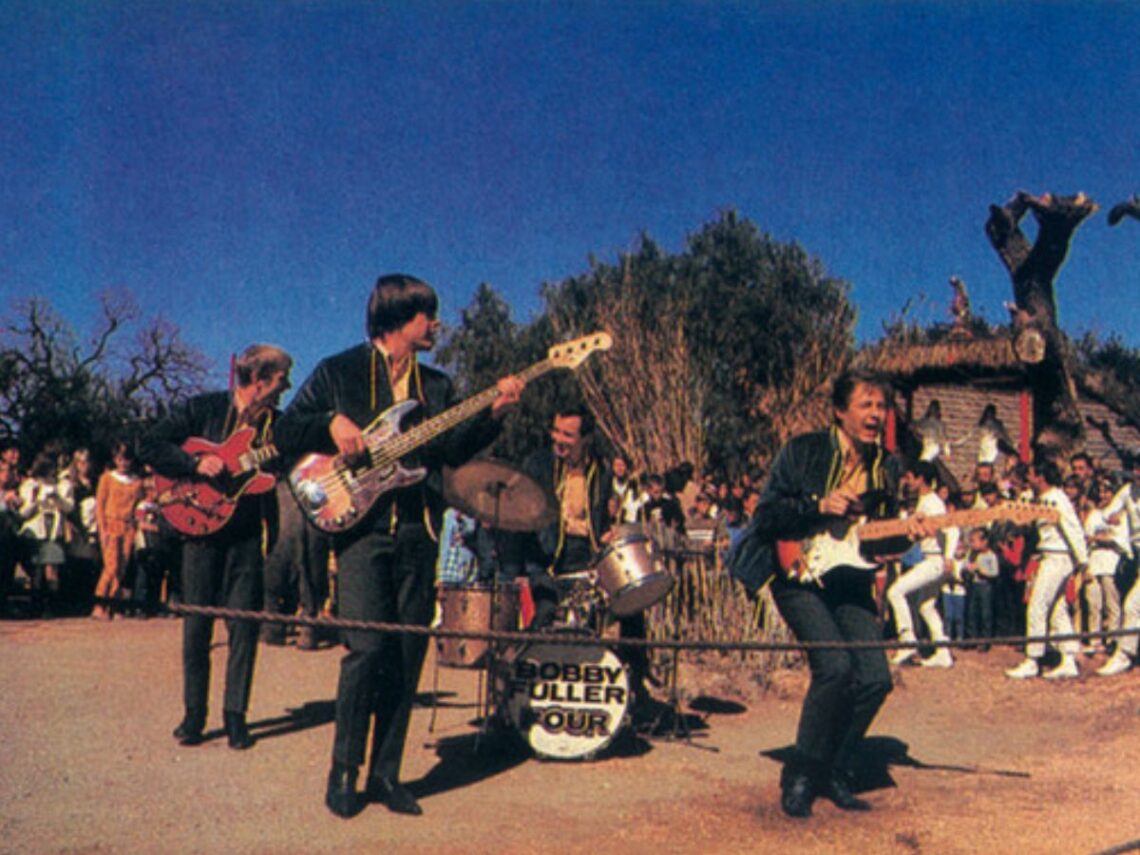
Bobby Fuller: The mysterious death of counterculture’s ‘next big thing’

It was a sweltering July day in 1966, and something didn’t seem right about Bobby Fuller’s car parked on the drive of his Hollywood home.
When the police were summoned, his lifeless body was found slumped inside. Fuller was only 23, and just a few months earlier, he had claimed his first top ten hit and was promptly being lined up as counterculture’s next big thing. Snuffed out by a mysterious death, his bright future would never come to fruition, and question marks still linger over his untimely end.
Flash forward to 1979, though, and you can see precisely why many thought he was an artist ahead of his time, destined to be a star. ‘I Fought the Law’ by The Clash was causing a wave of punk pandemonium. It was daring, catchy, and personified the sardonic spirit of the whole punk movement.
So, it came as a surprise to many when they found out it was a cover. The track was originally written way back in 1958 by Sonny Curtis and recorded in 1959 after he joined The Crickets on guitar to replace the late Buddy Holly. However, it was not The Crickets who popularised the song. Instead, it was The Bobby Fuller Four, some seven years later in 1966.
A popular rock ‘n’ roll band, the group formed in El Paso, Texas, in 1962. They had a string of hits in the middle of the decade, which included ‘Let Her Dance’ and ‘Love’s Made a Fool of You’. The band’s biggest hit was undoubtedly their rendition of ‘I Fought the Law’, and it peaked at number nine on the Billboard Hot 100 chart in the US, launching a lucrative career for the band with Fuller as their fresh-faced frontman.

Although it was a huge hit, and The Bobby Fuller Four’s rendition helped the song to establish itself as rock ‘n’ roll classic set to be covered countless times over for years to come, the success was quickly overshadowed by a grisly event that occurred just six months after its release, when on July 18th, 1966, Fuller was found dead by his mother in their blue Oldsmobile.
It was the LA deputy medical examiner, Jerry Nelson, who performed the autopsy. According to Dean Kuipers, Nelson’s report stated that, “Bobby’s face, chest, and side were covered in ‘petechial haemorrhages,’ [chemical burns] probably caused by gasoline vapours and the summer heat. He found no bruises, no broken bones, no cuts. No evidence of beating.”

The report in the Los Angeles Times somewhat filled in the blanks of Nelson’s report. In his obituary, the cause of death wasn’t stated, but it was remarked that he was found with a “plastic hose in his hands leading to a gasoline can”. Given the smell of fuel around his face, it was believed by many that Fuller had drunk from the jerry can, fulfilling a strange suicide method.
However, Nelson’s report placed question marks in both the “accident” and “suicide” boxes. In truth, the whole case is riddled with such question marks. Given the total mystery surrounding Fuller’s death and society’s innate penchant for wanting there to be something more nefarious at play, some commentators believe Fuller was murdered.
These rumours rose to the fore almost immediately, with a couple of people stoking the fires of conspiracy shortly after he was pronounced dead, despite an apparent lack of tangible evidence. The first of these was Erik Greene, a relative of the late soul icon, Sam Cooke, who also died in mysterious circumstances in 1964.
Greene argued that “both had at one time been artists signed to record labels owned by Bob Keane. Both died in absurd manners whose evidence was largely ignored. (Fuller’s death was ruled a suicide even though his autopsy revealed gasoline was poured down his throat after he died.) The last place both were seen alive was PJ’s—the Los Angeles nightclub owned by reputed mobsters.”
Greene continued: “It was rumoured Keane had a $1 million insurance policy on Fuller at the time of his death, though I haven’t found evidence of a similar policy on Sam. It is unclear if this incident had a direct correlation with Sam’s homicide, but it’s interesting enough to note just the same.” Her claim was far from legally sound, and Greene certainly had a vested interest given her connection with Cooke, but her claim did keep Fuller’s tragic passing in the spotlight, prompting further commentators to come forward.
There was no denying that Keane played a pivotal role in Fuller’s life, though. Signing to his little was no small matter for the Fuller Four, but he didn’t really seem all that interested in them until they scored their big fat top ten. Shortly after that, he began moulding them in a much more commercial manner than they were inclined to adhere to. So, tension undeniably grew. But tensions were commonplace in the music industry, and it seemed stark to align the discordance with what eventuated.
Another piece of speculation came from Jim Reese, the virtuoso guitarist in The Bobby Fuller Four. Retrospectively, he once argued that perhaps it was The Manson Family who played a role in Fuller’s death. This has been widely discredited as there is no real evidence for it, and Charles Manson was incarcerated from 1961 to 1967. But it is noteworthy that someone so close to the case was inclined to comment in such a manner.
After all, there was plenty to fuel justified speculation. Not a huge amount can be gleaned from the police reports, given how swiftly misadventure of some description seems to have been determined, but there are a few glaring details. Firstly, the Oldsmobile had not been on the driveway until 30-minute prior to the discovery of Fuller’s body, yet he seemed to be in an advanced state of rigor mortis.
Nobody was interviewed in the aftermath to solve this discrepancy. Nothing was wiped for fingerprints. And the jerry can was even discarded. This roughshod handling of the case has resulted in a startling lack of evidence, and thus, a great number of questions. Some claim that a recent deal with Roulette Records and their notorious mob ties may have proven his undoing, but there is nothing tangible to base that on. The only certainties are that Fuller was found dead.
If those pesky question marks in Nelson’s report weren’t there, then maybe the rumours would never have arisen in the first place. No doubt about it, mysterious circumstances abound with the Fulelr case. However, the rumours that account for his death are still pretty untenable, regardless of the intrigue stirred by Pynchon-esque accounts of insurance policies and hippie cults.
But beyond the whys and wherefores, ‘I Fought the Law’ still lives on as clear, bona fide evidence that Fuller was a star ahead of his time, imbuing rock ‘n’ roll with enough fresh bite that further hits would surely have been on the horizon for him and his El Paso band.
