


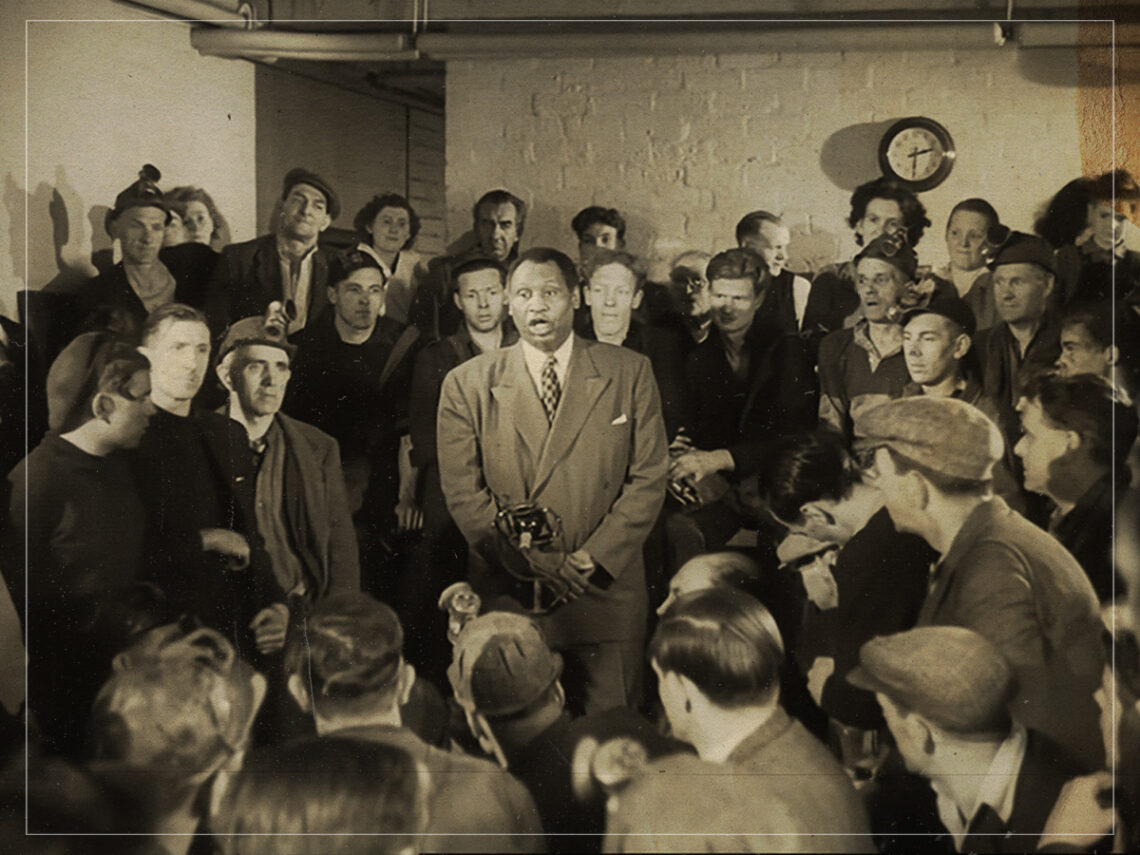
The strange day in 1949 Paul Robeson performed for the Midlothian miners

Carried across the Atlantic by the strength of his socialist internationalism, one of the biggest US stars of the stage, Paul Robeson, saw to it to perform a stirring show for the Midlothian miners in the Scottish Lowlands.
Born in 1898 in New Jersey to a former slave who escaped his plantation captivity, Robeson swiftly found a level of social mobility his father could never dream of. Battling the racist prejudices of the 1910s, Robeson’s athletic force on the football field and sharp academic mind won him a scholarship to the prestigious Rutgers University.
Yet, it was his booming baritone croon that would ultimately lead him to a life away from his initial lawyerly ambitions and into the world of Black spirituals, garnering silent movie roles and leading prominent parts in prominent New York productions.
It’s the UK that elevated his fame, however, as well as sharpened his leftism. Landing the role of ‘Joe’ in the London production of Show Boat in 1928, Robeson coasted up the social circles of the political and celebrity class at odds with his second-class citizenry back home, mingling with MPs and even being summoned for a Royal Command Performance at Buckingham Palace. It was during one of his many Show Boat appearances that an affinity with the British working class was sparked, leading to an enduring champion of socialist struggle for his entire life.
In 1929, Robeson encountered by chance a Welsh male vocal choir busking on the street. It turned out that the collective was marching miners who had travelled on foot from the Rhondda Valley, wearing their work clothes and protesting the blacklisting practices in place in light of their involvement with the General Strike three years earlier. Hoping to provide for their families with any income from their busking, Robeson joined their march and sang with them, donating the funds of his next show to the Miners’ Relief Fund.
The experience never left him. Alongside further fame in the Savoy Theatre production of Othello and landing the first Black starring role in a Hollywood picture, 1933’s The Emperor Jones, an immersion in anti-colonial politics and a visit to the Soviet Union, entrenched in Robeson a commitment to worldwide communism and the unwavering support of the labouring classes. Such convictions would lead to his role in 1940’s The Proud Valley, playing the part of an unemployed Black seaman’s acceptance in a South Wales mining town after hearing his commanding singing voice.
The UK’s mining communities always held a mutual regard for the ‘Ol Man River’ singer, and when Robeson was touring Europe in 1949, the Scottish area of the National Union of Mineworkers that May booked the Hollywood star to perform a special show at Edinburgh’s Usher Hall for miners and their families, the unions arranging travel from the surrounding coalfields to attend. That same afternoon, however, Robeson ventured to the Woolmet Colliery in Midlothian and sang ‘Joe Hill’ for the miners in their own canteen, the folk song penned by Alfred Hayes in honour of the executed union hero in 1915.

Caught for posterity on film, Robeson’s performance for the Scottish miners is more than just a slice of entertainment, but a reflection of his spiritual affinity for Britain’s working class, and a dream that the shackles of oppression would be broken for all exploited peoples, from the white miner in Midlothian to the Black man in Jim Crow America.
In 1960, Robeson would lead Glasgow’s May Day Parade, and later that year, embark on a tour to Australia, reportedly singing ‘Joe Hill’ once again to construction workers building the Sydney Opera House. Right up until his death in 1976, Robeson always knew who his real audience was.
