


Mamdrax, fist fights, and stolen gear: the story of Sex Pistols’ live debut

It’s now 50 years since the Sex Pistols first took to the stage, a live debut that barely lasted 15 minutes, performing to a room of 40 at best, yet would presage a foundational repercussion across Britain’s musical tapestry for decades, still ringing to this day with insurrectionary fervour well into the 2020s.
The topic of punk is often riddled with well-trodden narratives and lazy lapses into clichés that waver on hagiography as the new wave’s embers burn with ever-distant memory, but it can’t be overstated how deep a stagnation society and the pop charts had succumbed to across the 1970s.
The Western world in general was stricken by a bad fog of malaise, economic downturns, oil crises, mass unemployment, industrial unrest, and a pervading sense that the previous decade’s peace and love idyll had soured to a bad joke, all hanging in the air with leaden lethargy. Coupled with the UK’s distinctly fusty class system still propped up with Victorian mothballs, what fitting soundtrack could the youth look to for sorely-needed escape and pressure-valve venting?
Not much. While the nation was shuffling listlessly into grey paralysis, the rock and pop charts seemingly offered nothing in the way of relatability or reflecting the broiling mood. The Woodstock promise had died a death, yet the Flower Generation’s double-denimed seriousness still clogged the charts, earnest singer-songwriter types crooning behind acoustic guitars on The Old Grey Whistle Test, much of it fine music but unable to shake off a misread of the room and lacking fire in its belly. Worse was the prog theatrics proffered by the likes of Yes or Emerson, Lake & Palmer, bloated, lofty excesses in compositional fuss and self-satisfied, furrowed-bowed conceptual marvels a million miles removed from what made rock and roll so exciting when the likes of Chuck Berry and Little Richard first plugged in their guitars 20 years earlier.
It’s this barren political and cultural wasteland that punk began to rear its head. There were musical cues, a childhood diet of glam’s sugary glitter, as well as reverence for Detroit’s garage rock scene and the mod-leaning pop of the 1960s before the acid took greater hold, but just as the likes of Ramones and Patti Smith were first playing shows in New York’s famed CBGBs, a cohort of young kids rejecting the stale social norms and the diminishing returns music had to offer congregated at London’s King’s Road fashion store-come-hang out Sex, run by iconoclastic designer Vivienne Westwood and former New York Dolls manager Malcolm McLaren.
Among the many characters flocking to the Sex shop by the mid-1970s was local band the Strand. Formed by old school friends Steve Jones and Paul Cook, a bassist vacancy was filled by part-time Sex assistant Glen Matlock, and with McLaren stepping up to managerial duties, efforts were made to convince Richard Hell and Sylvain Sylvain to head to England and front the nascent band.
Acquaintance and future Clash manager Bernard Rhodes spotted a teenage John Lydon sporting a self-fashioned “I Hate Pink Floyd” T-shirt and offered an audition from his striking look alone. Spitting a version of Alice Cooper’s ‘I’m Eighteen’ during the session, Lydon, adopting the moniker Johnny Rotten, was appointed frontman and lyricist. The Sex Pistols were born.
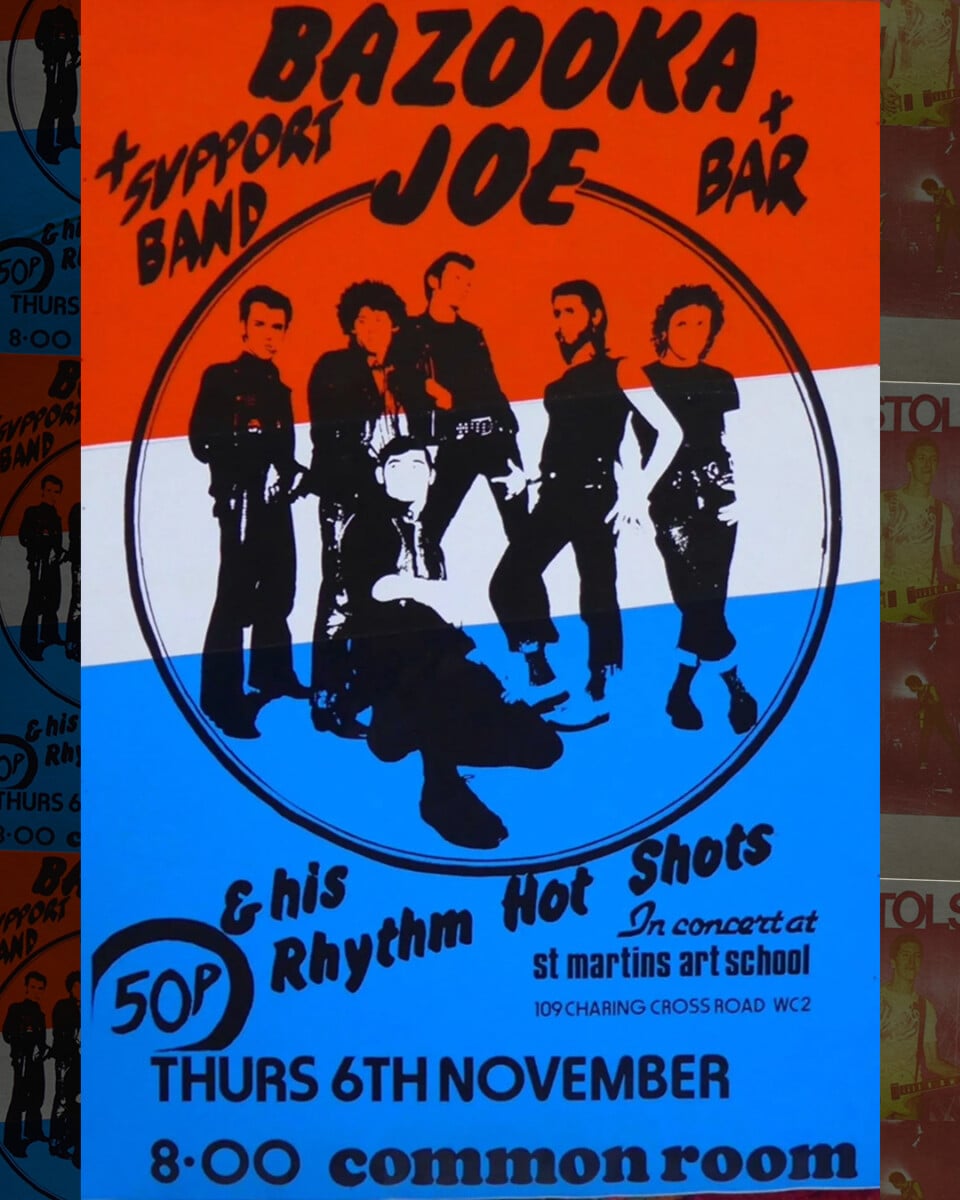
Whilst possessing a fierce and confrontational look, all ripped jeans, chopped hair, and a million miles away from hippie locks and bell-bottom flares, the newly-formed Sex Pistols needed a gig. A student of Saint Martin’s School of Art in Charing Cross, the band managed to eke out a support slot for pub rock group Bazooka Joe, featuring Adam Ant on bass, well before his highwayman pop pomp.
Tipping up to the upstairs common room with gear largely pilfered from big names passing through Hammersmith Odeon—legend has it Jones nicked various equipment from David Bowie’s final Ziggy Stardust show in 1973—the Sex Pistols arrived at the stageless floorspace with instruments but little else, pleading with Bazooka Joe to use their backline.
Taking the figurative stage on November 6th, 1975, the Sex Pistols ripped through a set of covers from The Who, Small Faces, and The Monkees, a very drunk and Mamdraxed Jones insisting on dialling up an already loud 100-watt Marshall amp to deafening volumes, resulting in a swift pulling of the plug after only a few songs. “Bunch of fucking cunts” Rotten reportedly yelled to Bazooka Joe in response. Already irate, the Pistols frontman’s boot to the PA system tested the patience of Bazooka Joe guitarist Danny Kleinman.
“I was watching from the sidelines, and Johnny Rotten turned around and started kicking the speaker cabinet, which we still hadn’t finished paying for,” he recollected to GQ in 2015. “I was thinking, ‘What’s going on? You’re not Pete Townshend, mate’”.
Accounts differ as to the degree of physical explosion, claims of a full-blown brawl tempered by photographer Paul Madden’s “school-playground” description of the clash, but such antagonism and eager affrontery established that a new force had arrived in the London music scene, matching the belligerent simmer sowing the seeds of punk’s lightning bolt. “Not a single hand-clap,” Lydon later recalled, yet few bands can count such a disastrous first show as still sounding a clarion call for music and the broader youth culture.
“I’ll never forget it. They came in as a gang: they looked like they couldn’t give a fuck about anybody,” Ant would recount to John Savage years later. “The impression they left on me was total […] They had the look in their eyes that said, ‘We’re going to be massive’”.
Across three short years, immortal shows at Manchester’s Free Trade Hall, Bill Grundy controversies, Sid Vicious’ entry to the group, and an ill-fated US tour in 1978 all furthered the Sex Pistols’ mythology, for better or worse. Now a towering pillar of the cultural landscape and inevitably co-opted by the mainstream, the gaggle of bewildered and intrepid art students witnessing the Sex Pistols’ chaotic live debut arguably witnessed the punk mythmakers at their most raw, pugnacious, and gleefully irreverent.
