


“We’re over it now”: the story behind Radiohead’s bear logo

Up there with Motörhead’s Snaggletooth and The Rolling Stones’ lips and tongue among the premier of rock and pop insignia are the slew of bears that litter Radiohead’s branding landscape.
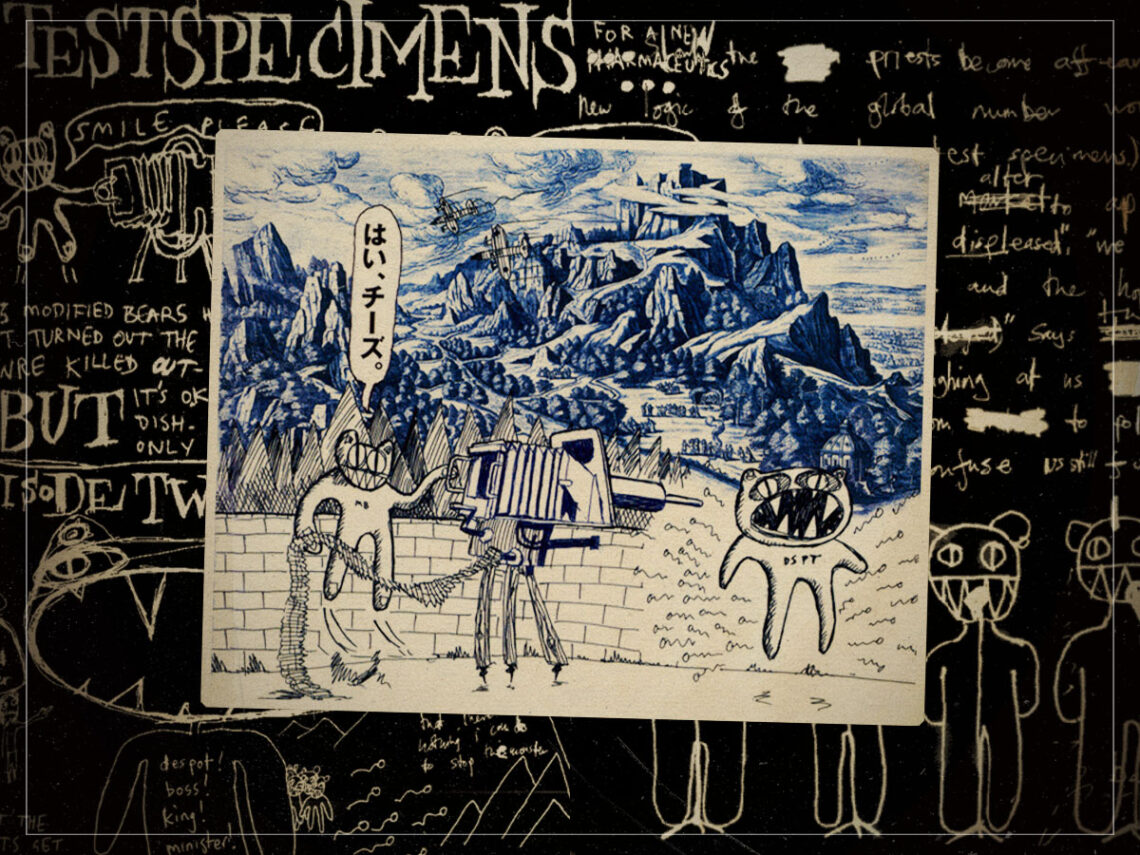
So established as a symbol, Radiohead can whip out the “Modified Bear”, as fans have dubbed it, as a wordless calling card with such familiarity that they were able to announce their Glastonbury Festival 2017 headliner by painting the giant grimacing ursine on Worthy Farm. Sometimes known as “Blinky” or “Despot Bear”, that disquieting set of sharp teeth, a blur between a smirk and a snarl, and wide, dilated eyes look set to stand as Radiohead’s long-time artistic collaborator Stanley Donwood’s most enduring creation.
Supposedly, the gnashing bears came from a bedtime story for his daughter. Sometime in the late 1990s, Donwood dreamed up a tale of neglected teddy bears coming to life in the attic to eat the adults who’d abandoned them, genetically modifying themselves in their preparations for revenge by sharpening their teeth and amping up the aggression.
Such themes were already a minor obsession between Donwood and Radiohead frontman and old art school mate Thom Yorke, who were immersing themselves in the murky world of biotechnology and cloning developments’ ethical quagmire during the run-up to Kid A.
But what did the band say?
“It stemmed initially from a deep paranoia of genetic engineering,” Yorke told Blender in 2001. “And then from a children’s book. You know: creating monsters, only to awaken one morning to the terrible truth that there is nothing at all you can do to stop them. We’re over it now.”
The Mod Bear made its debut in the Radiohead universe in 2000, when a surreal and crudely drawn comic strip known as Test Specimens appeared on the band’s official website. The narrative is mired in layers of cryptic intrigue and jokey idioms between Yorke and Donwood, but essentially Test Specimens tells the cautionary tale of the genetic Mod Bears run amok among the corporate and political sphere, along with the ‘sperm monster’, lurking in the world’s media machine and serving as some kind of artificial harbinger of doom.
Donwood ensured the Mod Bear would glare with arresting impact. Made up of bold, geometric lines, Radiohead’s genetic nightmare was not only instantly identifiable, but the logo’s stark menace was easily reproduced by fans with the most rudimentary artistic skill.
It was a perfect soft rebranding for the group. After the explosive success of OK Computer three years earlier, Radiohead were eager to let the artwork handle the press and promotion that all aided the band’s retreat away from the spotlight, dropping no singles for Kid A and issuing short animated “blips” for the internet and the day’s music channels featuring the Mod Bear let loose in the mini-series’ puzzling promo buffers.
The Mod Bear would find its way on the cover of 2004’s Com Lag (2plus2isfive) EP and receive a nod on Amnesiac’s ‘Hunting Bears’ instrumental, but otherwise, Yorke and Donwood’s genetic paranoia never adorned any of Radiohead’s future album artwork, instead serving as a surreal mascot of the band’s merchandise and broader visual identity, and standing as a perfect emblem to the political failure and millennial alienation they once explored so pertinently.
