


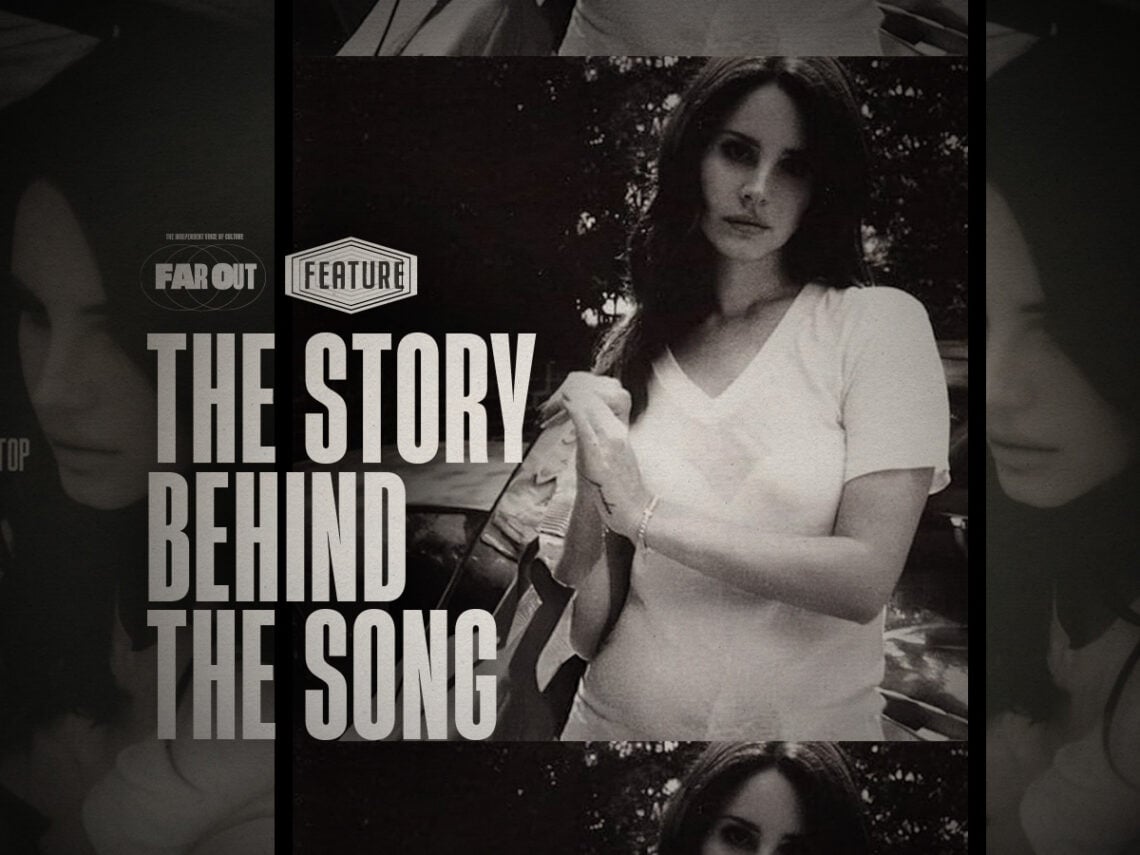
The Story Behind The Song: Lana Del Rey’s ‘West Coast’

Despite being born and raised on the East Coast, Lana Del Rey and the world she has built will always be synonymous with the enticing mystique and blinding sunshine of California.
From her earliest career beginnings, performing as Lizzy Grant (a shortening of her birth name, Elizabeth Woolridge Grant), Del Rey evoked images of Californian iconography as talismans of glamour and romance where Marilyn Monroe and James Dean were patron saints, Jim Morrison was a symbol of hedonism, palm trees, beaches and the literal Hollywood sign loomed like visions of utopia.
“One day I’ll drive in a gold Mercedes Benz,” she sings on ‘Hollywood’, a gem from her trove of unreleased songs, “Singin’ opera on Bel Air Road… In Hollywood, I’m alive again.” Del Rey would channel this energy into her debut, 2012’s Born to Die, a glimmering collection that holds the same emotional resonance as a classic film, and the succeeding EP, Paradise. Her full-length follow-up, 2014’s Ultraviolence, would further this, with a classic rock flair that merges her bicoastal influences into an all-consuming haze of psychedelia.
“I’m writing songs that I really like right now. They’re really low-key and stripped back, all sort of West Coast inspired,” Del Rey told Radio in 2013. Beginning the slow burn of writing new material, the singer was living between Santa Monica and Brooklyn, New York, fashioning visions of what her next collection would communicate. Eventually, she enlisted the Black Keys’ Dan Auerbach as a producer, a dream collaboration that saw Del Rey shift from the trip-hop baroque of her Born to Die era into a guitar-driven sound, evoking glimpses of psych and desert rock that enchanted with every chord. But, this was all unprecedented when she released its lead single, ‘West Coast’, a cinematic descent into her conflicted heart.
‘West Coast’ was written with her frequent collaborator, Rick Nowels, in California. “That’s what someone just said to me when I was on the beach,” Del Rey explained of the song’s title and opening lines, in an interview with Triple J in 2014. “I was at a beach party, he said, ‘They’ve got a sayin’, if you’re not drinkin’ then you’re not playin’.’ I thought it was a cute opening line.”

In Del Rey’s rendition, the saying reverberates like a warning of the captivating allure of the West Coast. The opening drum beat tumbles into a groove reminiscent of a surf rock melody, languid as Del Rey contemplates her next move. “Down on the West Coast / I get this feeling like / It all could happen, that’s why I’m leavin’ / You for the moment,” she whispers, the effects already beginning to take hold.
“For me it’s like thinking about the way things were for me, and how my motivations were for so long, they still seem a part of my life even though I’m not drinking now,” Del Rey explained further. “For some reason I really like soaking up the mood of like a really dynamic party whether it’s on the West Coast or whatever. I like that other people can have fun and let loose. I feel like I’m a part of it when I’m there – so yeah, I felt comfortable with it.”
Del Rey’s ease takes hold as the song transitions into a dual narrative in its chorus. With a descending riff, ‘West Coast’ turns into a soundtrack fit for a neo-noir romance. This switch is mirrored in ‘West Coast’s music video: shot entirely in black-and-white, her story begins with her and her lover, both clad in leather, prance across a beach; she is thrown into the ocean before the chorus drops.
Our gaze changes to a scene of Del Rey in the arms of a different lover, tattoo artist Mark Mahoney, cruising in a convertible. Her leather is traded for a white dress and diamonds, and her vocals shifting into a sensual croon, repeating, “Ooh, baby, ooh, baby, I’m in love.” The sole glimpse of colour in the video is Del Rey superimposed in flames, swaying and singing with her eyes closed as the instrumentals are dominated by high-pitched synths.
‘West Coast’ turns into a tale of Del Rey, torn between two worlds, weighing the option of leaving her lover for a chance at stardom and a change of heart, abandoning a free-spirited romance for a dramatic, possibly dangerous one. The story, in turn, reveals more of Del Rey than fans had previously been exposed to. We meet her at a crossroads, but she sings with an assured confidence, too, one that would be amplified on Ultraviolence, in its entirety.
On ‘West Coast’, the listener is swept up in Del Rey’s breathy vocals and the song’s soft rock aura, creating such an intoxicating blend that suddenly we, too, want to take our chances of running away to California and throwing all caution to the wind.
