


Which sound of the 1960s can be heard in Amy Winehouse’s ‘Back to Black’ the most?

When Amy Winehouse said she never listened to music made past 1967, many would have simply passed it off as a flippant comment. But that woman went to pains to prove her point.
It was part of the reason that Back to Black has undeniably become one of the most important albums to be created in the 21st century, not just because it was Winehouse’s sublime swan song. But through every swinging beat and soulful note, a sound of an entirely different time burst through the speakers, and made the singer a transcendental star.
Without question, the fact that the 1960s is the world’s most nostalgic and beloved decade was something that Winehouse was incredibly smart to tap into, beyond her own immediate fascination and reverence for the music of the era. That jazz-drenched warmth was something she’s already well-established on Frank in 2003, but Back to Black took it to a whole different level.
It’s worth considering that the specific mid-2000s crossroads that the album was released at the heart of was also a major contributing factor. In the years shortly leading up to complete financial ruin, people were dreaming of simpler times, and for a demographic approximately in their 40s at that moment, the exact sweet spot was, indeed, the ‘60s.
You could create a whole separate discussion on how the mechanics of the record made Back to Black so genius, but the specific aspect of Winehouse’s ‘60s influences warrants an exploration into the flashes that showed themselves to be so integral. As mentioned, the singer never made any secret about how this informed her sonic psyche, but the process by which they created her masterpiece was the manifestation of a true artist at work.
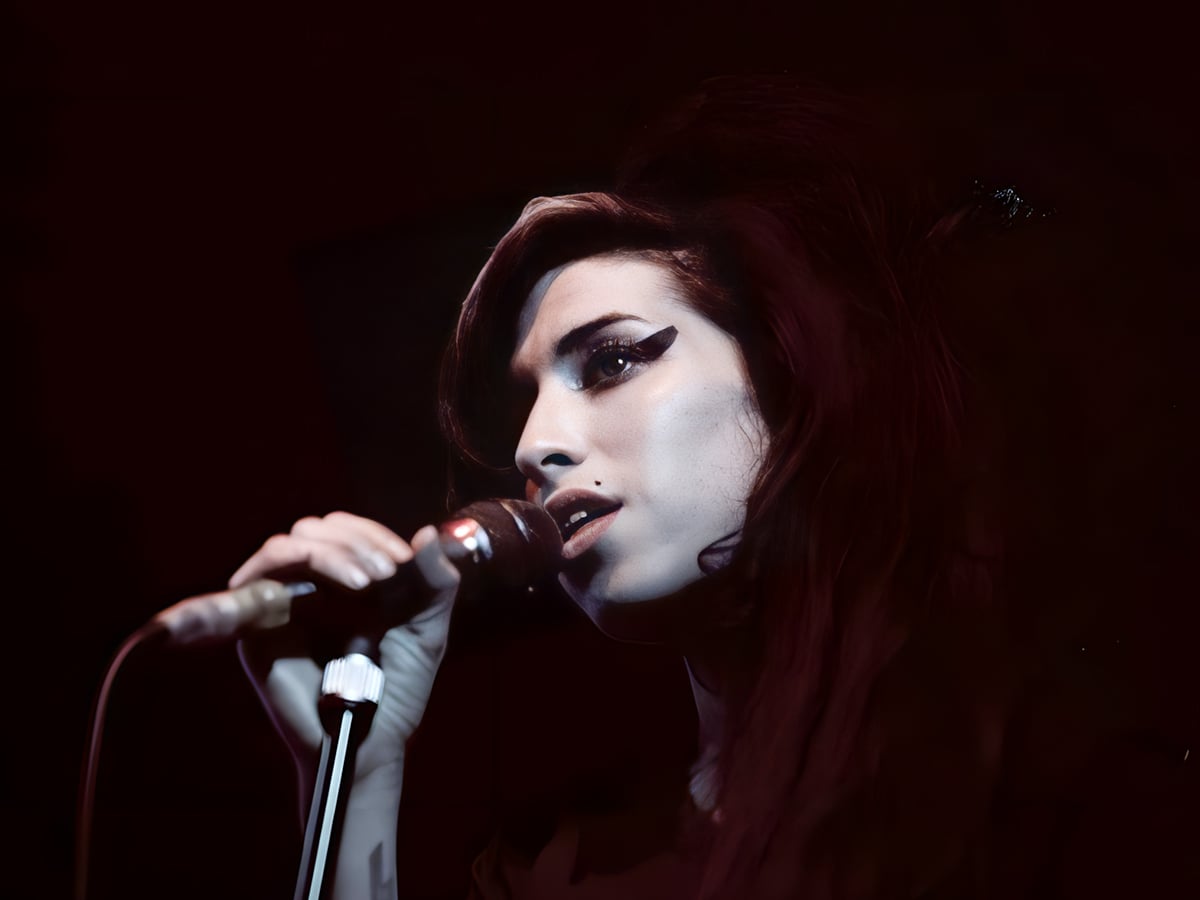
Primarily, the presence of Sharon Jones’s band The Dap-Kings were the instrumental force that kept Winehouse buoyed in a specific liminal space between the past and the present of the time, but in many ways, it was those who weren’t physically in the room that also did much of the heavy lifting.
Winehouse herself regularly cited the influence of ‘50s and ‘60s girl groups as the main driving force of the album – and certainly, the sound of acts like The Supremes, The Ronettes, and The Shangri-Las palpates from every one of the 11 tracks on Back to Black. The upbeat turns of ‘Rehab’, ‘Addicted’, and ‘Tears Dry on Their Own’ are the particular hallmarks of this.

Yet beyond that immediate layer of shiny sonics, there is a much richer and more insightful layer that exists at the heart of the album, perhaps more often left unsaid. That arrives in the songs where the sound is stripped, the lights are dimmed, and the high heels are metaphorically taken off. Take the examples of ‘Love is a Losing Game’ and ‘Wake Up Alone’.
An artist like Carole King didn’t immediately fit within the confines of the girl groups that Winehouse worshipped so much, but nevertheless, as a product of that same era, she was someone that the singer viewed with the utmost reverence. Even though it fell outside her self-proclaimed 1967 boundaries, the London star often said King’s ‘So Far Away’ was her favourite song.
And in this respect, it’s easy to see how a simple but heartfelt poetry like this was the dominating voice that led the words to the page in the case of ‘Love is a Losing Game’. Similar things could be said for a track like ‘Wake Up Alone’, where on this occasion, the sonics hold more than a reminiscent mark of Etta James’s ‘I’d Rather Go Blind’.
To this end, there was no arguing with the artist when she said that girl groups were her main muse on Back to Black. That distinct sound blares proudly from every moment and movement of the record, but on perhaps a more intimate level, there is a far more resonant message that its course of songs sends, whether consciously or otherwise.
Above all else, Back to Black is a celebration of women. Their boldness, their power, their quiet strength and sorrow – through every emotional facet of life, Winehouse paid tribute to the music that shaped this in a particularly pivotal era, while undeniably stamping her own unmistakable mark on the scene.
The ‘60s beckoned a new era of politics for women, found in pockets of activism like the liberation movement. It was no coincidence that, although things were far from perfect at this time, the rise of female artists truly singing from their hearts, whether in soul or any other genre, sat at the centre of the popular zeitgeist. In many ways, Winehouse was saying thank you and passing the baton forward.
