


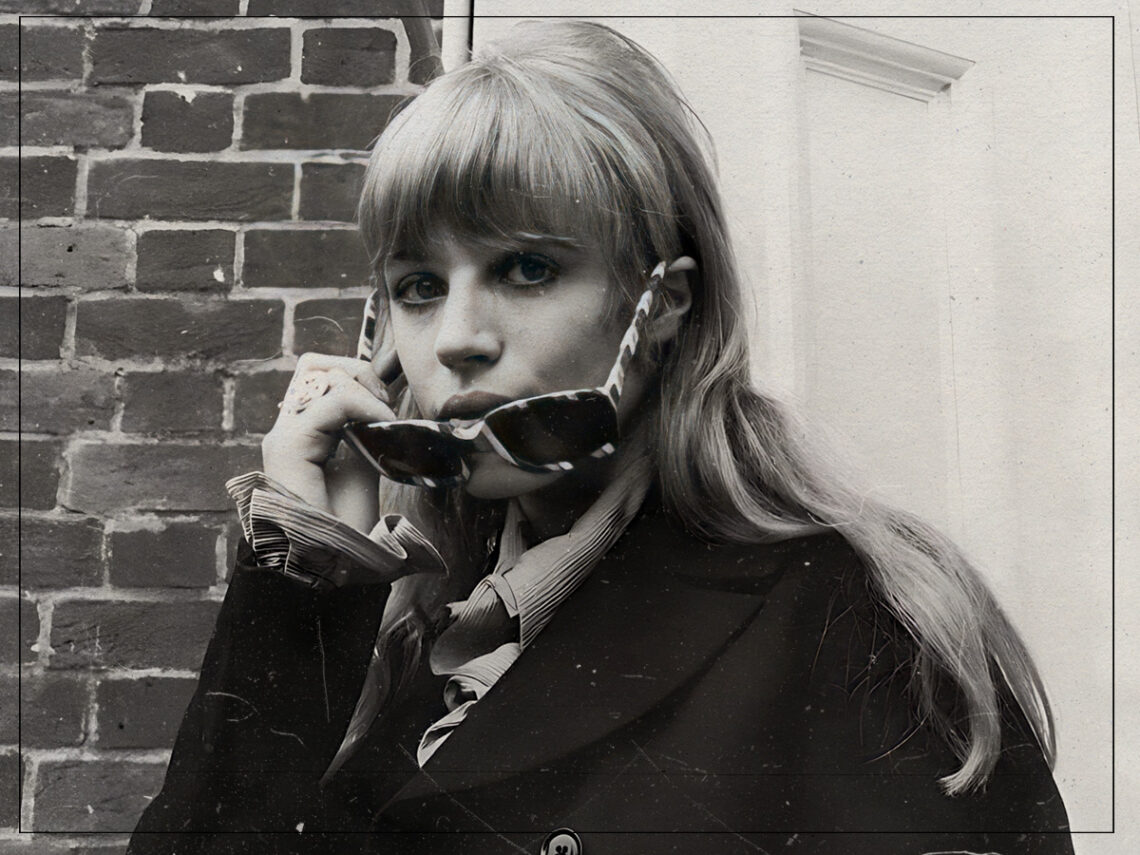
The song that set Marianne Faithfull off in the wrong direction: “Also known as drugs”

There was a time when Marianne Faithfull was on top of the world. In the mid-1960s, she was one of the most popular singers in Britain, Mick Jagger’s girlfriend, and a burgeoning film star, with everything she touched seemingly turning to gold. She was in a place that many dreamed about reaching. However, dark clouds soon circled.
Like most people, Faithfull’s route to the top began somewhat haphazardly. Although her first shows were as a folk artist in coffee shops, the door to the world of superstardom came after she immersed herself in swinging London’s heady social scene. It was a happening time, and she quickly found herself rubbing shoulders with an array of fast-rising stars at the forefront of Britain’s cultural revolution.
In the early stages of 1964, she attended a Rolling Stones launch party with her boyfriend and fellow musician John Dunbar. There, they met the band’s colourful manager, Andrew Loog Oldham, a moment he indexes as discovering her. She might not have known it at the time, but the 17-year-old Faithfull had everything it took to be a star, and it was swiftly arranged for her debut single to be ‘As Tears Go By’, an original by Jagger, bandmate Keith Richards, and Oldham himself.
The song was a massive success after it was released in June 1964, with Faithfull’s newfound status bolstered by her self-titled debut and follow-up, Come My Way, arriving simultaneously in 1965. This was the start of a whirlwind period for Faithfull. While she would release a string of successful records across the rest of the decade and branch into films, her life would fall into chaos.
Not long after giving birth to her and Dunbar’s son Nicholas in November 1965, Faithfull left her husband for Jagger. She was with the frontman until 1970, and it was a highly publicised and chaotic affair that certainly played a role in her increased use of drugs, which before long would sadly lead to a heroin addiction, homelessness and anorexia. Breaking out with ‘As Tears Go By’ and the ensuing hits, Faithfull made a name for herself with her harmonious, high-pitched vocals, but a bout of severe laryngitis and drug abuse would also lead to her voice changing to something all the more gravelly.
While this would eventually become her signature sound, for a time, things looked incredibly bleak for her career, particularly in the early 1970s as her world fell apart. In one of music’s great turnarounds, though, after a period out on the heath, Faithfull delivered a definitive comeback with the immense Broken English in 1979. Coming to terms with her new voice, and more musically and thematically substantial than her previous efforts, it was the start of a resurgence. At last, Faithfull cemented her place amongst the greats. It even earned her a Grammy nomination.
When discussing her album Negative Capability in 2018 with Uncut, Faithfull explained that it was co-producer Warren Ellis’s idea to re-record ‘As Tears Go By’ for it. She didn’t think it was a good idea at first, but Ellis persisted, and in the end, she found that the Australian musician was right. As you might expect, while the track is her best-known, it brings back uncomfortable memories for Faithfull, as it was what changed the trajectory of her life, leading to many years of drug abuse and pain.
She explained: “For a long time I didn’t really like it, actually – it seemed to me to be the start of all the trouble, but in fact it’s a really wonderful song. Trouble? Well, I got famous and I became a little pop star and blah blah blah.” The vocalist added: “It set me off in the wrong direction, also known as drugs.”
It’s a strange paradox. Marianne Faithfull would not have existed in the way we know and love her without ‘As Tears Go By’, but as we have seen countless times across history, fame is a double-edged sword. What starts as a good thing can often come to represent something completely different and much darker. Kurt Cobain’s thoughts on ‘Smells Like Teen Spirit’ mirror this.
