


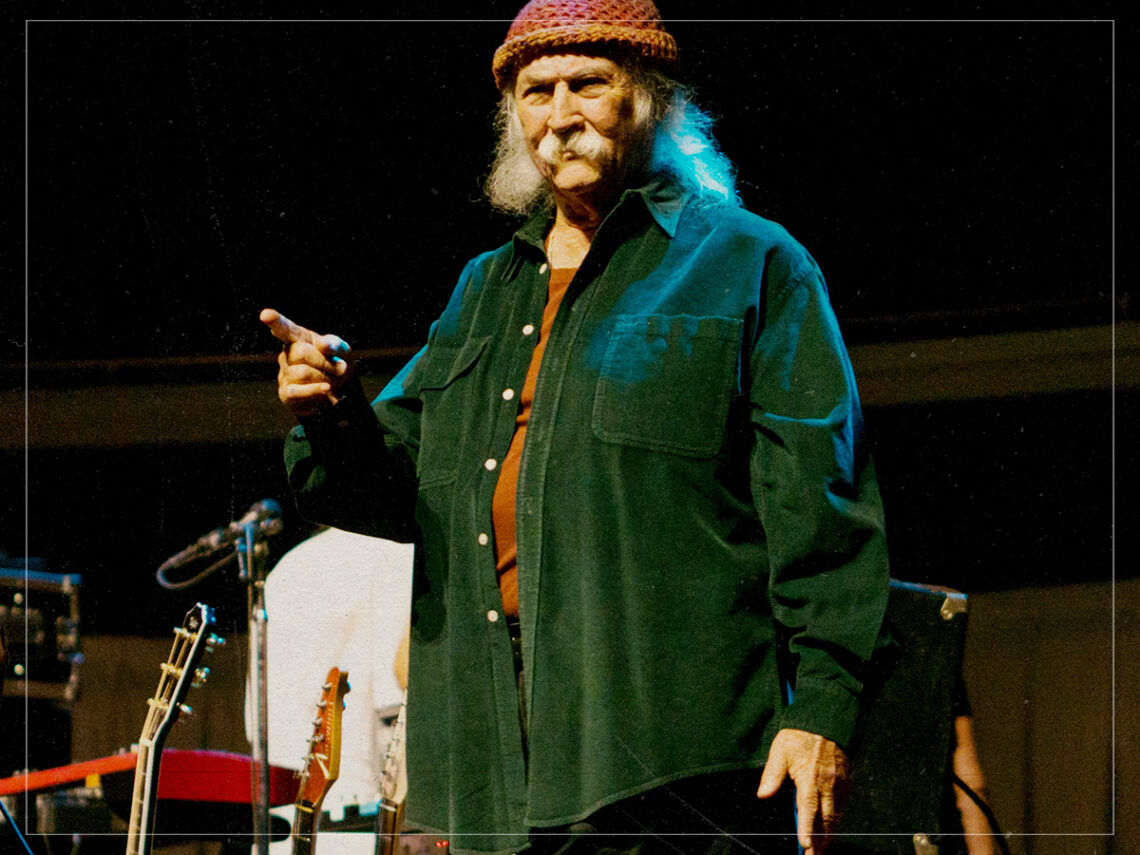
The song David Crosby called “the all-time activist anthem”

As the British invasion was dominating the Billboard charts and Motown/Stax was scoring the Civil Rights era, it took The Byrds’ David Crosby to sense the countercultural winds emanating from the US’ bubbling West Coast.
Following 1965’s ‘Turn! Turn! Turn!’, Crosby would endure as one of the era’s towering musical figures, crafting a folk rock soundtrack to the rapidly exploding youth movement and all its ensuing political challenge and social upheaval. Forming the acclaimed trio with Buffalo Springfield’s Stephen Stills and The Hollies’ Graham Nash, everything from condemnations of ‘The Man’ to vociferous critiques of American foreign policy would pepper their anthemic vocal harmonies for the peace and love generation. Recruiting Neil Young into the fold, 1970’s Déjà Vu would stand as the supergroup’s finest hour.
As the hippy idyll ebbed across the next decade, Crosby still clung on to his former revolutionary pedigree, if tested by a crippling drug habit and bouts of incarceration, playing live shows during various protests and benefit gigs, and remaining a vociferous critic of the Donald Trump administration and its legacy until his death in 2023.
He also kept the faith with music’s power to inspire and organise. “I’ve been to a number of these Tibetan Freedom Concerts that Adam Yauch and Michael Stipe and different people from the younger bands have been putting together,” Crosby revealed to Pop Culture Classics in 2000. “They’re very committed people. They’re extremely bright. They understand what’s going on. Eddie Vedder—God, you should talk to the guy, man. He’s brilliant. And he understands”.
Bestowing further high praise to the contemporary music scene, Crosby highlighted one band in particular as having written one of the defining political numbers of his life, “…look at Bono and U2. Good God, these are stand-up guys, man. ‘Sunday, Bloody Sunday’ is one of the all-time anthem activist songs…”
Such platitudes may stick in the craw of the most committed haters of Ireland’s biggest musical export, but back in the early 1980s, Dublin’s U2 were hailed as a humanitarian clarion call of a rock band, long before liberal philanthropy and advocacy triggered eye rolls over earnest celebration. Shaking off the embers of their youthful new wave posturing, U2 looked to the political turmoil engulfing the North’s province to fuel the furious ‘Sunday Bloody Sunday’ that opens 1983’s War, a record that soaked up the anxieties of the age while also spelling a maturation in their developing sound.
Inspired by Derry’s Bloody Sunday atrocity, when British troops opened fire on civil rights protestors and killed 14 unarmed Catholics in 1972, the sectarian campaigns engulfing the region shaped U2’s lyrical plea to peace and resisting the cycles of violence swirling endlessly across The Troubles’ deadly conflict. Imbuing the lyrics with their penchant for biblical allusions, War’s third single attempted to grapple with Northern Ireland’s mire via a lens excoriating the political battles that claim the lives of innocents caught up in the middle across the wider world.
“We’re into the politics of people, we’re not into politics,” drummer Larry Mullen said at the time. “…you can move that into places like El Salvador and other similar situations—people dying. Let’s forget the politics, let’s stop shooting each other, and sit around the table and talk about it… There are a lot of bands taking sides, saying politics is crap, etc. Well, so what! The real battle is people dying, that’s the real battle”.
‘Sunday Bloody Sunday’ would prove a pivotal single for U2, pushing War to the top of the UK album charts and marking the arrival of a future stadium heavyweight, counting the original Byrd rabble rouser Crosby as a lifelong fan and admirer.
