


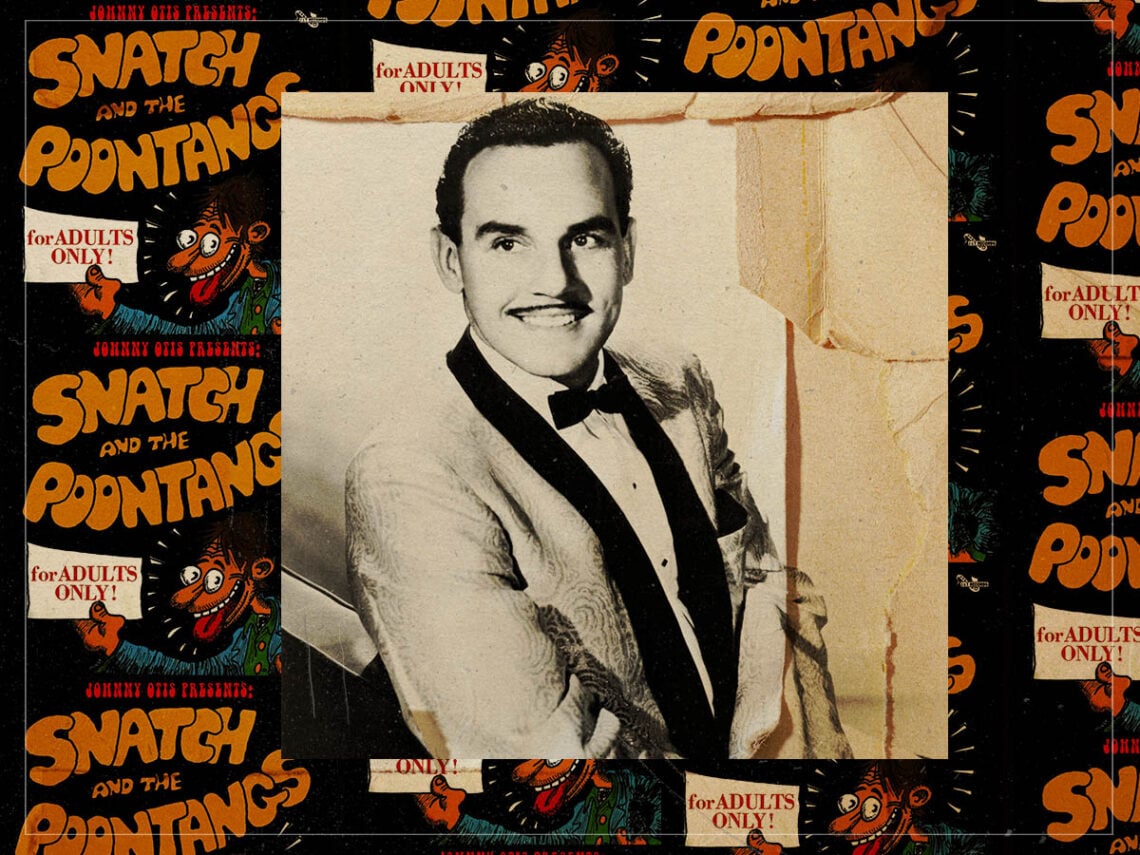
‘Snatch and the Poontangs’: Johnny Otis’ bizarre sex-blues side project

Pseudonyms have been commonplace within literature, art, and music for centuries. The benefits of publishing under a fake name are pretty obvious: you can get away with saying things or expressing feelings that you couldn’t under your own name or personality. In popular music, pseudonyms are sometimes used by intensely successful, acclaimed artists who wish to record tracks without any expectations attached to them. Others simply use pseudonyms as an opportunity to have a little fun, as in the case of R&B pioneer Johnny Otis.
Modern American music would look very different without the impact of Otis, the Greek-American musician, band leader, producer, and talent scout who played an essential role in developing the landscape of R&B and, by extension, rock and roll. The California-born artist entered the music industry during the 1940s, playing in a variety of jazz and swing bands at the height of America’s swing era. He became fairly successful within the jazz world towards the end of the decade, but it was not until he began to pursue rhythm and blues that his career really took off.
Throughout the 1950s, Otis worked tirelessly, penning a multitude of rhythm and blues tracks that seemed to capture the zeitgeist of the time. All the while, he was also working as a talent scout, discovering now-iconic artists like Etta James, Jackie Wilson and Big Mama Thornton, and helping them make their mark on the American musical mainstream.
His work was always popular and often had a timeless quality to it, exemplified by how often other artists covered Otis’ songs in the decades after he wrote them. ‘Every Beat of My Heart’, for instance, was written by Otis in 1952 but later became a hit for Gladys Knight & the Pips in 1961, and then James Brown in 1963. In case I’m not making myself absolutely crystal clear, Johnny Otis is a very big deal within the world of rhythm and blues, and his work was often treated with a kind of reverence afforded to very few songwriters.
Once he had amassed such a colossal reputation, however, Otis found that he was being limited by expectations put upon him. So, in an effort to break free of expectations and have a little fun, he recorded an album in 1969 under the pseudonym Snatch and the Poontangs. As the name implies, this bizarre project was a huge departure from Otis’ previous work, seeing him write and record a variety of X-rated blues tracks, invariably centred around sex.
Sex has always been a prevailing theme within popular music, and blues is certainly no exception. In most cases, though, the topic of sexual gratification is dealt with a lot more subtly than on Snatch and the Poontangs’ self-titled album. Among tracks like ‘The Pissed-Off Cowboy’, ‘Two-Time Slim’, and the concluding ‘Two Girls In Love (With Each Other)’, Otis and his group – which, stranger still, included his son, Shuggie Otis – sing passionately about various dirty deeds and sexual encounters in the style of classic blues recordings.
Released via Kent Records in 1969, shortly after Otis’ signed a deal with Columbia, the album’s sleeve also featured explicit cartoons, including a mural of naked people out in the street, with signs that read “Let it all hang out” and speech bubbles like “Fuck this shit, I’m goin’ out and get me some pussy” (that particular line is spoken by a cat). It would be easy to write the album off as being a product of outdated and often misogynistic sexual attitudes were it not for the fact the album is so unbelievably bizarre.
According to the sleeve, the cartoons on the cover were created by The Hawk, who is also credited with the production, engineering, drums, and piano. It is safe to assume, therefore, that it was actually Johnny Otis who created those drawings. Given that the album was recorded and released under a pseudonym and bore the warning “For adults only” on its sleeve, it had virtually no ties to Johnny Otis.
It was only decades later, thanks to the cult following that the record had amassed, that the album became tied to the R&B pioneer. Even now, it is almost unbelievable that a musician of his acclaim and success would devote a considerable portion of time to writing, recording, and illustrating this underground sex-blues album. After all, his regular music career carried on throughout this period, appearing at the Monterey Jazz Festival that same year, inspiring a live album and a feature in Clint Eastwood’s Play Misty for Me.
Perhaps that secrecy – along with its unavoidably strange content – forms the core appeal of Snatch and the Poontangs. It was so different from anything else being released at the time and worlds apart from the rest of Otis’ work, which gives it an unwavering sense of fun and spontaneity – It didn’t matter what they put on the album, so they just had fun with it. As such, Snatch and the Poontangs remains one of the most notable and bizarre uses of a pseudonym in the history of American music.
