


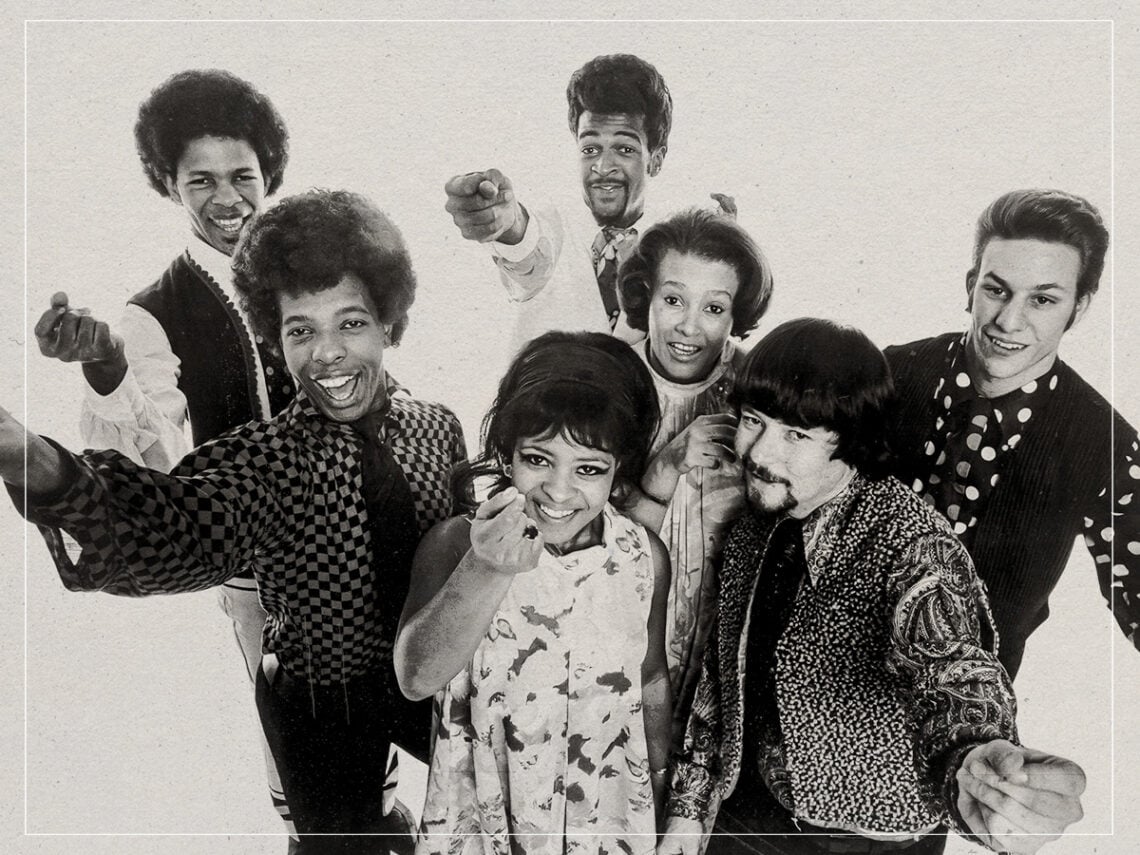
Why Sly Stone believed it was important to have a diverse band

In setting up America’s first major integrated rock band, Sly Stone wished to cut through every genre that would conventionally divide the diverse members.
Despite the name ‘Sly and the Family Stone’, only three members were related. Alongside the multitalented Sly were his siblings Rose and Freddie, weaving magic on the keyboard and guitar, respectively, and Cynthia Robinson flying on the trumpets. The family band also had some white ‘brothers’, with Gregg Ericco behind the kit and Jerry Martini manning the saxophone. Their canon slid with ease between funk, psychedelia, soul, rock and R&B, proving that these culturally disparate styles could coexist in the same space, creating a unique new soundscape.
In a racially fraught decade, this impact was by no means unintentional. Stone’s mission to break down social division started early, when, as a local DJ in California, he played both Black and white artists. When it came to forming his own band, as he told The Guardian in 2013, “I wanted people to look onstage and see the world and how the world can get along… If they could see us, see we were having fun, it might make it easier for them to catch on.”
One of the best evidence of this is the footage from The Ed Sullivan Show in 1969, where a bemused, largely white audience can be seen swept along by the band’s infectious energy and assertion.
The title and goofy, light-hearted cover of their first album, A Whole New Thing, invoke the novelty of a racially integrated band among the riots and unrest of the mid-60s. But this glittering patchwork was more than just a gimmick; the band’s utopian microcosm was always underpinned by their fierce musicality. The instant danceability and relentless optimism of their early party-starter hit records, A Whole New Thing, Dance to the Music and Life, worked to move feet in busy rooms and shatter the boundaries of division. Then, their popularity and countercultural cool were cemented when they played for 500,000 bleary-eyed hippies at the 4am slot at Woodstock.
Continuing onto their acclaimed and confrontationally-titled albums Stand! and There’s a Riot Goin’ On!, much of their politicism would still reside more in the fact of their membership than the lyrical content of their music. Though historicised as coherent, radical statements, the albums bounced between overtly political tracks and introspection, while the dancing continued. However, the grooves got decidedly darker and deeper as Sly and the band’s drug use intensified.
Like so many others of the time, the band’s darkening tendencies preceding their dissolution are a handy symbol for the death of ’60s optimism.
The conception of Sly and the Family Stone was rooted in radical, optimistic acceptance, so the increasing bleakness of their hedonistic tones, lack of concert attendance due to Stone’s famed unreliability and pressure from the Black Panthers to de-integrate into the ’70s can all be read as the curdling of a dream into a nightmare.
But their influence persisted, to the point where it is considered that Black music that existed after Sly Stone was markedly different from what it used to be before he blazed onto the world’s stage. His vision was also his great legacy: of an integrated, multicultural band fighting against bigotry with the infectious power of joy and a jig.
