


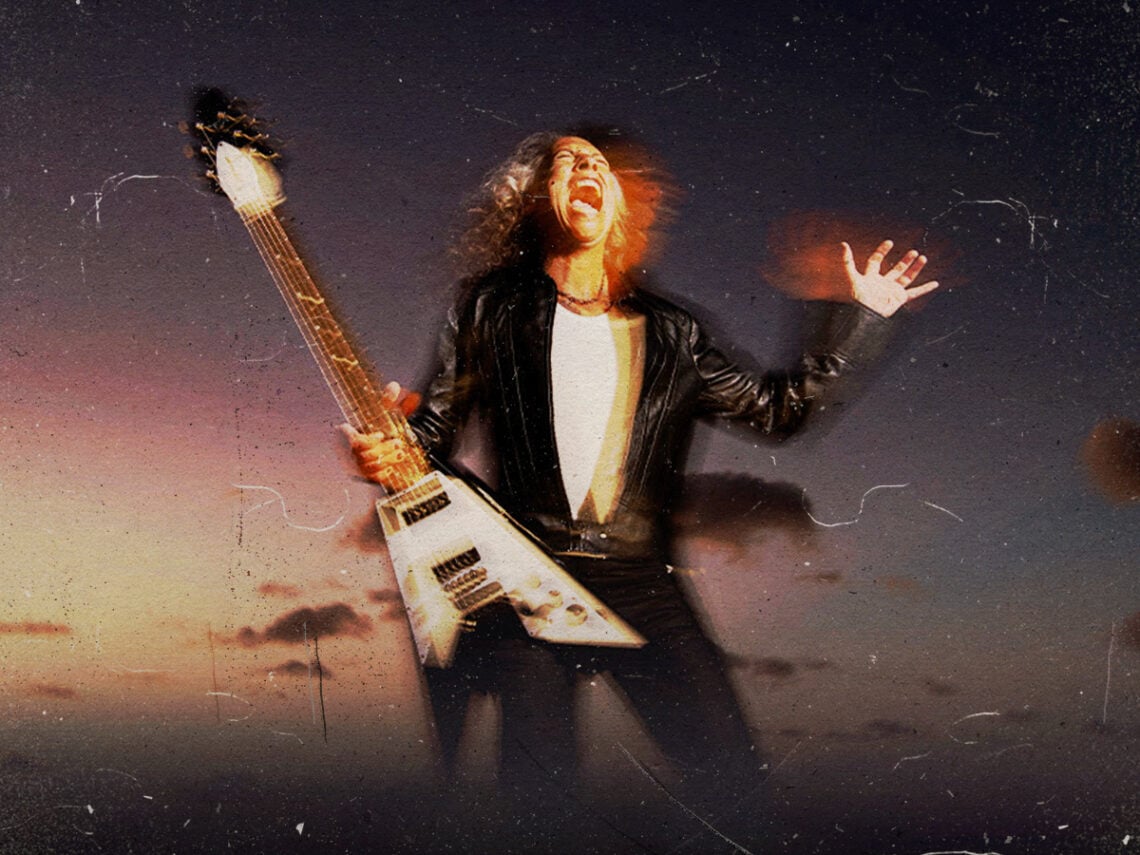
“Distortion in his throat”: The singer who blew Kirk Hammett’s mind

Regardless of your thoughts on the landscape of American metal during the 1980s, the colossal and enduring success of a group like Metallica can certainly not be disputed. Raised on a hearty diet of hard rock and hardcore punk, the band were essential in establishing the sounds of thrash metal, and went on to represent the pinnacle of the American metal scene. Throughout that early period, however, Kirk Hammett and the gang took major cues from the established sounds of Motörhead.
Motörhead were always in a league entirely of their own. While their sound was often cited as metal or hard rock or any number of vague genre descriptors, the band themselves were always quick to distance themselves from those sounds. “Motörhead don’t fit into any category, really,” frontman Lemmy Kilmister once declared. “We’re a rock ‘n’ roll band, which no one knows how to market anymore.”
Either way, the otherworldly rock sounds of Motörhead, coupled with the band’s loud and fast delivery, meant they united multiple different factions of the rock and roll landscape. Emerging during the mid-1970s, the band managed to capture the attention of the blossoming punk movement, which resonated with Kilmister’s ‘live fast, die young’ attitude, as well as the distortion and delivery of the band. However, the group also resonated with the sensibilities of metalheads and even some mainstream rock audiences.
One such audience member who was utterly gripped by the emergence of Motörhead was Kirk Hammett. Having cut his teeth listening to groups like Led Zeppelin, Hammett was predisposed to a love of metal music, so it is no surprise that his first major jaunt into the music industry came in 1979 with the thrash metal outfit Exodus. At the same time, however, the guitarist was a disciple of the blossoming hardcore punk scene in San Francisco. Motörhead managed to unite those two disparate musical loves.
Recalling the moment he first discovered the iconic tones of Lemmy Kilmister, Hammett recently told Metal Hammer, “When I first saw the cover of Ace Of Spades, I just fucking knew, man. I’d heard Overkill before that and remember thinking, ‘this is way faster than Scorpions or UFO. Overkill, cool!’ But then a week or whatever later I saw that Ace Of Spades cover and was just like, okay, I’ve gotta buy this album.”
Arguably the band’s defining work, Ace of Spades firmly established the sound of Motörhead, even earning the band a spot at number four on the UK album charts. For Hammett, the record was akin to a spiritual awakening. “I got home and put it on… Oh my god,” the guitarist explained. “Lemmy opens up his voice and starts singing, my mind fucking exploded.”
“Me and all my friends were into punk rock, right?” he shared, explaining the universal appeal of Kilmister as a performer. “Local San Francisco hardcore bands; me and my friends fucking loved it. The tone of Lemmy’s voice was like he’d got a distortion box in his throat. The sound of that bass, too! I felt like I was in the mud with those guys. It’s so dirty and aggressive, so real!”
Undoubtedly, Hammett used that trailblazing influence delivered by Lemmy and Motörhead during his early days with Metallica, who recruited the guitarist in 1983. After all, the rest of Metallica also tended to hero worship Lemmy as the archetypal rock god and, in turn, Kilmister was supportive of Metallica. In fact, the two artists performed together on multiple occasions, uniting two different rock and roll worlds.
