


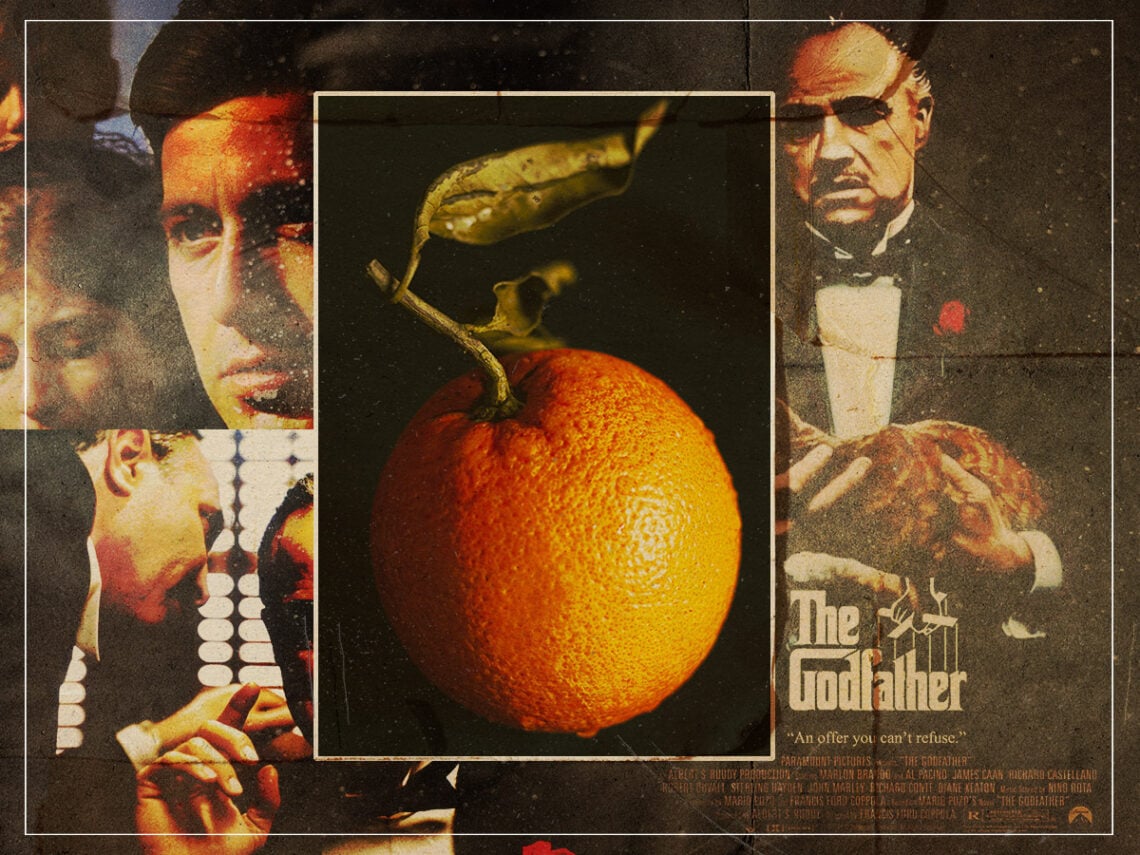
An ominous dose of vitamin C: the significance of oranges in ‘The Godfather’

Fruit and vegetables are a key part of any healthy and balanced diet, but it wouldn’t be out of the question to expect anyone even tangentially associated with the Corleone crime family at the centre of The Godfather to be reduced to a quivering wreck whenever they found themselves in close proximity to an orange.
Francis Ford Coppola’s seminal gangster trilogy comprises two of the greatest movies ever made and a third film. The connective tissue that threads the three together is many recurring thematic and visual motifs that underline how family, loyalty, power, and death are woven into the fabric of the Corleone lifestyle.
In some bad PR for the orange industry, though, whenever the fruit was spotted on-screen, death was almost sure to follow. When Marlon Brando’s Vito Corleone is the victim of an attempted assassination in the street, it’s oranges that he’s buying before he takes a bullet for his commitment to fresh produce.
When he finally shuffles off his mortal coil, it comes when he’s peeling an orange and pulling faces at his grandson. The patriarch clearly has failed to pick up on the fatal consequences of combining vitamin C with his multifaceted existence as a feared crime boss, grocery shopper, and doting grandfather.
It’s not all about the bloodline, either, with Jack Woltz seen eating dinner with consigliere Tom Hagen in the scene prior to the bigshot Hollywood producer waking up with a severed horse’s head in his bed. What could be spotted sitting on the table when he sits down for that meal? Oranges, of course.
Right before Sonny Corleone goes out in a blaze of bullet-riddled and blood-splattered glory after being ambushed and massacred at a highway tollbooth, a billboard for Florida oranges can be spotted in the background. Despite those three instances happening within the space of the same film, though, it wasn’t entirely part of Coppola’s meticulously crafted masterplan.
In Harlen Lebo’s book The Godfather Legacy, production designer Dean Tavoularis admitted that it wasn’t a planned part of the process but a happy accident that eventually became a running theme. “We knew this film wasn’t going to be about bright colours, and oranges make a nice contrast,” he said. “I don’t remember anybody saying, ‘Hey, I like oranges as a symbolic message.'”
It may have been a fortunate coincidence that added even more subtle nuances and complexities to a movie that was already overflowing with them, but Coppola’s continuing to feature oranges so prominently in the second and third chapters indicates that the way the fruit took on a life of its own following the success of the original wasn’t lost on him.
It may have leaned more towards accident than design, then, but in The Godfather, any sight of an orange is a signal of impending doom. Whenever one is spotted in the 1972 classic, it’s a clear sign that the character acting as the focal point of the scene is not in store for a good time.
