


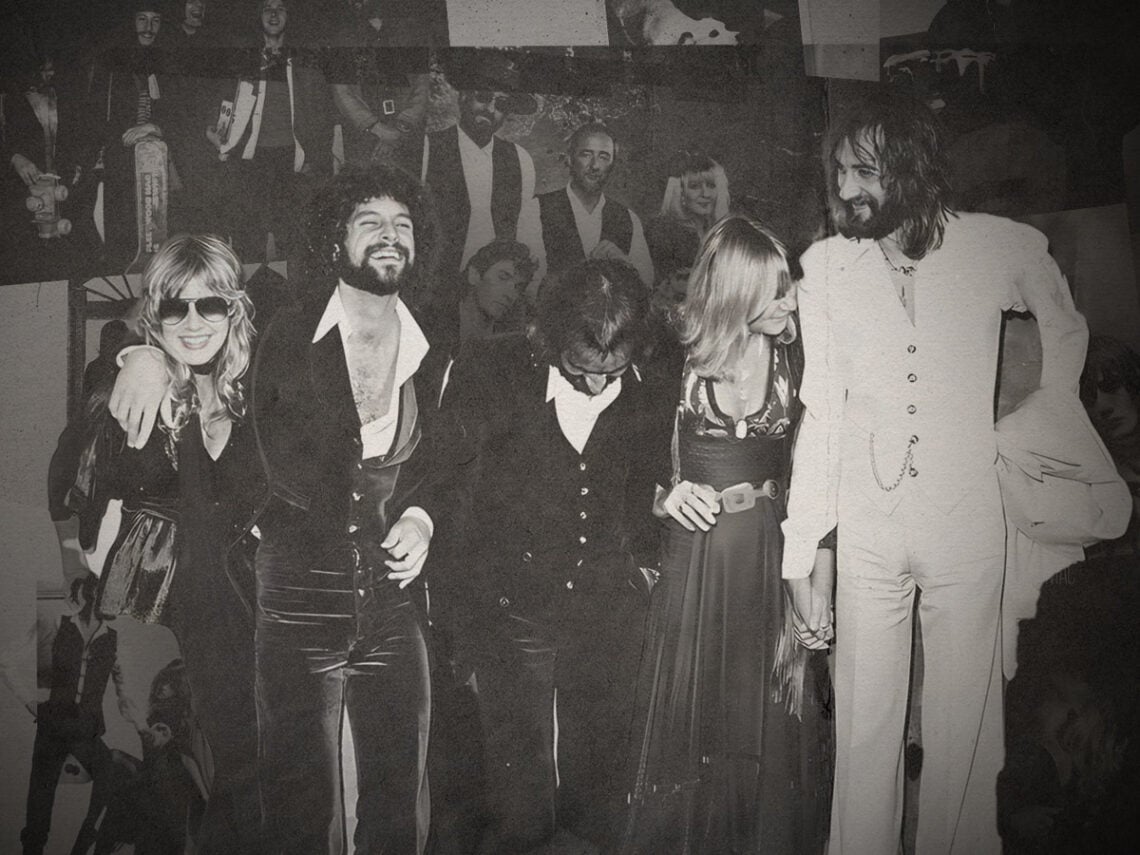
Homelessness, cults, and suicide: Have Fleetwood Mac been cursed since 1967?

Rock’ n’ roll is just a laugh and a joke until the point that it really isn’t. The many members in the rolling cast of Fleetwood Mac know this all too well.
From cults to the curbside and cocaine addictions, the band is one that has seen its brethren blighted by all sorts of ills since its inception in 1967. The musical output may have been outstanding over the various eras, but it has come at a heavy cost.
Such a bewilderingly heavy cost, in fact, that a few spiritualist folks in the music industry believe that there’s a Curse of Mac afoot in classic rock. The first instance of this supposed scourge befell Jeremy Spencer.
In ‘67, after Peter Green and Mick Fleetwood left their band The Bluesbreakers, they teamed up with slide guitarist Jeremy Spencer and bassist Bob Brunning to form Fleetwood Mac. An avid fan of the Chicago blues scene, Spencer helped to define the band’s early sound, but his status as an integral member didn’t last long.
In the frigid February of 1971, amid a largely successful tour, Spencer nipped off to pick up a magazine and never returned. The distressed band searched for their starring blues influence for days, only to find that he wasn’t quite leafing through Country Homes in a bus shelter. He was actually holed up as a happily ordained member of the Children of God cult.
This, however, was not some flowery, barefoot hippy jaunt that the musician had embarked upon. The Children of God cult remains one of the most despicable in American history. Its founder, David Berg, told members that God was love and that love was sex. Thus, it stood to reason to spread the sexual love of God to anyone and everyone, regardless of age or relationship.
When I spoke with Christopher Owens, the indie musician who fled the cult in his teens, he remarked that while secular music was banned, Berg was keen to use hymns as a form of bonding. “I wasn’t really fully aware of songwriting as a concept,” he said. “I was learning to play the guitar at about 13, but that was just for like group singalongs”.
Jeremy Spencer and the crooked cult
Although horrific stories have continued to come from the cult (which now goes by the name The Family International), Spencer remains inexplicably blasé about the whole thing. “I was sad, uninspired musically, I had questions about life, death, love, my future, God – everything,” Spencer responded when asked about the moment he nipped for a magazine and never returned.
“I couldn’t go on with it,” he continued. “Bottom line, I had to leave in order to step back from the picture and get my life sorted out. I wouldn’t be here today if I hadn’t, and they would not have gone on to be one of the biggest bands in history!” It’s a unique take that conveniently evades the morality of his spotlight escape.

Nevertheless, he concludes, “I don’t say that in a self-demeaning way, because I knew when I heard the first album with the Buckingham-Nicks line up, that they had hit on something good with an enormously catchy appeal. Besides that, after I left them, I prayed for God to reward them with success beyond their dreams. He answered that prayer.”
It is suspected by many that although Spencer’s initial impetus to leave group behind seemed offhand and undefined, drugs may well have played a part in the matter just as they did for Peter Green a few years further down the line.
Green was the iconic guitarist who trailblazed blended rock ‘n’ roll blues riffs in scintillating style. He had an aura that led Christine McVie to compare him to “Jesus”. And even his early Fleetwood Mac records elucidated the fact that he had songwriting skills to go along with his virtuosic chops in the shape of lilting ditties like the beauteous ‘Man of the World’.
The downfall of Peter Green
Sadly, however, he only lasted three albums with the band. Those first three albums had enamoured a European fanbase, and when they embarked on a huge tour, a tragedy befell them in Munich. Green was greeted at the airport by suspicious fans. This innocuous greeting was seemingly laden with cataclysm.
“John McVie would certainly blame an evening in Germany where Peter took some more drugs and, for sure, never really came back from that to our recollection,” bandleader Mick Fleetwood once recalled. “John is, to this day, absolutely furious with these people. We call them the German jetset, and they captured Peter completely and pulled him away.”
Even the aforementioned Spencer himself has commented on this strange incident. He describes a woman who greeted Green as a “model/actress looking girl dressed in black velvet”. He says she was with “this John Lennon looking guy in wire glasses.” These peculiar fans accompanied Green to the gig and watched the rest of the band with a certain disdain, before inviting everyone back to “a party at this huge mansion place in the forest.”
Amid a manic, psychedelic party in the commune-like mansion, Green descended into the basement and arrived out of the other side “in tears”. In the band’s eyes, he was distraught. However, Green asserted that these were tears of joy. He had just played the most spiritual music of his life in the bowels of that psychedelic basement, he explained.
How Danny Kirwan succumbed to homelessness
Another member of the band present that day was Danny Kirwan. Fate also besieged him that night in the forest, partly because of his affable character. “Peter Green and Danny Kirwan both went together to that house in Munich,” their one-time manager Clifford Davis recalls, “both of them took acid, as I understand. Both of them, as of that day, became seriously mentally ill. It would be too much of a coincidence for it to be anything other than taking drugs, as of that day.”
While Green would, to some extent, recover and enjoy a creative life away from the spotlight despite persistent health problems, things fared differently for Kirwan. “Danny had been a nervous and sensitive lad from the start. He was never really suited to the rigours of the business,” Mick Fleetwood once opined.
In a rather callous reflection of the times, he continues, “Touring is hard, and the routine wears us all down … Our manager kept us touring non-stop, and we were being stretched to our limits … and the pressure was obviously taking its toll. He simply withdrew into his own world.”
“I suppose I am homeless, but then I’ve never really had a home”.
Danny Kirwan
One night, while backstage, this regression came to the fore. “Danny was being odd about tuning his guitar,” Mick Fleetwood continues. “He got up suddenly … and bashed his head into the wall, splattering blood everywhere. I’d never seen him do anything that violent in all the years I’d known him. The rest of us were paralysed, in complete shock. He grabbed his precious Les Paul guitar and smashed it to bits.”
He was promptly sacked from the band, and in the ruthless world of showbiz in those days, very little was done to provide a parachute for the former star. Once he was turned away, his mental wellbeing was largely disregarded. As Mick Fleetwood bluntly told Men’s Journal, “he was wonderful, but couldn’t handle the life,” eventually ending up homeless on the streets of London.
When Bob Brunning tried to track Kirwan down for a memoir, he found him holed up in St Mungo’s Community Hostel for the Homeless in the leafy district of Covent Garden. The derelict man that Brunning recalls merely looked at him and said in an incoherent mumble, “Can’t help you Bob. Too much stress.”
A little over four years later, he was traced once more. This time he was in a Los Angeles hostel for the homeless. He had been there for four years, apparently living on social security and a small trickle of royalties. As he told The Independent: “I’ve been through a bit of a rough patch, but I’m not too bad. I get by. I suppose I am homeless, but then I’ve never really had a home since our early days on tour.”
The end of the road for Fleetwood Mac?
After the departures of several bandmembers, Fleetwood Mac, as an entity, was next to be stricken by the so-called curse. When Bob Weston was brought in to replace those lost to a German basement, he soon found out that he and Mick Fleetwood’s wife, Jenny Boyd, were “born within an hour of each other”, and trouble was afoot.
From the outside looking in, it remains difficult to see why that would’ve been an issue. However, according to Weston, this happenstance created an “astrological” connection so profound that they simply had to have an affair with Boyd.
Mick found out, fired Weston, cancelled the tour, and temporarily called a halt to the band. He’d had enough. He had seen Green and Kirwan lose themselves to drugs. Spencer fled mid-tour to join a problematic cult. Now, his wife was riding Weston because they shared a birthday. Meanwhile, the hits were waning, the money was drying up, and substances were flying around like an explosion at Johnson & Johnson.

It was time for Mick to hang up his top hat and pack away his waistcoat. Everything went very quiet until 1974. With so many members coming and going in their seven years as a band, the contractual question of ‘Who owns Fleetwood Mac?’ came to the fore when the drummer looked to settle up.
Manager Clifford Davis said, “This band has always been my band,” while the band themselves said that he had the matter the wrong way around: the band will always be the band, and he will very shortly not be their manager. With the legal arm wrestle ongoing, the beleaguered group thought that if they were fighting for their name (literally), then they may as well make use of it. So they reformed, moved to America, signed to Warner Bros., and eventually settled out of court with Davis four years later.
Bob Welch’s broken “bridge” era
This reunion, however, did little to change the fortunes of the band. Their new label had far more successful acts on their roster, and Bob Welch – who had been brought in back in ‘71 to replace Spencer – felt like they were being neglected. He hatched a plan to summon the band to Los Angeles, where he thought they could stake more of a claim and connect with entertainment attorneys.
He was also pivotal in the band’s decision to self-manage. Yet, at a point when he was the only remaining guitarist in the moribund group, his almost singular determination to keep them going wasn’t just borne from love of the Mac. His marriage was failing, and despite creative exhaustion, he was keen to avoid two major losses at once. That was a battle he wouldn’t win. In Decemeber 1974, he resigned from the band.
While he departed on good terms, he began to allege that the band had since signed new deals with Warner that dwindled his royalties. The legal battle turned acrimonious, and the stress of this further exacerbated his personal issues. This was compounded when the band were inducted into the Rock and Roll Hall of Fame, and Welch wasn’t included.

“My era was the bridge era,” he raged in Plain Dealer in 1998. “It was a transition. But it was an important period in the history of the band.” Once again, the anger that he felt over this perceived slight negatively impacted his health. In 2012, he would receive much-needed spinal surgery, but he was told his condition would not improve, he fell into depression. Unable to cope with this news, three months later, he shot himself in his Nashville home, and died by suicide.
Not much is mentioned about Welch in the annals of Fleetwood Mac’s story, but in Mick’s memoir, he looked to right this to some extent, crediting him with helping to save the band and set up their Californian future in the mid-70s.
1975 and the start of a new cursed chapter
While all this might seem like a sorry symptom of the era, when the band rose from the ash heap of history and welcomed Stevie Nicks and Lindsey Buckingham, the good time of their 1975 self-titled LP soon fell to ruin as tour stresses and addictions took their toll once more. The soap opera that followed is well-renowned sitcom fodder… if only it wasn’t so truly tragic.
During the making of the masterpiece of Rumours, John and Christine McVie were in the midst of a mutually self-destructive divorce and took to the secluded Sausalito studio in a sort of comatose stupor, the symptoms of which pertained to denying each other’s existence unless it involved simple uncommunicative utterances, like ‘what key are you in John?’
Buckingham and Nicks, meanwhile, had previously been so close that they seemed to exist as a single entity. So much so that their break-up was like splitting an atom along with the volatile reaction that ensues.
Simultaneously, poor old sticksmith Mick Fleetwood was trying to hold this fragile band of despairing brethren together while also coming to terms with the fact that his wife had left him for his best friend.
To complete the Rumours hex, added to whichever cauldron that concocts the band’s lore was a glug of alcoholism, and a hefty pinch of mass cocaine addiction. This was then left to bake in a hot Californian, windowless oven for 15 hours a day for almost a year, and garnished with a strange sort of symbiosis. Pop perfection did end up getting served up, nevertheless. The sort of manic perfection that provides a paradigm for the curious happenings in the most cursed band on the planet.

Never Miss A Tale
The Far Out Classic Rock Newsletter
All the latest Classic Rock content from the independent voice of culture.
Straight to your inbox.