


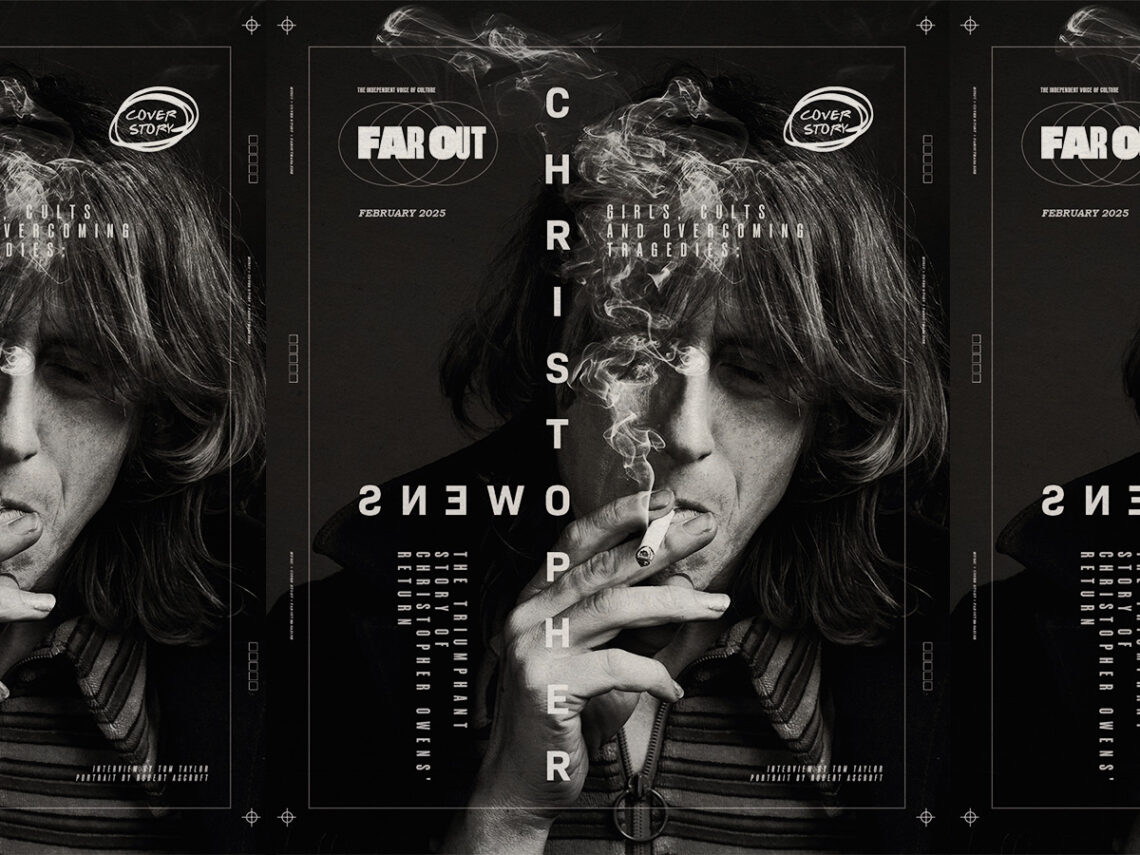
Girls, cults and overcoming tragedies: the triumphant story of Christopher Owens’ return

The dinghy subterranean room in San Francisco carried a fetid smell unmistakable to a trained nose: this is the sort of place musicians hang out. The scent of spilt beer, cigarette stubs, faulty smoke machines, street food, leather and unwashed attitudes perfumed the noir scene. The room was not quite a bar and not quite a practice space, simply a dimly lit lair for folks with guitars. On this particular night in 2007, the air was not only thick with a welter of rock ‘n’ roll‘s most notable odours but a hefty distending of hushed anticipation. At the age of 28, Christopher Owens was about to perform his first songs.
It was an age of irony where the overbeating influence of The Strokes’ debut masterpiece had encouraged acts to pursue a ‘coolness’ uber alles. Feelings weren’t readily admitted in the indie sleaze age, but Owens had too many of them to hold back. “I thought people would sort of make fun of my songs because they’re so emotional,” he recalls. “Everyone in the scene and California, in general, was doing this fake it until you make it kind of thing—they put on their coolest face and are very scared to admit hardship and doubt.”
Svelte, shy and shaking under the spotlight, the few friends and hangers-on in the crowd could’ve butchered Owens and his earnest sincerity then and there, but instead, he found himself finally embraced. Doubt and hardship were things he knew all too well, fixtures of his life that he couldn’t ignore, and as he quietly strummed his guitar and sang lines not too dissimilar from one of his latest – “I think about heaven, and I break out into a great big grin” – things finally began to make a little bit of sense to him.
This outbreak in song had been a lifetime time in the making. And a very strange lifetime at that. “I’ve never really met anyone else with a childhood like mine,” he casually explains as he struts through the streets of New York. If I wasn’t so captivated by his gentle charisma, I might’ve chirped, ‘You can say that again!’
Unlike most of the indie musicians I speak to, he wasn’t a kid raised on the refrains of The Beatles, The Beach Boys, MTV 2 and garage rock bands wearing trilbys in the bar that’ll serve you when you’re underage. Far from it, in fact. Owens was raised as a member of the Children of God cult. It’s a cult that first came to my attention when covering a story about how Fleetwood Mac guitarist Jeremy Spencer had hopped off the tour bus to pick up a packet of cigarettes, and the next time the band heard from him, he was trying to indoctrinate them into the cult he had spent the last few months living with.

Sadly, they came to the attention of many others a few decades before when rampant child abuse was reported. The infamous founder, David Berg, sinisterly capitalised on the spirit of the age in the 1960s and put forth a message that sex was love and love was sex, and, according to the BBC, “there should be no limits, regardless of age or relationship”. Thankfully, Owens’ memories are not of such acts but rather a curious sense of absurdity. The main sense you get from him is that he harbours bemusement towards the whole thing. Particularly its approach to the arts.
Rather than being bombarded by culture as a kid, he was brought up singing songs written strictly by the cult themselves. “We didn’t listen to any secular music,” he says. So, in the same way that nobody thinks about anyone having to write hymns, Owens never even considered that you could be a professional musician. “I wasn’t really fully aware of songwriting as a concept. I was learning to play the guitar at about 13, but that was just for like group singalongs,” he explains.
But then, the magic of music would trickle into his life in a way that seemed uncanny. And if you’re ever in doubt of its subversive potential, his testimony is all you need for reassurance. “It started to leak in through movies. They were pretty careful about what movies we could watch, and they would usually always be pausing the film every five minutes and sort of explaining their take on things, you know, like critiquing people’s choices and just using it as a way to indoctrinate.”
For the adults, who had chosen to leave the likes of The Beatles behind, they barely even noticed the secular nuggets deriding their message with glaring emancipation, but for the kids, there was magic in these mystic songs. When the movie ended, and the latest spiel about the biblical undertones had faded from their ears, they set about making covert mixtapes of the strange anthems they had just heard.
With that, Owens’ interest was piqued. But professional musicianship still felt like a world away until the head of the cult himself inadvertently intervened. “There was one little collection of tapes that the leader of the group put out. I think in a moment when he let his ego get the better of him,” Owens comically recalls. He put out two of these tapes, My Old Favourite and My Old Favourites Two. Suddenly, a tangible link between the cult and the rapturous music that had infiltrated it was made.

However, you don’t just gain an interest in music and choose to ‘go clear’. It would take Owens a while to sever ties. His father and sister had already left the family behind, but he was still a youngster, and cutting loose in the big wild world was daunting. But he was equally sure that the cult held no future for him, and with the help of his sister, while on a missionary trip in Slovenia, he slipped away, leaving his mother behind, and landed in the punk scene of Amarillo, Texas.
It would take nine years for him to eventually find his feat in the world, thanks to a curious Texan oil baron named Stanley Marsh III. Marsh is a controversial philanthropist who hired Owens as an assistant, providing an income that allowed him to pursue art and move to San Francisco—where music pretty much found him.
“I had this epiphany where I was like, ‘Oh, these are just normal people who make these records,” he recalled. “To me, when I first left, and I would get these CDs of Simon & Garfunkel or something, they seemed larger than life.” But now, he was partying with them—or at least two of them in the form of Holy Shit.
Owens had first encountered the band thanks to a girlfriend who was too cool to call their relationship a relationship. She was the local tastemaker, but most of the tastes she was making left Owens thinking he simply “didn’t like new music” all that much until Holy Shit came along. So, he ventured to one of their shows. The fact the gig was cancelled over some sort of disagreement that he can’t even fully recall changed his life forever.
“Matt Fishbeck and I were just sort of drawn to each other,” he says. That same night, Fishbeck would ask Owens if he wanted to become a touring guitarist for the group. The rest is history. The only certitude in Owens’ life had been faith. When he cut loose from that, his days were marred by uncertainty, but suddenly, he had an income, purpose and sense of identity. Around a year later, he’d step out into the spotlight of that fetid room in San Francisco, and a measure of seconds after his final chord was strummed, he’d be in Girls, a brand-new indie group with his best friend, Chet ‘JR’ White. They’d soon go on to be one of the most beloved indie bands of the era, subverting the sleaze with a soft, vulnerable sincerity.
Owens’ latest album, I Wanna Run Barefoot Through Your Hair, reconciles the loss of that band and JR’s death. While he strums away, gently and earnestly, as he did decades ago in San Francisco, a gospel chorus croons in the background, as it did a few more decades before that at the cult’s singalong sessions, and Owens tries to find peace and transcendence from heartbreak. It’s a warm and quilted reconciliation that breezes forth as a culmination—piecing together the various chapters of Owens’ life, vying hopefully to set up a brighter future beyond tragedy as a sober, working musician. “I really just want to play music,” he says. “It’s saved my life”.

The journey to this new chapter has been a brutal one. Girls had exploded. This was equal parts “a dream” and “a daunting” proposition. Through writing songs, he could “figure out” the confused web of his life. “Rather than talking to a therapist, I write the songs,” he says. But the pressures also blighted this progress. “I leaned pretty heavy on drugs. I really didn’t know what I was doing,” he admits.
Both JR and Owens had plenty of lingering questions from their childhood, and Girls felt like “two dreams coming true”. Owens adds, “The best part about it was knowing what I could do by myself. That I was valuable to me and other people.” While this brought fulfilment, it also, tragically, brought entirely unknown territory, and drugs added a degree of normality. The opioid crisis was surging through the States, and JR, and Owens would be swept up.
“I wasn’t expecting to become dependent. I thought, ‘Oh, I’m not putting a needle in my arm or anything’. I didn’t realise it was the same thing,” he recalls. Bandlife was soon beset by a “crazy series of ups and downs”. And he knew he had to get out for both of their sakes. So, Girls finished, and a solo chapter reluctantly began. But the whole time, his heart was set on making music again with his best friend, only this time they’d be sober. That chance presented itself in 2015, but once again, it was through hardship.
After three records, his solo contract expired, and the label made no renewal offer. Facing up to an uncertain future, Owens contacted JR about reforming Girls as they had discussed in the past. Excitably, JR “booked a studio and gave me the date to arrive. When I arrived, he was just a wreck, like a character in the movies. He was just like, ‘Oh my gosh. We’re actually doing this!’ But then, a few hours later, he was saying, ‘Oh, can I go home early today?’ The next day, he didn’t show up for a few hours.” On the third day, he didn’t show up at all. The dream of reforming Girls suddenly seemed infeasible.
Owens didn’t hear from him for weeks after that. When he finally did get a call returned, JR explained that the “pressure was too much”. Tragically, a few years later, in 2020, JR was found dead at the age of 40. Grief descended on Owens. He tried to throw himself into his music, but the pandemic foreclosed that, and his band, Curls, disbanded. Prior to that, his fiance of seven years had left him. A severe motorbike accent resulted in several health issues, and without insurance, these went without treatment. He was fired from his job at a coffee shop. He began living out of a camper van that was stolen along with his cat and his favourite guitar. He was homeless, without a deal, and was at such a rock bottom that a pickaxe would have gotten him to Australia.
But, as he said about his days in Girls, “The coolest thing throughout the whole thing has always been the fans. I mean, the fans have just never stopped being amazing to this day”. He might have been in short supply of everything else, but he still had plenty of those. His music means something to people. And a fan would come to his aid when he was at his lowest ebb. A woman he met at a gig expressed an interest in becoming his manager. “She paid out of pocket for this latest album to be made. She saved my life”.
I Wanna Run Barefoot Through Your Hair somehow reflects this story with soul and joy—and that’s just about as high praise as you can give anything.
