


Separating the Art from the Artist: The worst phrase to ever happen to art

There is plenty of art, and there are plenty of artists. Art is not a finite resource where a moral line would cut off beauty that can’t be replenished. So, why not draw that line? Why not, as my mother-in-law often yells at the tele, ‘Give someone else a chance’?
Originally, the phrase ‘separating the art from the artist’ was a tool for literary criticism. The philosopher Michel Foucault intended it to pertain to answering the question ‘What is an Author?’ more so than any ethical debate. However, in recent years, it has become a moral paradigm, widely philosophised on social media in the wake of the MeToo movement and so-called cancel culture.
Usually, the narrative has been driven by ‘professional’ artists, who overvalue their own endeavours, and argue from a position of vested interest that you simply must separate the art from the artist because it is the human thing to do. This is usually met with clapping emojis by sycophantic people who also desperately want to be troubled artists, and a few ambivalent headscratches from fellows who think, ‘Well, I do still love The Smiths’.
Those in favour of the separation often frame it as the compassionate, mature stance. They view it as the outlook that keeps art ‘interesting’ and saves us from becoming a mass of fussy brats. It is seen as a way of preserving beauty while acknowledging human imperfection. But beneath its surface, the phrase is deeply contradictory.
In practice, it doesn’t separate art from the artist at all. It separates art from accountability and perpetuates very real problems as a result. The world now knows all too well what happens when power – and the perceived worth that comes with it – is granted a free pass. But the art world that should hold the powerful to account is seemingly incredibly keen to hand those passes out to its own disgraced royalty.
What people really mean when they invoke this phrase is that the professional success of the artist should remain untouched by their wrongdoing. That distinction matters greatly because continuing to celebrate, platform, and reward an artist is not a neutral act; it is an endorsement of their place in culture.
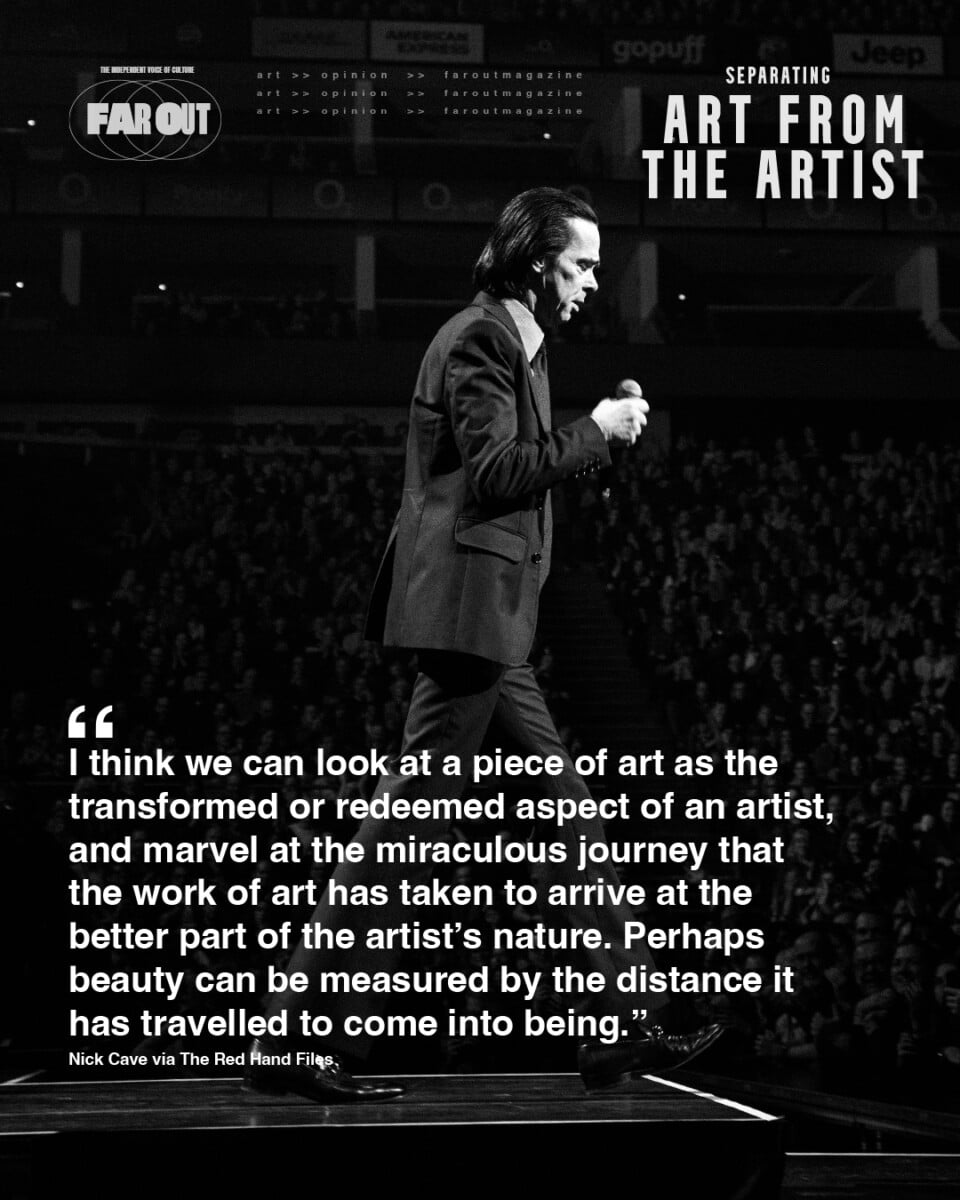
Nick Cave has been an active supporter of the phrase, and when discussing bad actors in the industry at Hay Festival in 2023, he argued, “We need to understand that the songs themselves are the best of them,” and we should not “eradicate the best of these people in order to punish the worst of them.”
But this argument assumes that great art possesses some kind of objective, irreplaceable value – that certain artists are so uniquely brilliant that losing them would impoverish culture itself, and that a moral line in the sand would act as a limitation of human kindness. This assumption does not hold up.
Firstly, there’s a major difference between mercilessly casting someone into a jail cell for a mistake and deciding that even celebrating “the best of them” is still problematic for society. Secondly, the “best of them” that we are often so vehemently defending are four chords or a pre-set 808 beat and a bit of cocky pizzazz.
By and large, there is nothing inherently indispensable about any individual artist. What we call “greatness” is often just the result of opportunity, exposure, timing, and hype. Undoubtedly, there’s an unlimited supply of unrecognised stars among the eight billion of us on the planet who could replace disgraced idols if we weren’t so hellbent on offering up commercially profitable after commercially profitable shots at redemption to those who are already recognised and often willfully waning.
As David Bowie once argued, “The art world is basically a commerce establishment.” Therefore, the rules of the game are to perpetuate profits for the few. He said, “It’s fundamental to keep the established art world that the ‘mystery’ is kept in place becasue once it falls into the hands of the proletariat, the ability to make art is, in fact, inherent with all of us; it demolishes the idea of art for commerce, and that’s no good for business.”
In the context of separating the art from the artist, Bowie’s argument effectively means that in the subjective world of art, ‘genius’ is an accolade assigned to people rather than strictly inherent. But usually, once the subjective tag is assigned, for some reason, we think it instantly becomes an irremovable objective truth.
In reality, these pop stars we hail as irreplaceable icons are hardly Mozart, but we build them up to that level in order to make them profitable. (That’s part of the charm of modern art. But we shouldn’t hold a quirk of that charm over moral retribution.)
So, when we continue to elevate or excuse artists who have caused harm, we are not preserving art, we are preserving power and profits. In doing so, we actively deny opportunities to others who may be just as capable and far more deserving of that platform. A moral line, therefore, does not create a loss of art. Instead, it provides an opportunity to give space to new voices and elevate artists who contribute to the world positively rather than destructively. In the process, you perpetuate a culture of accountability. The feeble excuse of ‘forgiveness’ does just the opposite and gets us nowhere.
There is another tactic, however, beyond forgiveness that is often taken by those who promote separating the art and the artist. As Lias Saoudi of Fat White Family succinctly put it when writing about Morrissey, “I don’t go to pop stars for politics.” But that just seems flagrantly incorrect. In fact, it is even partly disproven by his own intro to the very piece where he makes that claim.
“It’s been 20 years since I first set eyes on a Smiths LP,” he wrote in 2025. “The LP in question – Meat is Murder – was released 40 years ago this week. I loved that cover. It made me ponder an alternative universe, one where the US army solely recruited vegans to go and fight Vietnam.” That does sound like Morrissey influenced his teenage worldview – just as it influenced countless others.
Meat is Murder even resulted in a mini vegetarian uprising, prompting none other than Thom Yorke to admit it was the album that made him give up meat. You can’t divorce Morrissey from those outcomes just as you can’t divorce Kanye West’s hateful rantings, celebrated by young fans in the comment sections, from the development of the manosphere on social media.
To not see that connection while championing the importance of art’s beauty feels like a flawed double-standard. It effectively says that art is powerful enough to be worth preserving at all costs, but not powerful enough to carry responsibility. In other words, those in favour of the separation treat art as powerful when defending it, and artists as powerless when excusing them.
If a wealthy, influential artist repeatedly causes harm, choosing not to reward them with further exposure is not an anti-art act of inhumanity; it is a recognition that actions have consequences. More importantly, it signals that success does not place someone above ethical responsibility. So, when we insist on separating art from the artist, we are making a choice about where cultural value lies.
If we champion heinous people (or their art) because they once wrote a few good songs, we are choosing to prioritise the continued, damaging dominance of familiar, powerful figures over the possibility of a more equitable and diverse artistic landscape.
For victims of abuse, exploitation, or harm, the continued celebration of those responsible can feel like a quiet dismissal of their own experiences. It sends a message that talent can outweigh wrongdoing. We effectively say, ‘Recognising your suffering and endeavouring to ensure it is ameliorated and mitigated in society is quashed by the dancing ability of a paedophile.’ That’s the message, and it is a vital one that we have to correct because art clearly does not exist in isolation. It shapes norms, reflects values, and influences society. To paraphrase a man who reflected that clearly by starting a progressive quasi-revolution of sorts: Let me ask you one question, is your art that good? Could it buy you forgiveness? Do you think that it should?
We fear that we’ll lose art or defang its vitality if we dethrone already fallen idols, but that fear essentially means that we lose far more by defaulting to the same figures and not making space for the new. The world moved on from Elvis Presley when he became mildly disagreable and it led to the rise of The Beatles, Bob Dylan, Nina Simone…
So, if you park the grandiose bollocks that the world is somehow being robbed of irreplacable beauty and the chance for a great artist’s redemption when we hold them accountable, the real question arises as thus: Should we really give this borderline billionaire who has done nothing but spew hate for years, and never even bettered their debut album anyway, yet another big payday and a pardon that perpetuates problems, or simply give someone else a chance?
It is not a question of censorship or saying you can’t privately enjoy a troubled artist, as is often dramatically implied by those defending the separation. Instead, it is about asking, ‘Should we keep playing this half-decent pop song from 40 years ago, or see if someone new who isn’t a paedophile has written something good?’.
