


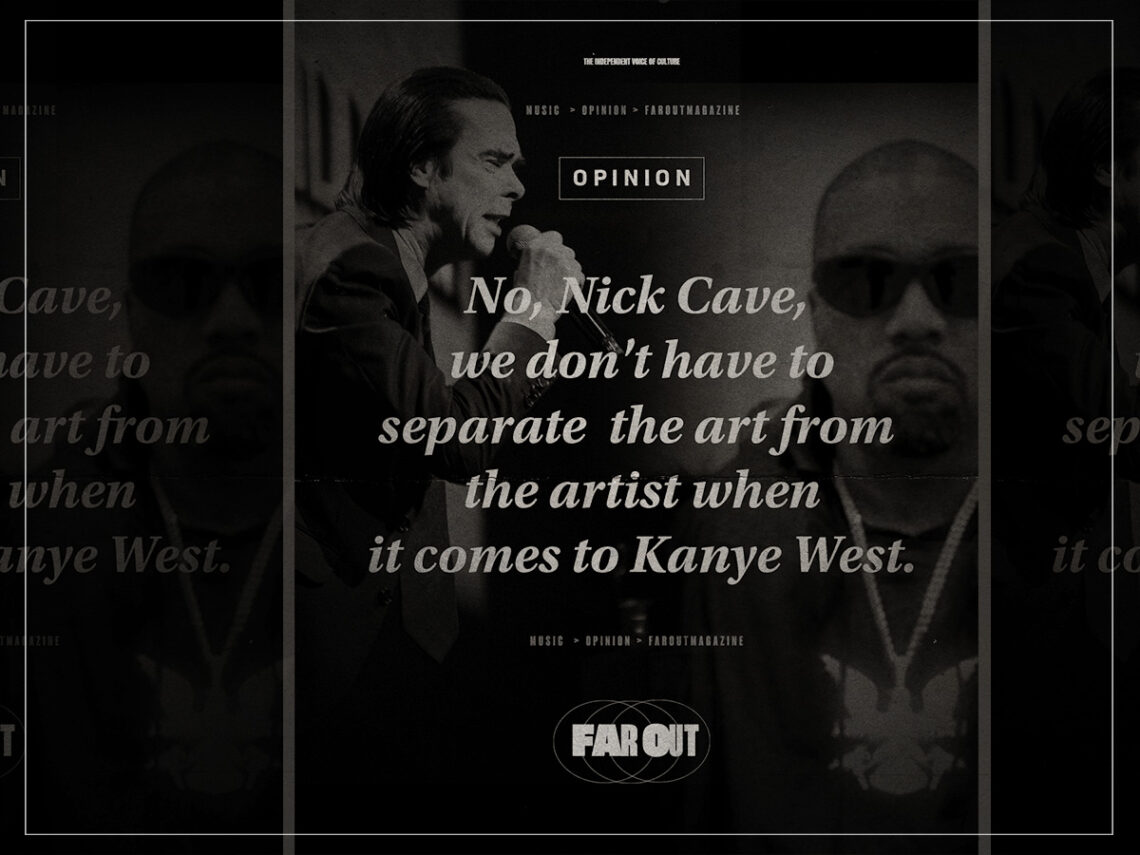
No, Nick Cave, we don’t need to separate the art from the artist when it comes to Kanye West

In the past month, Kanye West has proclaimed, “I love Hitler”, begun selling t-shirts emblazoned with a swastika on his official website, and, to borrow Nick Cave‘s own words, “coerce[d] [his] girlfriend into standing naked on the red carpet at the Grammys”. All of this proved problematic timing for the Bad Seeds singer, who recently chose ‘I Am A God’ by the disgraced rapper as the song he would like played at his funeral after discussing his love of West’s music on Desert Island Discs.
Following criticism from fans for this apparent show of support – at least for Kanye’s music – Cave has clarified his stance. “The great gift of art,” he writes on his Red Hand Files website, “is the potential for the artist to excavate their interior chaos and transform it into something sublime. This is what Kanye does. This is what I strive to do, and this is the enterprise undertaken by all genuine artists. The remarkable utility of art lies in its audacity to transfigure our corrupted state and create something beautiful.”
Such florid language seems sorely out of place. It is self-evident that any artist expressing support for a regime that exterminated millions of people should be disregarded. Veneration is patently ill-advised. Any support for the notion of separating the art from the artist, no matter how nuanced and reasoned, at a point where fascism and antisemitism are both observably on the rise, seems sorely misguided. It is also clear from the comments and responses to West’s remarks that he is actively fueling the ugly resurgence of fascistic views and racism.
I prefer my ‘artists’ a little less despotic than that. While that might sound glib, it is a differing stance derived from the fact that Cave is himself an artist, fighting for an idealised view of the revered power of art. In essence, Cave claims that while West’s recent actions deserve criticism, his art represents the best of him, and we should never “invalidate the best of us in an attempt to punish the worst”. But he needn’t bother—art can take care of itself without West or any remarks that tacitly shield him and his work from the condemnation warranted.
He’s right—art is humanity at its most “sublime”. But we owe it more than the belief that those once capriciously chosen as cultural heroes, cast in the lucky role, must perpetually remain in that position, without question. The notion that the art of fellows with grade four piano certifications, the ability to throw a few cool lines together, and the confidence to court controversy must be protected and seen as humanity at its most “sublime” is a tired and troublesome one that shackles art to darker, less democratised days.
Every year, millions of musicians release new work—over 100,000 songs are uploaded to streaming services every single day. In the past year alone, I have personally received more than 27,000 submissions of new songs, albums, demos, and EPs. Among them, there are undoubtedly unheralded geniuses who eclipse the talents of West or anyone else presently on the pedestal of public veneration—that is simply a statistical certainty. If you think you’re the greatest in the world, there’s a one in eight billion chance you’re right and a 7,999,999,999 to one chance you’re misguided.
In short, there is an unbelievable abundance of “genuine artists” undertaking the enterprise of “excavating their interior chaos” to “create something beautiful”. Sadly, the vast majority of those geniuses will never be heard by the world at large because we are too busy exalting the same few figures and then batting away any questions about the validity of such unimpeachable idolatry as sordid ‘cancel culture’.
From this standpoint, the notion of separating the art from the artist does not seem to be about protecting the sanctity of human creativity, but rather protecting the enterprise of disgraced creatives. To look at something like Donda and say, ‘Yes, that is humanity at its most sublime’, while the man behind it gleefully relishes in the genocide of six million Jews as one of Hitler’s “good ideas“, is like saying, ‘Yes, he wasn’t perfect, but we mustn’t forget Harold Shipman’s sartorial elegance’, because he wore a tie.
While Cave, indeed, might find joy in ‘I Am A God’, to publicly support it at present feels both dangerous and like a bolt on the door to a future that could offer us something greater. In fact, the most toxic thing about Cave’s decree is the illusion that sustained reverence for West’s art is necessary for humanity. It isn’t. The world of music will go on without him—and it will be better for it.
If Nick Cave really does “endeavour to seek beauty wherever it presents itself”, then he’d be better off looking for pastures a little more beautiful to begin with—beyond the nettlesome mire of ugliness that Kanye West has become.

