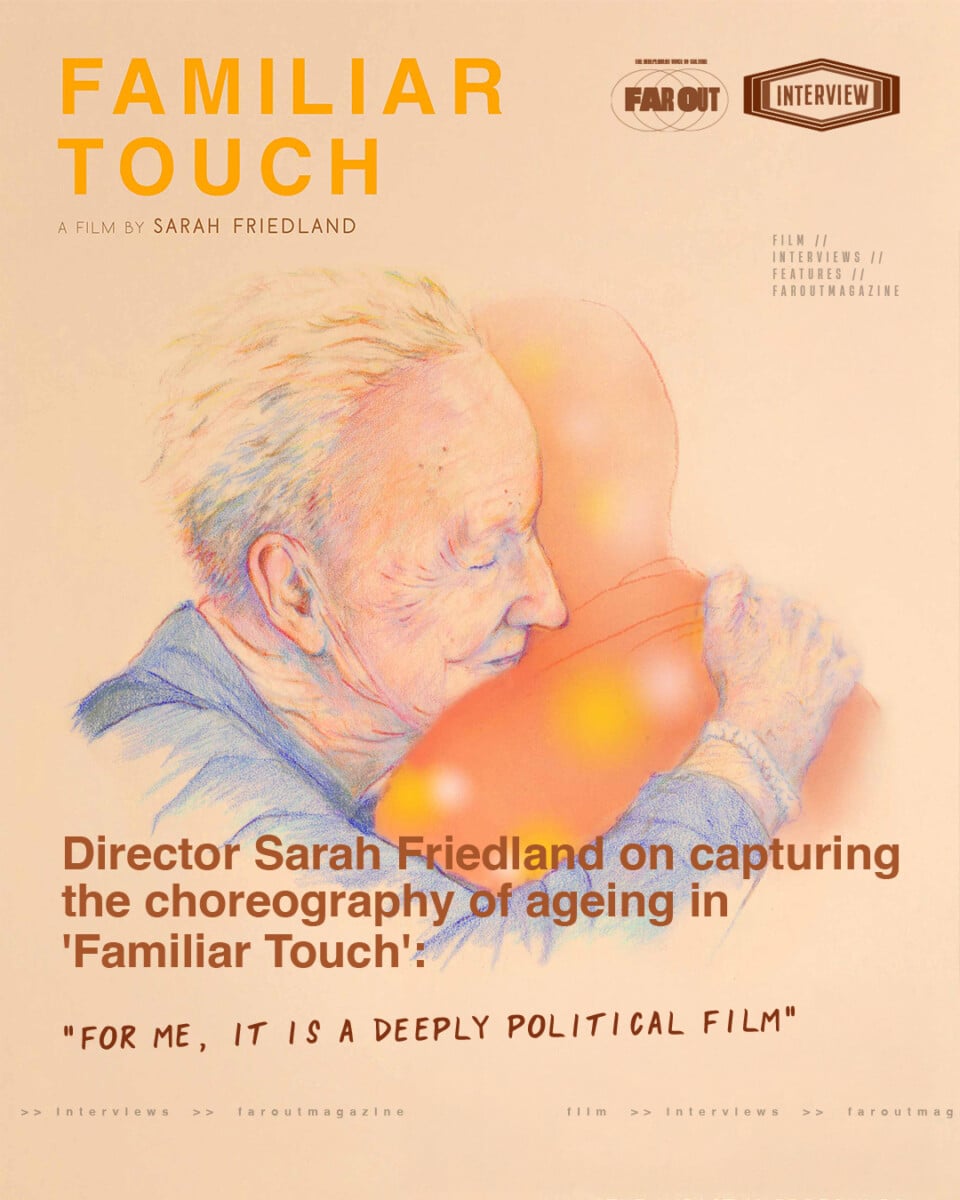
Director Sarah Friedland on capturing the choreography of ageing in ‘Familiar Touch’: “For me, it is a deeply political film”

In the opening scene of Sarah Friedland’s feature film debut, Familiar Touch, which lands in UK cinemas on June 19th, our elderly protagonist Ruth (Kathleen Chalfont) moves about her home preparing for a visitor.
We watch as she thumbs through clothes in her closet, dresses, and meticulously assembles a meal. When her visitor, a younger man played by H John Benjamin, arrives, she flirts shamelessly, hesitating only briefly when he reveals that he’s married. “Oh well,” she says breezily. “I’m married too.” Later, when he drives her and a suitcase of her clothes to a care home, we discover that he is the son she no longer remembers having.
Familiar Touch tells the story of Ruth’s dementia and adjustment to her new home through her experience rather than the observations of those around her. As such, it isn’t a film about forgetting, but about constant discovery. Some discoveries are painful. When her son tells her who he is, she responds incredulously.
“I didn’t want kids,” she says flatly. “I’m not a mother.”
Others are quietly overwhelming – orienting to an unfamiliar room, learning which pills she takes and why, watching her fellow residents navigate their shared space under the heavy lights of a midnight hallway. Over her years-long process of writing the film, Friedland drew upon her experiences working as a caregiver for dementia patients for three and a half years, particularly when it came to portraying the sensory experience of her protagonist.
“Something that I think a lot of people don’t know about dementia and memory loss is that as much as your cognition declines, for a lot of folks, their other senses are heightened,” Friedland said in a recent interview with Far Out. “Even the disinhibition that is typical of memory loss leads to a different relationship to physicality.” From those first moments when we see Ruth moving through her own home for the last time, it’s her movement that consumes the frame, the routine of how she wordlessly navigates her space.
Later, in her new home, we watch as she becomes acquainted with her surroundings through her senses. We hear her uneven breathing as she lies awake in bed the first night, the sheets hissing as she adjusts her position. We watch as she floats in a sun-dappled pool and stands in a steaming shower, remembering, again, that she has a son.
“We tend to think about people in our society as sort of being walking brains, and that their memory and their cognitive expression is foregrounded,” Friedland said. “But we are all of our senses. We are all of the things we have. We touch and smell and taste and feel, and so we wanted the character study to show a character that is herself through more than her mind.”
To create a greater sense of intimacy with Ruth and her sensory experience, Friedland and sound designer Eli Cohn built a soundscape that does the opposite of what most movies do. Instead of blocking out ambient sound, they dialled it up and layered it in, creating a sonic palette of birds, water, breath, traffic, rustling leaves, and cutlery that drops us into Ruth’s world. Her heightened senses are audible, and as we watch her move through her days with little context between each scene, her new life becomes an embodied process of discovery for us as well.
One of the inspirations for Friedland’s script was a client she worked with early in her time as a caregiver. The client used a walker when she was out in public, but when she was at home, she relied on a complex network of furniture and static surfaces. The director, who has a background in choreography, became fascinated with this sophisticated adaptation to physical limitation.
“She would have pathways through her home that she had memorised in her body, even though she had cognitive impairment,” Friedland recalls. “Memory was an issue for her cognitively, but physically she created these detailed pathways… And it was absolutely a choreography. It was this precise pattern, and I found it beautiful.”
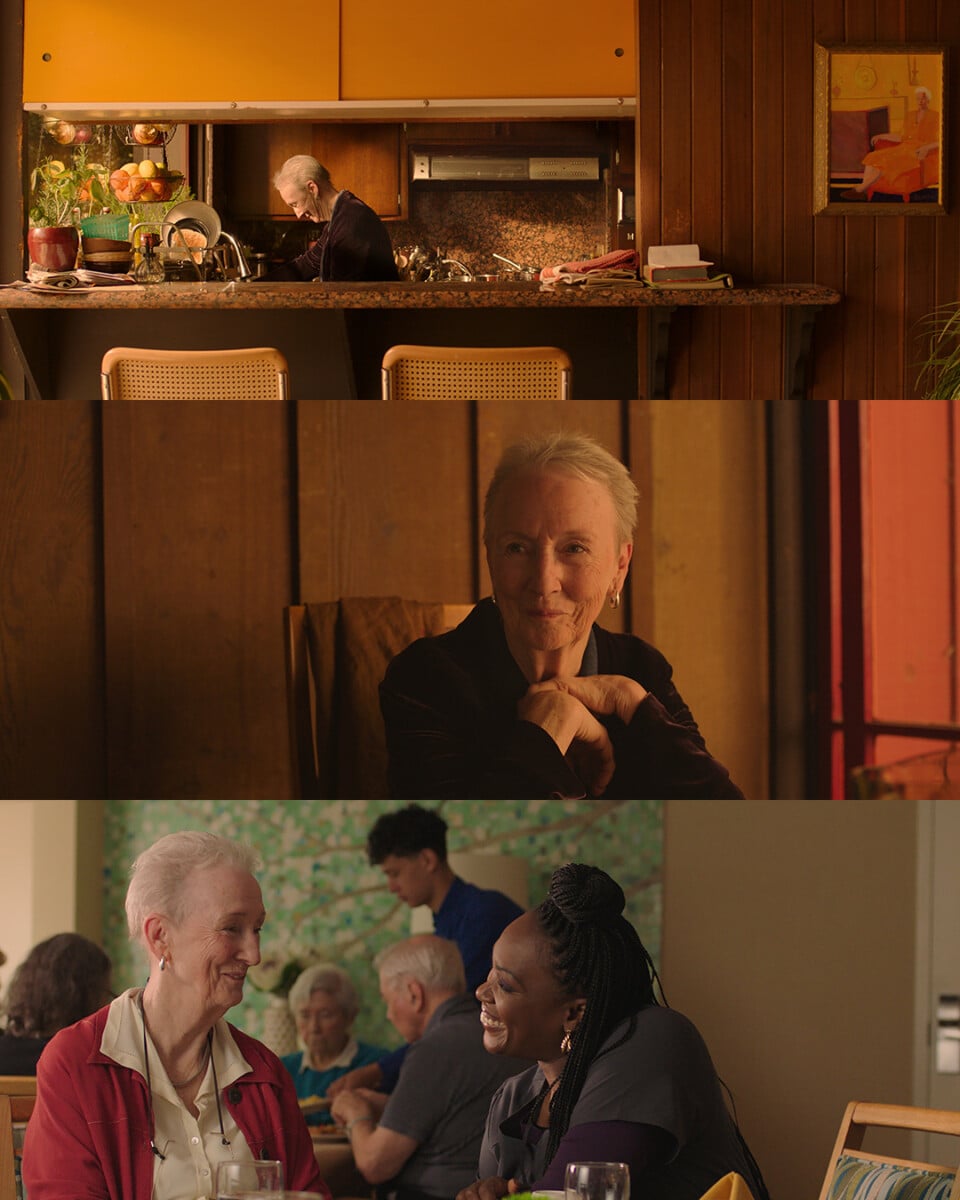
The experience made her realise that, to understand what her clients needed, she had to slow down and observe how they moved. “If you’re not still enough, you might not notice,” she said. “And within that kind of stillness and patience, the beauty of gestural detail emerges.” This became the guiding aesthetic of the film as well. Early on, she and cinematographer Gabe Elder realised that they needed to give Chalfont uninterrupted time and space for her movement to convey meaning.
Through her extraordinary performance, Chalfont reveals Ruth’s past and present with hardly any dialogue. She exudes gravitas simply through her posture, and when she does speak, her voice is clear and deep, as weighty and authoritative as a judge handing down a sentence.
What emerges most powerfully through this quiet performance is not that Ruth is losing her grip on reality, but that she is simply transitioning into a new chapter of her life. Far from being a tragic figure, she blazes with observation and personality. Through that early interaction with her son and later interactions with Carolyn Michelle’s care worker, Vanessa, we get a sense of a woman who was fiercely independent throughout her life and who remains independent now.
In one extraordinary scene, she storms into the care home kitchen, apologises for being late, and takes over from a young cook who stares on, with bemusement, as she deftly slices grapefruit and arranges each plate into a work of art. Her memory loss doesn’t rob her of herself. At moments like this, it allows her to time-travel.
“I think with older adults in general, as soon as they need care, we start seeing them as sort of diminished versions of themselves, as if the need for care is a sort of personal failure, as opposed to a universal experience of interdependence that we have from birth until death,” Friedland said.
“And that is sort of doubly true for women. If you think about all of the tropes about older women, of the little old lady, it’s so deeply infantilising.”
From the outset, she and Chalfont agreed that her characterisation would not come from Ruth’s dementia, but from her past and present. “I didn’t want to come into the process asking Kathleen to play a diagnosis,” she explained. “I wanted Kathleen to play a person.”
There are not many movies that take on the topic of ageing without resorting to clichés of misery or pluckiness. Even ones like The Tuesday Murder Club avoid the realities of old age by portraying their characters as impossibly sharp and spry. The reality is much more complicated and human, and telling that story without condescension or romanticism is no small feat. Brazilian director Gabriel Mascaro’s recent film The Blue Trail does a version of this, following an octogenarian who opts out of her culture’s erasure of the elderly, but few other filmmakers seem interested in challenging the stereotypes of this demographic.
For Friedland, doing so is an inherently political act, even if it doesn’t necessarily look like one for the audience. “It’s maybe not a film that seems political in a didactic or revolutionary way, but for me, it is a deeply political film,” she said. “The care system in the US is so incredibly broken, and ageism and ableism are inscribed in absolutely every part of our culture. For me, just telling Ruth’s story and showing one older woman with agency, with sexuality, with a sense of self, and trying to honour the care workers around her… It’s something.”
Familiar Touch is playing in select cinemas in the UK and Ireland beginning June 19th.