


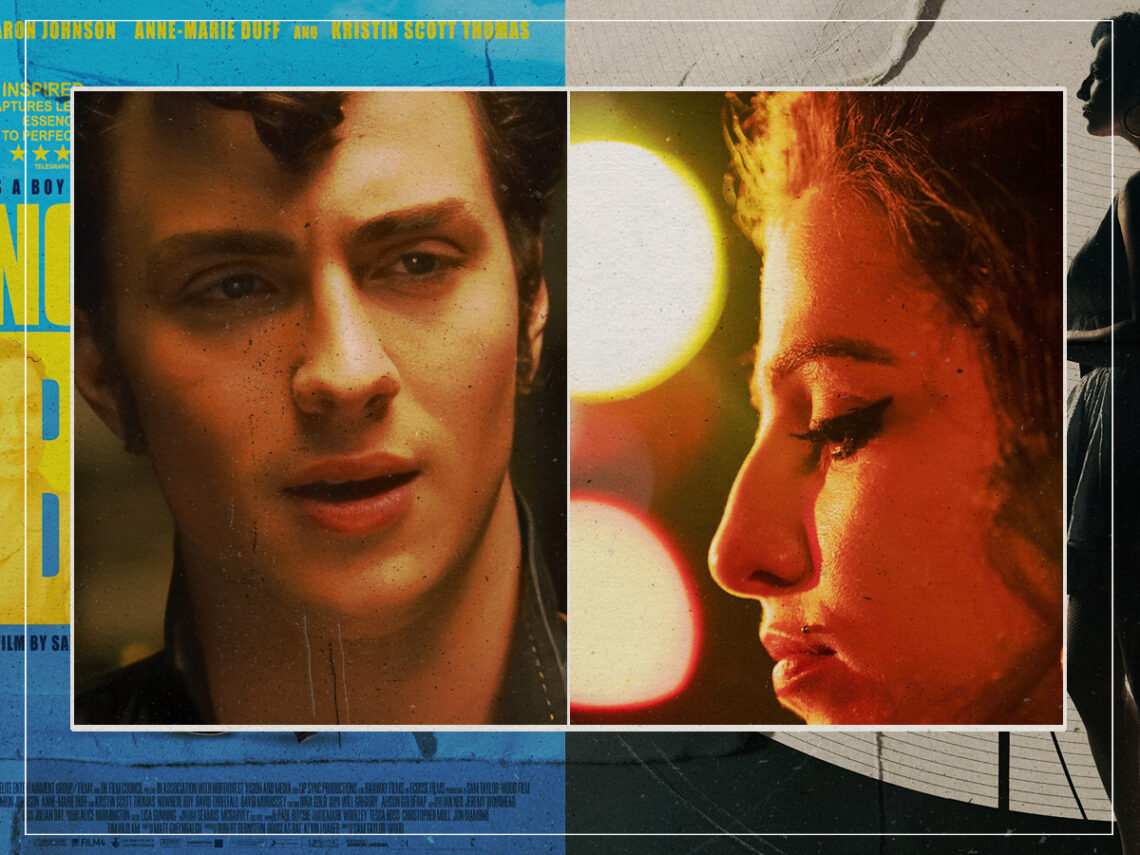
Selective Empathy: Sam Taylor-Johnson’s depiction of John Lennon vs Amy Winehouse

While Sam Taylor-Johnson’s Amy Winehouse biopic Back To Black is hitting the news with a string of critical reviews, it’s a shock to remember that this isn’t her first rodeo. When it comes to taking on larger-than-life figures from history, her failure to suitably depict the nuanced story of Winehouse’s life wasn’t a case of a rocky first attempt. Instead, the sense of disinterest or apathy she handled the star with feels even worse when reflecting on the caring and thorough lens she viewed John Lennon through. In the glaring differences in tone and feel between Nowhere Boy and Back To Black, Taylor-Johnson’s empathy feels problematically selective.
It could be argued that biopics are an impossible feat. No matter how well crafted or how hard a director tries, it’s an unthinkable task to cram years of life into two hours while still building drama and not leap-frogging from moment to moment. Filmmakers are usually forced to pick a lane or decide on an overarching theme or point of the retrospective. Whether it be their career, their origin, their personal life or lesser-known moments in their legacy, biopics demand a succinct and neatly understandable package. That’s bound to always upset someone as dedicated fans will always spot omissions or be up in arms about certain events being skipped over.
But in the case of Back To Black, Taylor-Johnson seemed willing to omit Winehouse’s entire career without replacing it with any new or more in-depth perspective. The biopic simultaneously fell into both camps, being too busy as she attempted to cram the singer’s entire, albeit short, life into one film but also leaving out major moments to give time to others that suit her point. As she time-jumped across the entire process of Winehouse gaining attention, getting her record deal and recording her debut, and then again skipped the release of her landmark album Back To Black, the direction instead seemed to want to fast forward to the singer’s downfall.
While it begged the question of whether the story of Winehouse’s addiction and struggles needed to be retold this soon after her death, it still could have been a worthy story if the director wanted to tell that. If she wanted to focus on the tragedy of the loss, she could have skipped the singer’s career and made an entire film on the final years of her life, her process of recovery and the various reasonings and instances that led to her relapse. She could have done that and handled it with care and a desire to truly understand what led to this happening. She just would have had to dare to let go of the persona and the celebrity, to deal with the person instead.
That’s precisely what she did with John Lennon in the 2009 biopic Nowhere Boy. There’s a sense with that film that you could go in with no knowledge of Lennon or The Beatles and still be hooked into an interesting and emotive tale of a young man working through a tricky family life. As the movie zooms in tightly on his origins in the years before The Beatles even existed, cutting off as soon as the band headed to Hamburg, where they would properly get going, it is a thorough and analytical look at the boy from Liverpool, not the star.
Taylor-Johnson clearly considered Lennon an interesting enough topic to trust that her audience would care about his story alone, without attempting to tell the story of The Beatles in a squashed package. As the movie ends with Lennon’s song ‘Mother’, it feels like the director heard that track and got curious about his past, the maternal figure that made him and who else shaped him into the star the world would come to know. The entire premise of the film can be summed up with the opening lyrics, “Mother, you had me, but I never had you.” In stark contrast, Black To Black barely even includes any of Winehouse’s lyrics, as the involvement of music is limited, let alone considering her inspirations or process. Despite writing incredibly telling and confessional lyricism that paints a clear picture of her psyche, the director rarely leans on them.

That isn’t to say, though, that Nowhere Boy never leans into John Lennon, the celebrity. The film regularly hints towards Beatles moments and deals heavily with the start of Lennon and McCartney’s creative relationship. But it handles it all with such clear yet non-judgemental curiosity. There are flashes of the violence Lennon displayed later in life towards his wife, daring for a moment to point out his flaws but then looking around at his childhood to wonder where it might have stemmed from. It considers his trauma as it deals with his absent mother, their difficult relationship and her death, it hints at the ways that might have shaped him but it doesn’t write Lennon off as an utterly damaged lost cause, destined to end up a violent man. There is a real nuance that is obviously fuelled by the director’s intrigue and her willingness to consider the musician on several levels and through several lenses.
Winehouse didn’t get that kind of treatment. Instead, Back To Black seems to only have one perspective. From the very start, it is littered with comments that all seem to point towards the singer’s addictions and death as a kind of fated inevitability that nothing and no one could have saved her from. She doesn’t bother to consider the role anyone else in the musician’s life might have played or the ways anyone could have helped her. It doesn’t even pause for a second to be inquisitive about why or what might have been behind her sadness. Instead, it tells Winehouse’s story strangely matter-of-factly, just as it’s been told a million times before. As she adds little to it, you don’t get the feeling that Taylor-Johnson is fascinated or interested in her life or that she’s spent time pouring over research or stories of her life. It doesn’t feel like a passion project, whereas Nowhere Boy feels fuelled by her own desire to know the figure better.
It’s a sadly common handling of Winehouse. Even before her death, her work, life and person were handled with palpable disregard and disrespect as she’s regularly mocked or brushed off as nothing but a ‘junkie’. However, there is something especially disappointing in the fact that Taylor-Johnson, a leading female director, would treat her legacy with shallow carelessness, too. There is no denying that The Beatles and Lennon were bigger than Winehouse ever was, but surely their memories deserve the same preciousness in their handling. Surely, Winehouse’s case, with the devastating tragedy involved, deserved the same level of empathy and investment as the story of what made John Lennon tick.
