


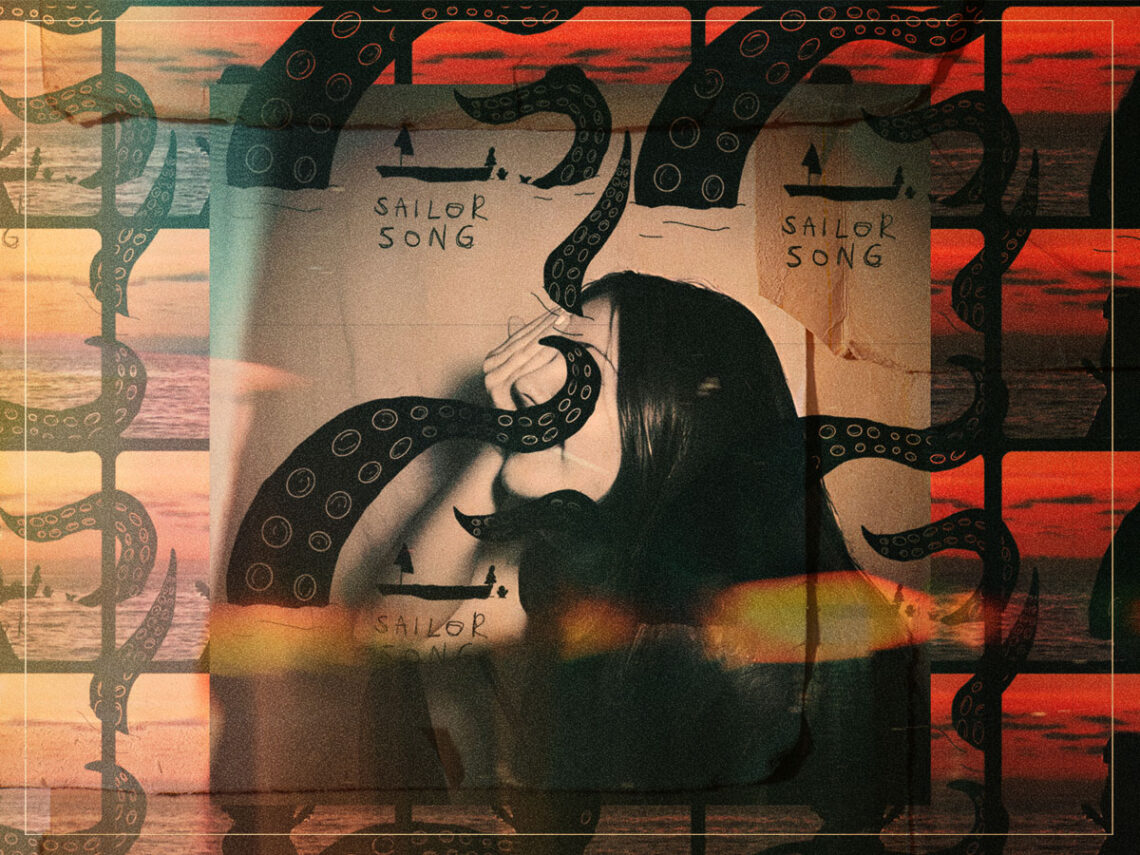
‘Sailor Song’: how Gigi Perez’s queer love song became a defiant anthem for the artist

For those in the know, Gigi Perez has been one to watch for a while. In 2021, within the weirdness and the strange intimacy of the internet during Covid, as people assembled around online videos like music lovers gathering around a fire keen on hearing some beauty, Perez offered up ‘Sometimes (Backwood)’, the first insight into her talent. She’s been busy since, releasing her emotionally sharp debut EP How To Catch A Falling Knife in 2023 and a scattering of singles since. But recently, one has broken through. With the release of ‘Sailor Song’, the singer gained sudden and mass recognition. However, with that comes the inevitable annoyance of misunderstanding on a mass scale.
There are people out there who believe in the idea that art must cater to the lowest common denominator. They argue that that is the reason why TV and film adaptations of books are often bad as to sell something; there can’t be as much nuance. The argument implies that the general public can’t be trusted to understand or appreciate or even simply be patient enough for metaphor or poetic meanings or open endings that don’t spoon-feed them an answer. That’s largely because those who don’t understand will be the loudest, making an artist or a project feel like a failure. In short, it is more straightforward and easier to be simple and easy, cater to the dumbest masses, lay meanings out, making things neat and understandable.
However, Perez has never been like that. From the start, her lyricism is heavy with complexity, and it’s beautiful because of that. Her debut single ‘Sometimes’ can’t really be explained; there is no easy, quick one-liner I could write here to sum up the story of the song in a nutshell as it feels more like an amalgamation of contemplations on longing, lust, regret and anger. ‘When She Smiles’ is another prime example of that, grappling with emotional manipulation without a clear statement of meaning. Or listen to ‘Please Be Rude’ for another masterclass in metaphor by Perez as she tries to figure out her own desire and her own relationship to intimacy.
‘Sailor Song’ is a love track handled with the same kind of expressionistic flair. Its meaning spirals through several spheres; it’s a siren song, with the idea of a siren being associated with something forbidden and dangerous, which relates to sin, then to religion, and then to the historic and enduring homophobia caused by ideas of what is holy or pure. But at the same time, the idea of a sailor is someone passionate and dirty, hinting at a kind of tongue-in-cheek idea of seduction, singing, “Oh, won’t you kiss me on the mouth and love me like a sailor?” as an invitation for lust.

The verses revolve around images of her lover, but the chorus is a straightforward song of pure desire and devotion. While still full of metaphor, it feels like the grandest thing Perez has ever written as she fills it with declarations, singing, “I don’t believe in God, but I believe that you’re my saviour”, as she casts her partner as her salvation.
It’s a metaphor that has been used time and time again throughout the history of art, connecting the concept of love as an all-powerful thing to the idea of God as the ultimate image of that. But as has also been seen throughout history, Perez’s use of the lyric in a song about queerness became the centre of a controversy that not only highlights quite how behind society still lags but also how stupid some ears can be.
Right when the song started to perform well, there was suddenly a chorus of voices calling for Perez to change the lyrics. They took offence to that line about God as Christian creators on TikTok began posting passive-aggressive videos refusing to sing along to the line and asking her to change it. Why those people didn’t simply just turn the track off and listen to something else is a thing of mystery, but instead, they demanded that Perez alter her piece so this community of people who the song was never for in the first place could claim ownership over it.
For one, this is specifically a song about queerness in the face of religion. The full section of the chorus goes, “And when you get a taste, can you tell me, what’s my flavour? / I don’t believe in God, but I believe that you’re my saviour / My mom says that she’s worried, but I’m covered in this favour / And when we’re getting dirty, I forget all that is wrong.” To spell it out, it means that Perez, as a gay woman, is facing up to homophobia but loves and wants her partner anyway.
It also considers her own personal relationship with God as she still sees herself as surrounded by his “favour” or grace, even as her mother worries about the sin of her sexuality. That conflict between traditional religion, love and her own personal religion is the whole point of the song, so the call to remove the mention of God would have voided the entire track. To say it for what it is, the calls to change the lyric feel ironically homophobic against a piece about homophobia and queer love.
Thankfully, Perez knew that and stood her ground. “I never had to consider whether or not I was going to change my song cause it was never up for discussion. My songwriting is not a democracy, and that applies to every other artist’s work,” she said in a statement. In another video, she explained, “I’m not changing the lyrics to ‘Sailor Song’. The piece is written the way that it is for a reason, and I put it in there exactly as it was meant to be written.”
She added, “I’m really happy that it’s connected with so many people, and honestly, it’s up to you. It’s up to you what it means to you. I wrote it for what it means to me,” standing her ground that at its core, her art is for her, not for her audience.
However, the audience Perez has found, through the track’s success, understands and appreciates it all the more for that, with the song being her breakthrough moment and her Billboard Hot 100 debut. Now, in her live shows, as an act of defiance against the cries of censorship, she emphasises that line, continuing to sing her song exactly how she intended it.
