


“A movement afoot”: the sacred Californian spot where the first Acid Test party took off

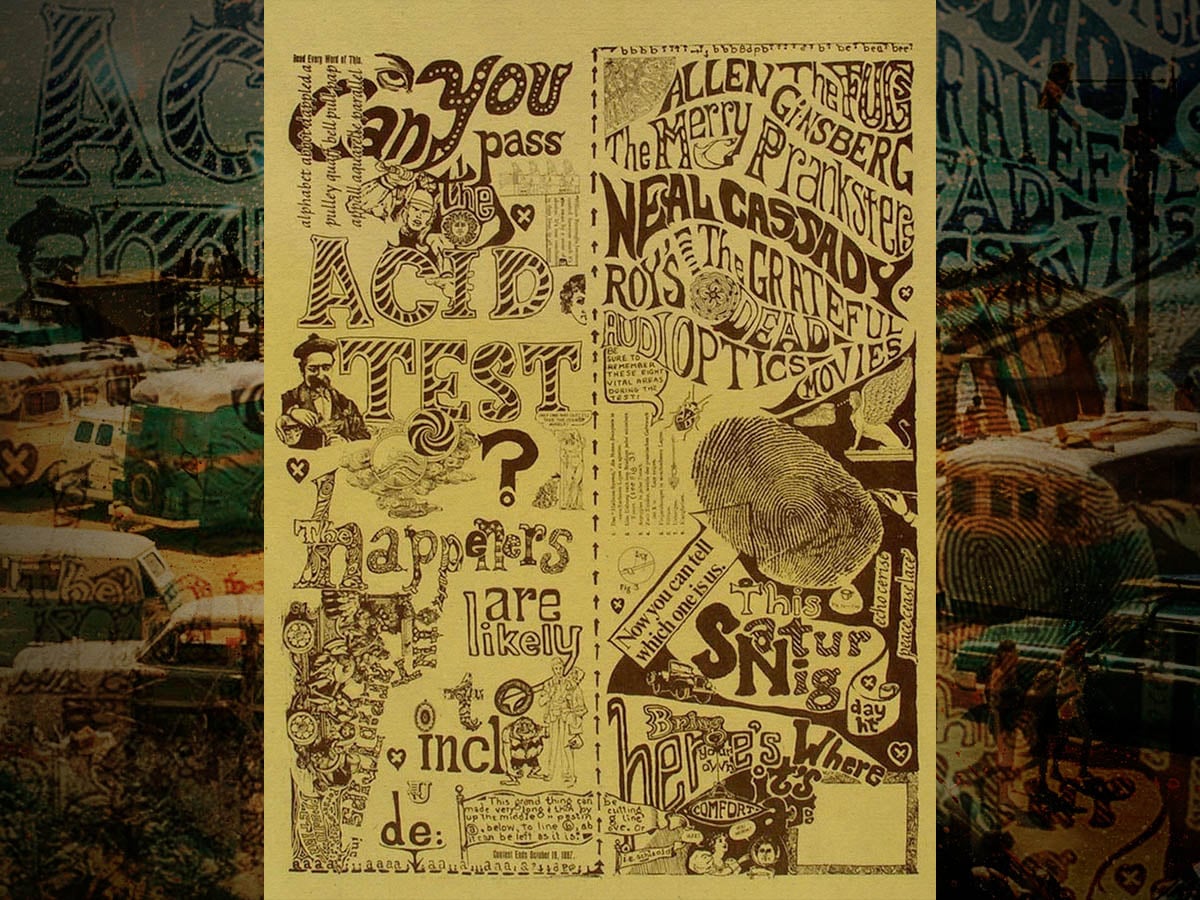
“Can you pass the acid test?” – such was the slogan printed on technicolour handbills and posters advertised between 1965 and 1966, a pivotal period in the counterculture.
They were created by author Ken Kesey, known for writing the 1962 novel One Flew Over the Cuckoo’s Nest, a fictional study of psychiatry and institutional treatments, and later made into a film starring Jack Nicholson. During this time, Kesey was involved in Project MKULTRA, an illegal human experimentation program carried out by the US CIA to develop procedures and identify drugs that could alter human behaviour.
Kesey claimed that he was subject to such experimentations without his knowledge. At the time, in 1959, he was completing a graduate fellowship at Stanford University and training for the 1960 Olympics team as a wrestler. His neighbour, psychologist Vic Lovell, invited Kesey to the trials.
“I’d never been drunk on beer, you know, let alone done any drugs. But this is the American government,” Kesey reflected on Fresh Air in 1989. “They said, ‘Come in here. We’ve just discovered this new spot of space, and we want somebody to go up there and look it over, and we don’t want to do it. We want to hire you, students.’ And I was one of 140 or so that eventually turned out.”
Kesey claimed that he had no idea the operation was CIA-sponsored until Allen Ginsberg (who, for a long time, Kesey believed to be merely paranoid) unearthed the records that revealed the CIA’s involvement. He was essentially thrown into the experiments with no preparation, but went in with somewhat of an open mind.
“We just happened to come at a time when it was not only a lot of stuff happening chemically,” he explained, “There was a lot of new changes in music and in film. Burroughs was just beginning to do his work in literature, and there was a movement afoot that this was just a part of.”
It was during these experiments that he was first introduced to LSD. “We suddenly realised that there’s a lot more to this world than we previously thought,” Kesey said, noting that his experiences taking the drug informed him “that there is room, spiritually, for everybody in this universe”.
Housed in the Menlo Park Veterans’ Hospital, Kesey began garnering inspiration for what would eventually become One Flew Over the Cuckoo’s Nest. “I saw that these people have something going, and there’s a truth to it that people are missing,” Kesey explained. He got a job at the hospital working as a night aide, writing the book during his shifts, when he discovered that he had access to the doctor’s offices, where the drugs were kept.
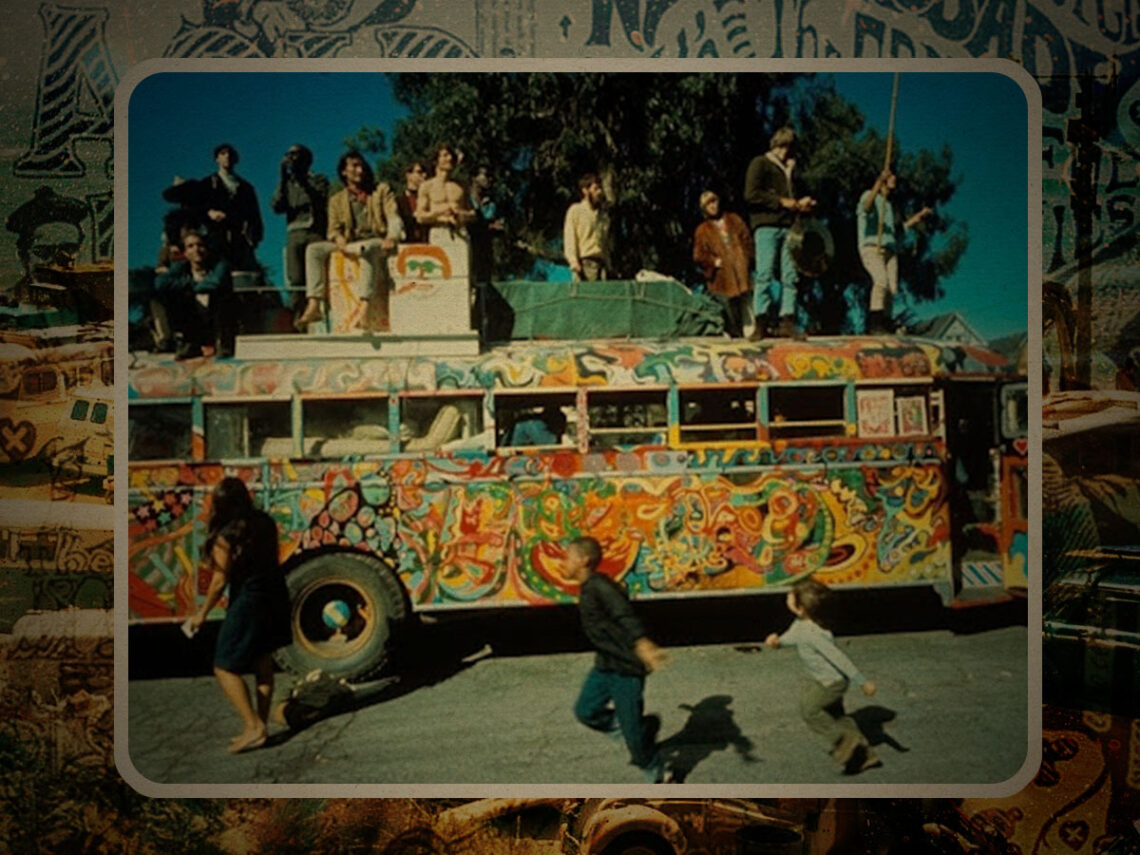
Kesey followed the novel with his second, Sometimes a Great Notion, in 1964 (later turned into a film in 1971, directed by and starring Paul Newman), and travelled to New York for its publication. For the trip, he rounded up a group of friends, including writer Neal Cassady and, calling themselves the Merry Pranksters, embarked on a cross-country road trip in a school bus, which they nicknamed Furthur.
Armed with an arsenal of drugs – including LSD, Benzedrine (or “speed”) pills and marijuana – they filmed their escapades while travelling from La Honda, California, to New York, which would be further immortalised in Tom Wolfe’s pioneering work of New Journalism, The Electric Kool-Aid Acid Test.
After this trip, the Merry Pranksters began to throw their infamous Acid Tests around the San Francisco Bay Area. Their incentive was to advocate for the use of LSD, involving chemists, including Owsley Stanley (the sound engineer for the Grateful Dead, named the ‘Acid King’) and Tim Scully. The parties would become central to the influence of acid across the San Francisco counterculture, bridging the gap from the Beat Generation of the decade prior.
The first-ever party was held at musician (and fellow Merry Prankster) Ken Babbs’ house in Soquel, California, on November 27th, 1965. Many sources claim that the band the Warlocks (who would later become the Grateful Dead) were present at Soquel, as Phil Lesh confirmed in his book, Searching for the Sound, writing, “We were at the first Test not to play, but just to feel it out, and we hadn’t brought any instruments or gear.”
Many parties would be thrown over the next year across the West Coast, including San Jose (where the Grateful Dead played their first show on December 4th, 1965), Palo Alto and Los Angeles in California, as well as Portland, Oregon and Houston, Texas. LSD would be made illegal in California in 1966, under Governor Ronald Reagan’s administration, and criminalised in 1968. But, for a short time, Kesey’s simple question of, “Can you pass the acid test?”, prompted an unforeseen revolution.
