


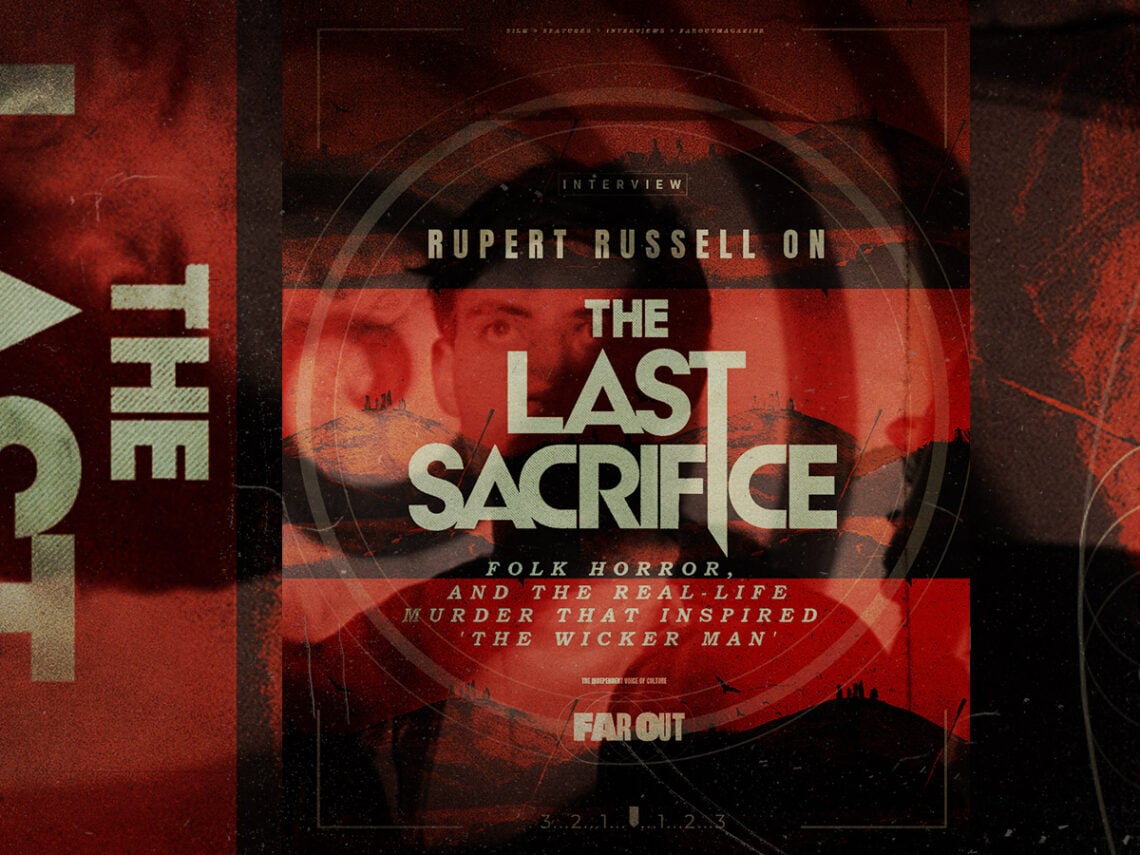
“Britain’s collective nervous breakdown”: Rupert Russell on ‘The Last Sacrifice’, folk horror, and the real-life murder that inspired ‘The Wicker Man’

On Valentine’s Day, 1945, a 75-year-old farmer named Charles Walton was found murdered on the slopes of Meon Hill in Warwickshire, England. When his niece and her neighbour found the body, they were horrified by the disturbing violence involved in his killing. The crime shook the sleepy village, which had never experienced anything like it before, and the local police felt they were in over their heads.
They quickly sought the help of the Metropolitan Police, who dispatched Chief Inspector Robert Fabian – a man who would later become a famous TV personality – to investigate. Over time, the case became the subject of outlandish theories involving witchcraft, black magic, Shamanism, and ritualistic sacrifice, and it would heavily inspire the creation of the classic 1973 folk horror film The Wicker Man.
When documentary filmmaker Rupert Russell first watched that unforgettably skin-crawling classic of British horror cinema, though, he’d never even heard of the Walton case. Amazingly, he didn’t see the film when he was growing up, instead revealing, “I had not watched The Wicker Man until 2022. It was one of those films that had been on my list to watch, as often people have classic films they’ve never seen. I got around to watching it, and it was great.”
Russell, who describes himself as “a concept-driven filmmaker and author”, has been building an impressive, highly varied CV over the last several years. He is the documentarian behind Price Wars, a wide-reaching film about commodity markets and how they directly affect our chaotic world, and Freedom for the Wolf, a stirring documentary about the struggle for freedom encompassing everything from #BlackLivesMatter to the Umbrella Revolution in Hong Kong.
As he watched The Wicker Man, the aspect that struck Russell the hardest was how a particular moment made him feel. As Edward Woodward’s Sergeant Neil Howie is being led to the towering, ominous wicker behemoth to meet his grisly fate, he pleads with the islanders, who have rejected Christianity and plan to sacrifice him to their ancient pagan Gods.
“Don’t you see that killing me is not going to bring back your apples?” he screams. Instead of listening to reason, though, they burn him alive. “He’s pleading with them, and everyone’s just shaking their heads like, ‘This guy’s a nutter,'” Russell marvelled. “And I was just like, ‘That is what it feels like to live in Britain right now.'”

“I started doing my own internet sleuthing on who this character Charles Walton was,” Russell explained. “And I just thought, ‘Wow, what an amazing story that nobody’s heard of. There was actually a real murder that inspired The Wicker Man. Why has nobody made a film about this? And that was the genesis of the project.”
Interestingly, when his ideas for The Last Sacrifice began synthesising, Russell wasn’t exactly an expert on folk horror. He didn’t see this as a hindrance; instead, he saw it as he does every other creative endeavour he’s ever worked on: as an opportunity for discovery. “Every project I do, I start off knowing nothing about it,” Russell chuckled. “I mean, I wrote a book and did a documentary on commodity speculation, which was a lot of work to figure out how that was a great story!”
Russell didn’t have to work hard to see the compelling story in the Walton case, though. Aside from it simply being a fascinating true crime tale, he was also drawn in by how closely The Wicker Man and subsequent films of its ilk – such as those cranked out by Hammer – mirrored its real-life chain of events in their own stories.
“The Walton murder provides a very prescribed formula,” he offered. “Which we kind of go through in the film. You’ve got the outsider, the village conspiracy, the blood sacrifice to the land.”
Through an exploration of the Walton murder and its influence on British folk horror storytelling, The Last Sacrifice expands into a documentary about the very soul of Britain in the ’60s and ’70s. Russell draws a parallel between Howie’s mental breakdown in the face of a pagan cult going back to the “old ways” and the “collective nervous breakdown” experienced by a British society whose mores around “nudity, religion, and sexuality” were collapsing in that period of vast change. The embrace of Wicca in that era – a uniquely British invention – also signalled a “collapse of modernity into something older. It could be not just something pagan but something feudal as well.”

When asked what he wanted to achieve with The Last Sacrifice, Russell said something unexpected. However, it makes perfect sense when you think about it through the lens of the genuine footage the film uses of real-life witches and cult members performing their elaborate rituals in a grotty British front room or social club. “I just want people to have a good laugh,” he smiled. “Really. I mean, I think it’s a black comedy”.
Obviously, the murder of Charles Walton is no laughing matter – but the way the bizarre theories surrounding it were co-opted by storytellers and real-life dabblers in the Occult most certainly is. Russell wanted to “highlight the absurdity of British people…but also acknowledge there’s a dark side and a self-destructive side to the UK as well and our politics, which sadly, we can’t quite get away from.”
Russell revealed that a distribution deal for the documentary is in the works, although he couldn’t spill the beans on where and when it will be made available. However, he was excited for it to play at the Glasgow Film Festival in March 2025. As for his career going forward, he has two narrative horror features in development, in addition to another couple of documentary projects he’d love to make.
Sadly, Russell admitted that the documentary market isn’t quite as strong as it may appear to outside observers – unless you’re making a true crime film or series, that is. “Two years ago, everybody just wanted true crime and music docs,” Russell explained. “Now they only want true crime docs every year. There’s kind of a, like, a narrowing of the field, and it’s sad, really.”
To illustrate his point, Russell noted that only one feature documentary was sold at the recent Sundance Film Festival: Perfect Neighbour, a harrowing story about Florida’s gun regulations, which Netflix bought for around $5million.
In truth, Russell admitted that the true crime elements of The Last Sacrifice – even if they lead to a much more expansive journey through history, politics, movies, and witchcraft – certainly helped get it greenlit. “It definitely makes it an easier sell,” he noted, hinting that sometimes you must play the game a little to tell your story. Still, he can’t wait for the doc to reach a wider audience, and he promised, “The film will be available for your readers to see at some point this year.”

