


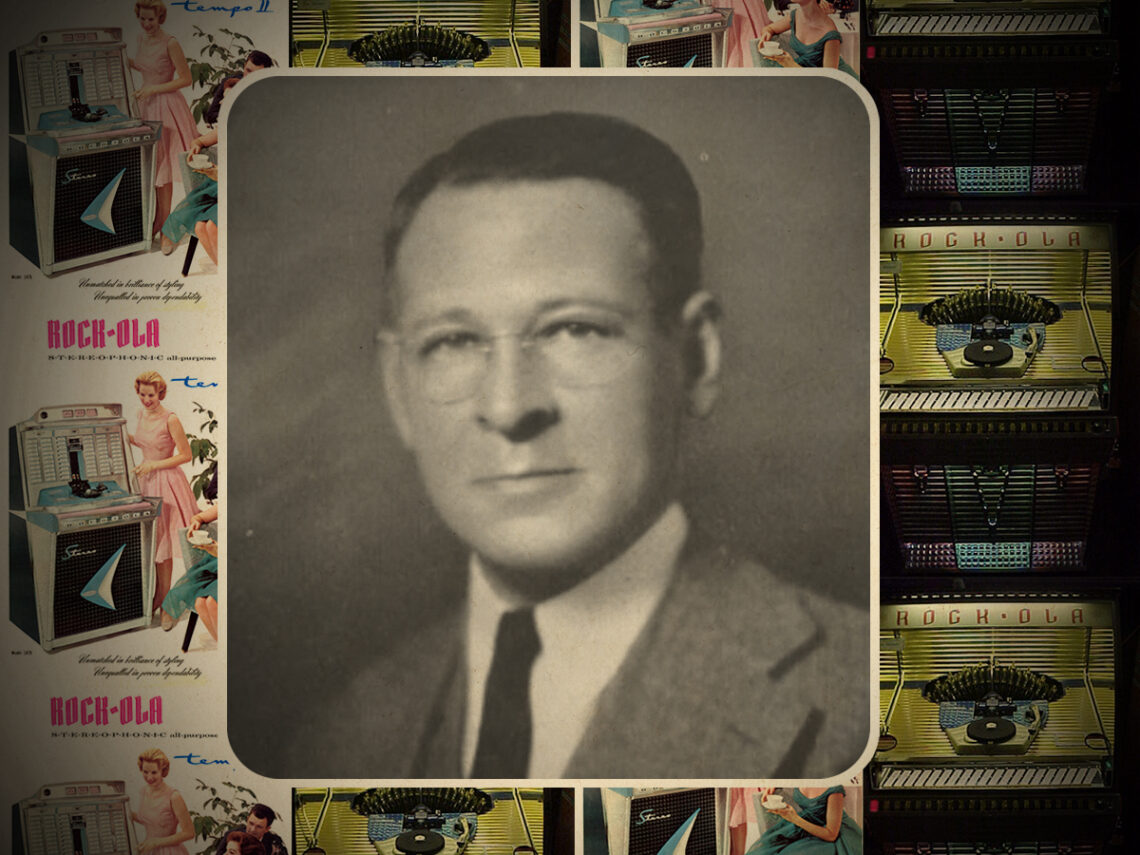
David Rockola and ‘Rock-Ola’ jukeboxes: the true inspiration for the term ‘rock and roll’?

Whether you’ve had a milkshake at one of those 1950s retro diners or a pint inside a conspicuously un-renovated dive bar from the ‘70s, it’s quite likely you’ve encountered a Rock-Ola jukebox.
As one of the big names in the industry alongside Wurlitzer, AMI, and Seeburg, the Chicago-based Rockola Manufacturing Company shipped its musical machines all over the world, achieving iconic status during the days of Elvis, Buddy Holly, and Chuck Berry.
As a result, many people have understandably assumed over the subsequent decades that the name Rock-Ola itself must have been a reference to the rise of the music genre their machines helped popularise: rock ‘n’ roll. The brand even sounds like an update on the old phonograph players of the early 20th century, like the ‘Victrola’.
But, incredibly enough, Rock-Ola was merely a man: David C Rockola, a Canadian dealer of coin-operated machines who got into the jukebox business in the mid-1930s, well before the concept of “rock” music had emerged. He’d stylised his trademark as “Rock-Ola” with a hyphen, supposedly, so people would pronounce his name correctly.
It sounds vaguely Italian, but David Rockola’s heritage was actually Russian, and when he went into business in Chicago in the 1920s, it was the Irish mob that he fell in with, helping the gangster James ‘High Pockets’ O’Brien run a slot machine gambling syndicate across the city. That little racket landed Rockola in prison in 1929, just after the stock market crash, leaving his future looking mighty bleak at 32 years of age.
Embracing his freedom and a second chance in the 1930s, though, Rockola bucked the odds and took the upstart Rockola Manufacturing Company to new heights in the middle of the Great Depression. Along with various coin-op games, the company started building coin-op phonographs – the predecessor of the jukebox – around 1934. Shortly thereafter, Rockola’s illuminated, Art Deco machines started popping up in clubs and diners all over the country, introducing a totally new way to experience music, free of the radio DJs’ whims.
“Back then,” Rockola said many years later, “If someone had a new song, the first thing they wanted to do was get it on a jukebox, because that’s how everyone would hear it. It was the way people got to hear music—it was very important to them.”
After World War II, a new boom period began, as Rock-Ola jukebox designs began mirroring the over-the-top trends of the automobile industry. Models like the ‘Comet Fireball’ and ‘Rocket’ became synonymous with the exciting new sounds of rock n’ roll – a genre supposedly coined by the Cleveland, Ohio radio DJ Alan Freed in the early 1950s.
Many factors are thought to have contributed to Freed landing on that terminology, including loose uses of the phrase among the African-American community as a reference to sex. It’s hard to completely disregard, however, the pre-existing prevalence of the name ROCK-OLA as the leading public vehicle for that new type of rhythm and blues music of the ‘50s. If you had a nickel and a notion, all you had to do was walk up to the Rock-Ola machine, and the whole room would soon have your attention.
“They used to call it the poor man’s opera,” David Rockola’s son, David Jr, told the Associated Press in 1974. “And it’s true. The jukebox is a completely democratic institution. Anyone can put his money in, pick a song, and nobody else has to listen to it until the next one comes along with his money.”
The communal nature of the Rock-Ola jukebox as a means for hearing new music and essentially vetting songs made it a massive part of the rock ‘n’ roll revolution. As for whether the machines and their manufacturer deserve more credit for inspiring the actual name “rock n’ roll”, that will probably always remain a matter of some debate. One thing’s for sure, though. A man has probably never had a surname more cosmically destined for an unforeseen commercial use than David C Rockola.
