


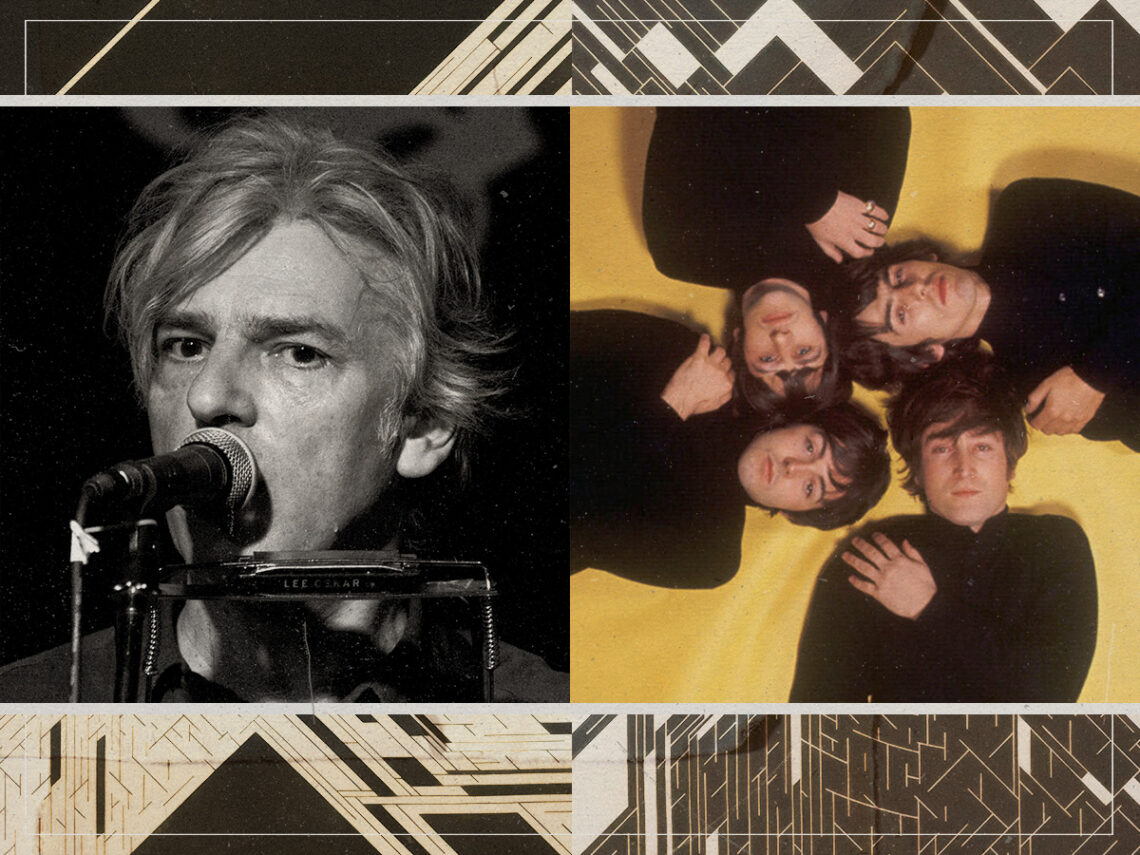
“Superb songs”: Robyn Hitchcock on his favourite album by The Beatles

In popular music, some seem to get lucky, and others make their own luck. Robyn Hitchcock, the founding frontman of The Soft Boys, was in the latter camp. Inspired by music of all shapes, sizes and locations from a young age, he set himself the task of combining disparate influences in an original package. Commercial success has never been of huge importance to Hitchcock; instead, he maintains artistic dignity by honing the skills required to scratch his creative itches.
During his formative run with The Soft Boys, Hitchcock played electric guitar and often contributed to bass parts in the studio. Over time, his longstanding affection for Bob Dylan and traditional British folk music also led him to embrace acoustic styles and the harmonica. Although The Soft Boys formed in Cambridge during the start of the UK punk wave and upheld some of the genre’s characteristics, they were never invariable or unrefined enough to be described as a punk group.
While The Soft Boys never enjoyed major global success, their blend of punk, folk, and psychedelic rock earned them a cult following on both sides of the Atlantic. During their initial run, they released just two albums. The latter, Underwater Moonlight, is today recognised as an underground classic and was hugely influential on prominent bands of the 1980s, including Pixies, The Smith, R.E.M., The Replacements, and Yo La Tengo.
When The Soft Boys split up in 1980, Hitchcock pursued what has become a satisfying and highly successful solo career. Like Yo La Tengo, with whom he has collaborated on several occasions, his catalogue displays impressive eclecticism, from the Syd Barrett-tinged ‘I Often Dream of Trains’ to the classic rock ‘n’ roll sound of ‘I Pray When I’m Drunk’.
As a blatant celebrant of idols like Dylan, Barrett and The Beatles, Hitchcock is rightly regarded as a crucial link between the 1960s and the indie rock movement. Speaking to Spin in 2021, Hitchcock identified Dylan and the Fab Four as his two most important influences, noting their impact on one another in the 1960s. “Bob Dylan, like the Beatles, peaked in 1966—they accelerated on the same momentum train and influenced each other a lot,” he said. “If the Fabs were brothers, Dylan was their barbed, visionary, super-literate American cousin.”
Hitchcock noted that, while The Beatles split up into four less impactful solo artists, Bob Dylan would have found splitting up with himself harder than persevering with his career through thick and thin. Though Dylan’s mid-1960s heyday was invaluable to Hitchcock’s success, his favourite album, Time Out Of Mind, arrived some three decades later.
For Hitchcock, only one album ranks higher than Time Out of Mind, and that’s The Beatles’ Revolver. His all-time favourite album has stuck with him for over 55 years, and he regards it as perfect in every way. “14 superb songs by three brilliant songwriters who played and sang on each other’s material, like three brothers from the same musical academy,” he praised. “Written and recorded at the zenith of our species’ cultural momentum, when I personally was mutating from an old child into a young adult.”
Hitchcock was just one grain on a beach of Beatlemaniacs who kept the flag aloft after the Fab Four’s breakup. “Beatles’ songs became the template for everything I and many of my contemporaries have written,” he concluded. The influence of The Beatles and Revolver, especially, can be heard in The Soft Boys’ classic song ‘Kingdom of Love’.

Never Miss A Tale
The Far Out Bob Dylan Newsletter
All the latest stories about Bob Dylan from the independent voice of culture.
Straight to your inbox.