


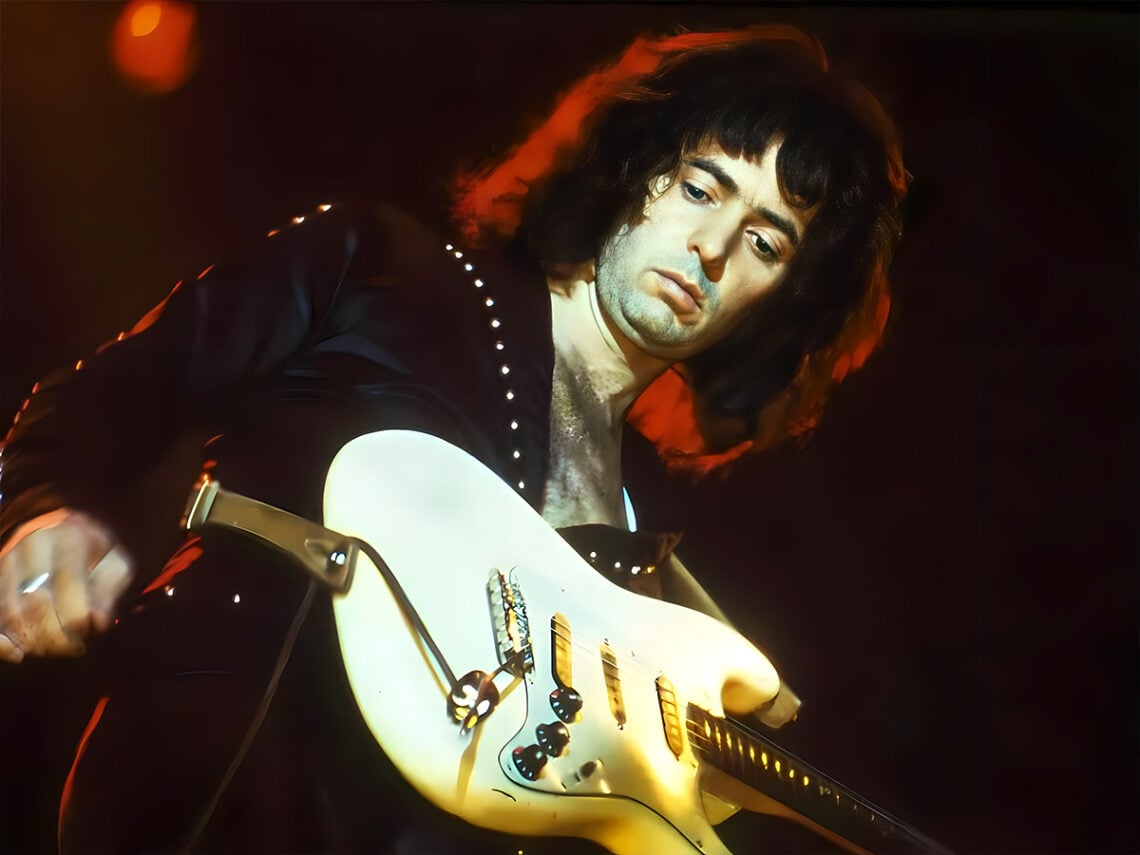
Ritchie Blackmore’s first-ever guitar playing “idol”

Tracing the lineage of music influence back can often be an enjoyable yet predictable journey for a music lover. But it’s necessary learning for any fan who adores the band they’ve moulded their personality on. Whether it’s hearing Noel Gallagher talk about The Stone Roses or anyone discussing The Beatles, it feels like taking a history module in the University of Music fandom. Ritchie Blackmore and Deep Purple sit firmly along that line of musical influence.
Along with Black Sabbath and Led Zeppelin, a group often coined “The Unholy Trinity”, they have written a blueprint for progressive rock that has been followed thereafter.
While the riff for ‘Smoke On The Water’ has been played in bedrooms all over the world, on guitars that were bought just five minutes prior, their discography is a catalogue of hard rock riffs, and lively drum fills that have gone on to be repurposed in modern music. While they’re credited for the influence of Queen and Aerosmith, they’ve been a direct muse in the trajectory of Metallica’s career.
In an interview with Louder Sound, Metallica’s drummer Lars Ulrich recalled seeing Deep Purple as a child at Copenhagen’s KB Halle. “I was just infatuated. Not just with the music but the event: the people, the volume, the reverberation, the light show, the whole thing”.
Along with the devil horns and axe-shaped guitars, Deep Purple embodies classic rock. But they achieved that status by laying the bricks in the genre’s foundation, creating a sound along with their peers that didn’t exist before them. So it begs the question, who did they draw upon for their influence?
During the 1960s, when Deep Purple guitarist Ritchie Blackmore would have been in his late teens, the landscape of guitar music was largely wrapped up in rock-a-billy pop and dense folk finger-picking. The sort of heavily reverberated guitar lines and crunching power chords that defined the decade thereafter hadn’t properly been established.
Amid all the ways the guitar was being played during that decade was Duane Eddy, with his characteristically “twangy” sound. In music that fused psychedelia, country, and rock, Eddy captured the hearts of an audience searching for difference with his standout tracks ‘Rebel-‘Rouser’, ‘Peter Gunn’, and ‘Because They’re Young’.
It was a style of guitar playing that utilised the lower strings of the guitar, harnessing the bass capabilities of the instrument, that would clearly go on to influence a young Blackmore. In a heartwarming full-circle moment, Blackmore shared that Eddy, his “all-time first hero,” had gifted him his iconic Duane Eddy Gretsch guitar.
Within the video, he shares that Eddy gifted it to him as a substitute for the unfortunate times that Blackmore missed his live show in his early teens. When Eddy died in April of this year, Blackmore shared more on those formative stories of sadness: “He was the first guitar player with that deep bass sound, which I loved,” he said.
Adding: “Unfortunately, I never saw him live, although I tried to see him playing on several occasions. One particular time, when I was 12, I went to London airport to meet him. I sat there for hours waiting, so I could get a glimpse of him”.
‘Smoke On The Water’ marks the beginning of a guitar player’s journey and a door into a world of rock music they will most likely adore later. So it seems apt that the writer of such an iconic riff shares the previous guitar with everybody. A guitar that explored the possibilities of the low E string and framework of guitar playing that still introduces people to the instrument to this very day.
