


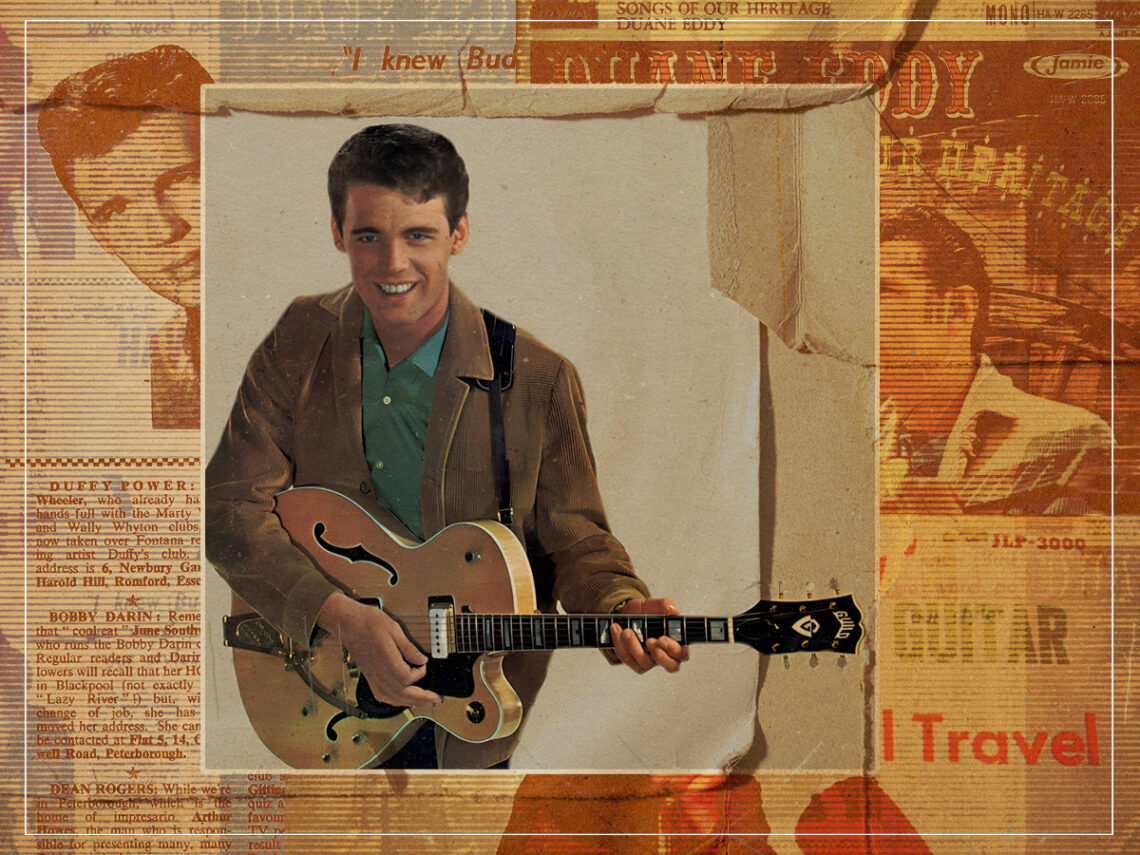
How Duane Eddy became known as ‘The King of Twang’

The rock ‘n’ roll period might seem very distinct from modern music in sound and aesthetics, but its influence can be heard ubiquitously on our airwaves. Without the giant steps made by the pioneers of the genre, life itself would be very different today. The Beatles, Jimi Hendrix, Kurt Cobain and even popstars such as Taylor Swift, who also draw upon the formula, would be completely different. One man who made a tremendous impact during this era was the late Duane Eddy.
While swathes of us who were not around then overlook the true force that players such as the innovative rock ‘n’ roll guitarist had at his peak, there remain many who do not forget. Whether it be the grandparents who were teenagers in the 1950s jiving at local bonanzas on Friday nights or those who would rise in the 1960s as era-defining musicians, for them, the likes of Eddy, Chuck Berry, and the rest of the titans from this period are invaluable.
Eddy was at his pomp in the late 1950s and early years of the following decade, producing a string of notable hits alongside the great studio whizz Lee Hazlewood, a man noted for fusing country, pop and psychedelia. Eddy’s guitar sound became famous for its “twangy” essence, with classics such as ‘Rebel-‘Rouser’, ‘Peter Gunn’ and ‘Because They’re Young’ typifying it.
Demonstrating just how vital he was for the cultural tsunami of the 1960s, the likes of Pete Townshend, Dave Davies, Jon Fogerty and George Harrison cited him as a hero. They say the classics never go out of style, and later players such as Adrian Belew, Mark Knopfler and Bruce Springsteen have all also mentioned his prowess and effect on them.
To achieve his famous twang, Eddy weaponised a 1957 Chet Atkins Gretsch 6120 and following the release of 1959’s The “Twangs” the “Thang”, he sometimes used a Danelectro six-string bass guitar to augment it. While he conceived many notable moments, 1958’s ‘Rebel-‘Rouser’ was perhaps the most significant for his career as it was the instance in which he distilled his signature sound.
The instrumental was recorded at Audio Recorders in Phoenix, Arizona. The studio had an echo chamber that was initially a big water tank. A speaker was placed at one end of the tank, and a microphone at the other, with Eddy’s Gretsch 6120 recorded through it. Hazlewood then took the recording to Gold Star Studios in Los Angeles, where he added all the ornamentation, including the saxophone and hand claps.
Famously, Hazlewood helped greatly refine Eddy’s guitar sound in Phoenix. The two had first conceived it when they recorded the latter in a grain silo, producing the twang for cheap.
Eddy’s 1956 debut album, Have Twangy Guitar Will Travel, first brought his sound to the world. When speaking to Mojo in 2010, the guitarist recalled how he coined the term ‘Twangy’. He said: “We were recording in Phoenix, starting my first album, and one of the guys said, ‘Man, that guitar sounds twangy.’ And (Hazlewood’s business partner) Lester Sill fell down laughing. He’d never heard that word, and it became a running joke. ‘Is that twangy enough?’ So we finished the album and called it Have Twangy Guitar Will Travel.“
Adding: “To be honest, I never really liked the word. I thought it was kind of corny and rather undignified, but at the same time so many people liked it I just shut up and went with it.”
