


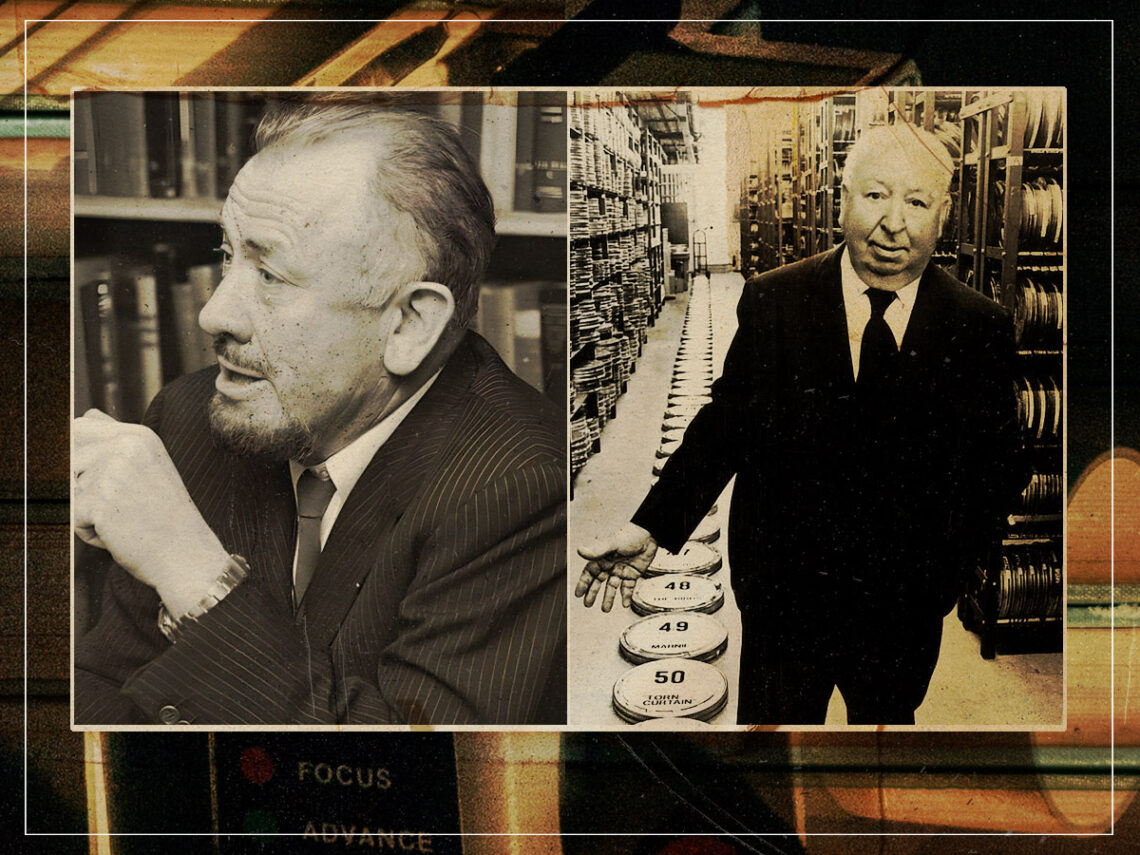
The rift between John Steinbeck and Alfred Hitchcock

John Steinbeck established himself as an immovable force in American literature throughout the 1930s on the tail end of the ‘Lost Generation’. While Ernest Hemingway wrote of war and inebriated strife in Europe and F. Scott Fitzgerald documented the social nuances of the Jazz Age, Steinbeck found his footing in framing the pitfalls of the American dream. In his two most famous works, Of Mice and Men and The Grapes of Wrath, Steinbeck explored the tenacity of the working man under the oppressive light of capitalist greed and the unsettling truth about the so-called manifest destiny.
Just five months after Steinbeck published The Grapes of Wrath, World War II broke out in Europe. Though he made a handsome living as a writer, his hands were no stranger to calluses. With a young adulthood spent working on ranches, Steinbeck was practical-minded and physically handy. So, when the US entered the war in 1941, he offered his services to the military. Alongside his work as a war correspondent for the New York Herald Tribune, he worked closely with the Office of Strategic Services, the predecessor of the CIA.
During the war, Steinbeck operated mostly away from the front line but did engage in occasional armed operations. Most famously, he joined Douglas Fairbanks Jr on an invasion of a small Italian island, using a Thompson submachine gun to capture Italian and German prisoners of war. Steinbeck was just one of hundreds of esteemed creatives who put their careers on ice to aid the Allied resistance during the Second World War.
Alfred Hitchcock, the celebrated British filmmaker, was born in 1899 and was of prime fighting age during World War I. As an enthusiastic patriot, he signed on at age 18 but received a C3 classification, deemed “only suitable for sedentary work” due to his obesity. Despite this setback, Hitchcock’s desire to contribute to the war effort transpired in his filmography during World War II. He created several wartime movies as part of the Allied propaganda machine against Adolf Hitler and the Axis forces.
Clearly impressed with Steinbeck’s wartime commitment and his recent literary success, Hitchcock contacted the American author in 1943, asking him to write a novella to provide the basis for his next movie, Lifeboat. With such masterpieces as The 39 Steps, Rebecca and Suspicion under Hitchcock’s belt at the time, Steinbeck consented excitedly and turned the novella around quickly in spite of his wartime commitments.

The story of Lifeboat takes place entirely on board a lifeboat full of survivors after a Nazi U-boat torpedoed a passenger vessel. The survivors include a wealthy journalist, a nurse, a factory worker, a British sailor, an African-American steward and a wealthy industrialist, among others. Tension reaches a fever pitch when the group rescues a German sailor who turns out to be the U-boat captain responsible for their close shave with death. As resources dwindle, the group grapples with moral dilemmas and prejudices.
Hitchcock’s Lifeboat premiered in January 1944 and received mixed reviews, with some criticising the positive portrayal of a German character. This aspect of the story was seen as dissonant with the propaganda push. Subsequently, the movie has been more universally regarded as one of Hitchcock’s finest limited-setting movies.
However, even in the postwar climate, Steinbeck was unhappy with Hitchcock’s work on Lifeboat. Steinbeck felt somewhat betrayed and mortified by the director’s adaptation, which, as he saw it, turned his robust and virtuous Black character into an insincere “stock comedy Negro”. By no means did he want Hitchcock’s “strange, sly obliquities” to reach the public eye under his name.
Shortly after attending a screening, Steinbeck Penned a letter to 20th Century Fox. “I have just seen the film Lifeboat, directed by Alfred Hitchcock and billed as written by me,” he began. “While in many ways the film is excellent, there are one or two complaints I would like to make. While it is certainly true that I wrote a script for Lifeboat, it is not true that in that script as in the film there were any slurs against organized labor nor was there a stock comedy Negro.”
In some of his famous literary works, Steinbeck created stoic, venerable Black characters to convey his feelings about the inequality in the US and the struggle of marginalised ethnicities. He felt that Hitchcock completely undermined his cause and sentiment to a defamatory extent. Steinbeck added that, in his novella, “there was an intelligent and thoughtful seaman who knew realistically what he was about”.
Adding: “And instead of the usual colored travesty of the half-comic and half-pathetic Negro there was a Negro of dignity, purpose and personality. Since this film occurs over my name, it is painful to me that these strange, sly obliquities should be ascribed to me.”
A month later, Steinbeck asked his agent, Annie Laurie Williams, to convey his request once again to 20th Century Fox. “My script for the picture Lifeboat was distorted in production so that its line and intention has been changed, and because the picture seems to me to be dangerous to the American war effort, I request my name be removed from any connection with any showing of this film,” he wrote in a telegram. Sadly, the production giant and Hitchcock failed to respond or react to Steinbeck’s request, leaving the writer embittered towards both.
