


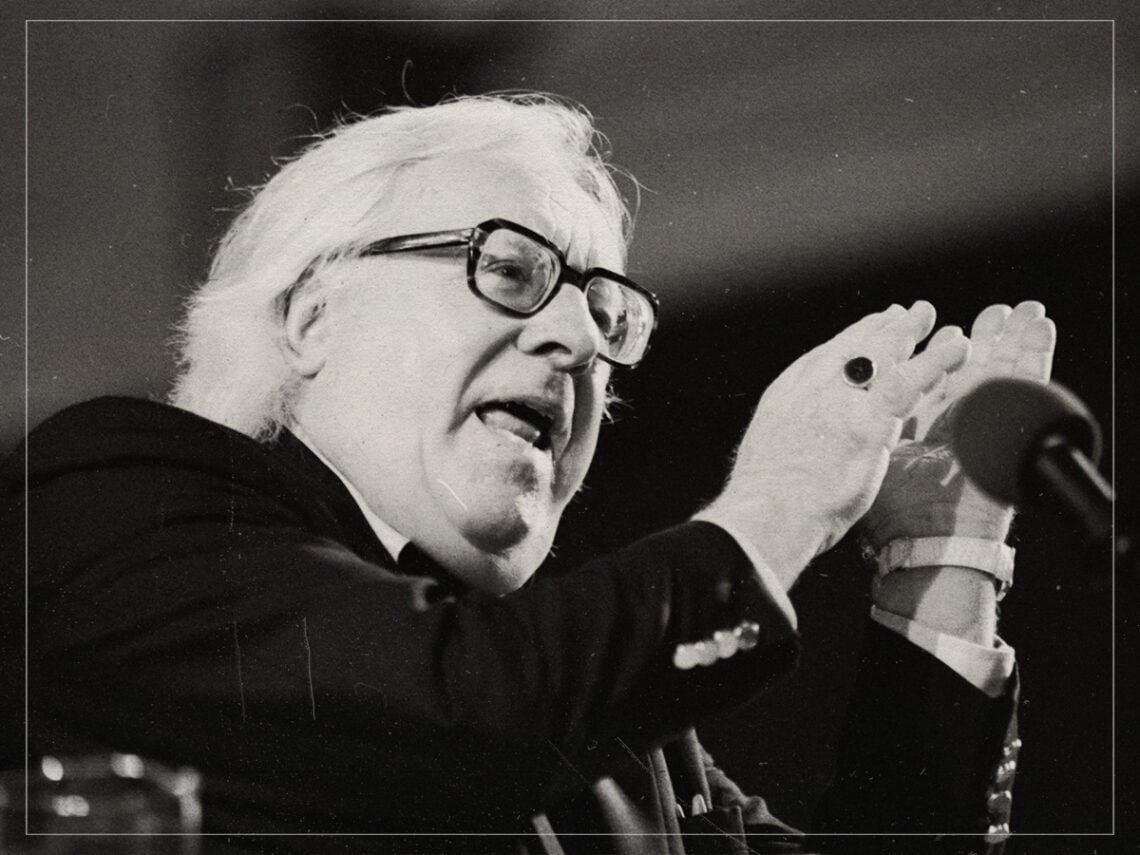
Ray Bradbury’s favourite books of all time

In Fahrenheit 451, Ray Bradbury writes about a future where books are banned and burned, and a darkness rules over everything, noting, “There must be something in books, something we can’t imagine, to make a woman stay in a burning house; there must be something there. You don’t stay for nothing.”
Before the author passed away in 2012 at the age of 91, he left behind a list of his favourite books of all time, which is a culmination of sorts because Bradbury began writing stories as a child, in reaction to the Great Depression, and at the age of 18, he was already publishing short stories in fan zines, which were enshrined in a slippery sci-fi sensibility.
While Shakespeare’s Hamlet lauds “Words, words, words”, both in and out of his madness, we might picture Bradbury meandering through the great hall of life, smiling, sighing, ‘Books, books, books’. The first of his very favourite works was The God of Mars by Edgar Rice Burroughs; forget the book, for he deemed Burroughs’ entire oeuvre “the most influential” of any “writer in the entire history of the world”.
Bradbury has similar tastes to the likes of Bob Dylan, Bruce Springsteen, and Nelson Mandela, who have all recommended The Grapes of Wrath. Though we deem it today as one of the great American novels, Bradbury thinks differently: “every other character is a description, a metaphor, prose poetry, it’s not plot…”
Ernest Hemingway is known for a sharp writing style, depicting his adventurous life with a fruitful sourness; however, less than a decade before the end of his life, he penned the beautiful novella, The Old Man and the Sea, which follows an ageing Cuban fisherman in a solitary struggle to catch a giant fish in the Gulf Stream.
Bradbury and his friends read the mature work the very day it was published in Time Magazine, reminiscing, “We carried them off to a bar that was still open, and we sat and read The Old Man and the Sea, and we talked about Papa and how much we loved him”.
Continuing on the theme of epic sea adventures, Bradbury also loved the great epic, Moby-Dick, by Herman Melville (funnily enough, this, too, is a favourite of Bruce Springsteen and Bob Dylan). There are, in many editions, over 700 pages of philosophical ruminations on nautical life, the pursuit of greatness, the limits of human knowledge, obsession, race, class, madness, you name it, and it’s there.
Nevertheless, ever the genius, he had a curious way of reading the classic text: “I dove into the middle of it instead of starting at the beginning. I came across a lot of beautiful poetry of the whiteness of the whale and the colours of nightmares and the great spirit’s spout… I turned back to the start: ‘Call me Ishmael’, and I was in love!”
He also included in his list of all-time favourites a book by his teacher, whom he “of course” went on to imitate. Leigh Brackett, among other things, wrote Bradbury’s favourite book, Lorelei of the Red Mist: Planetary Romances. “The magic is only in what books say, how they stitched the patches of the universe together into one garment for us,” Bradbury wrote in Fahrenheit 451, so go forth and read it all and more for it’s what he would’ve wanted.
Ray Bradbury’s all-time favourite reads:
- The God of Mars by Edgar Rice Burroughs
- The Grapes of Wrath by John Steinbeck
- The Old Man and the Sea by Ernest Hemingway
- Moby-Dick by Herman Melville
- Lorelei of the Red Mist: Planetary Romances by Leigh Brackett
