


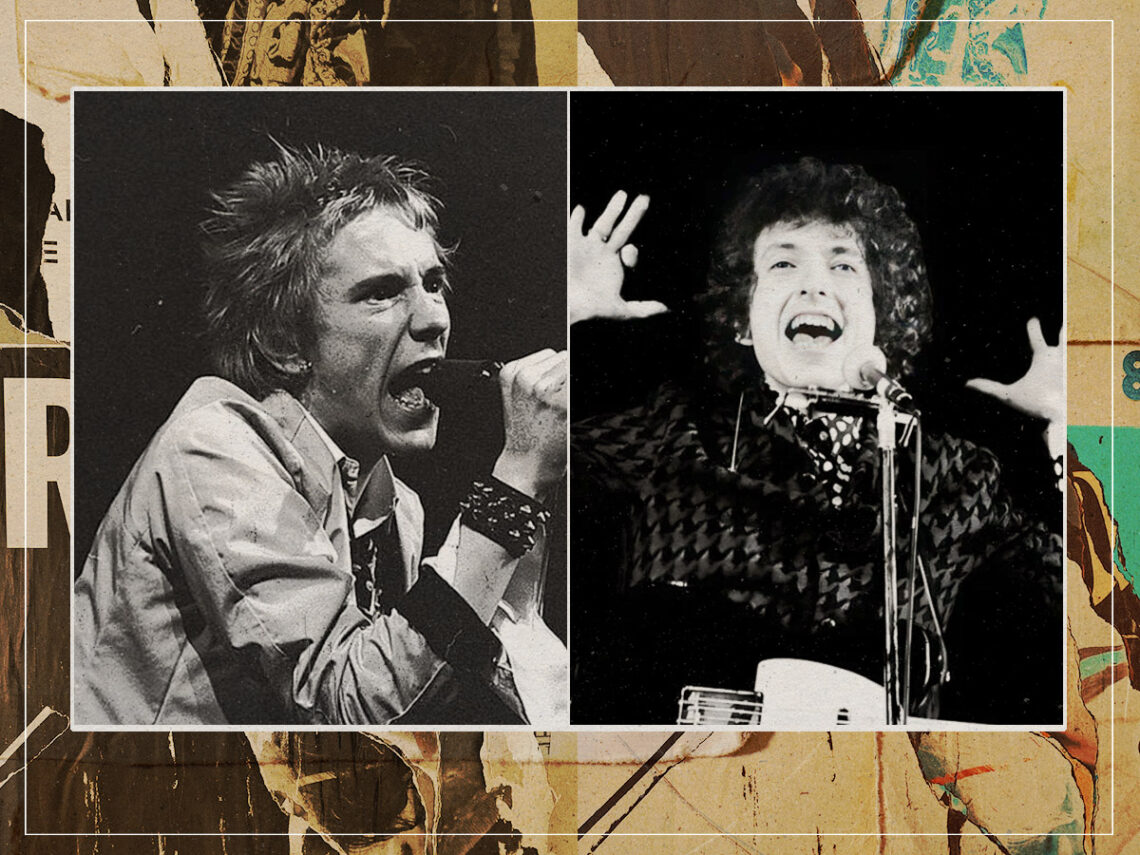
Was John Lydon as influential as Bob Dylan?

When combing through the beginnings of punk, the whole thing should start with Bob Dylan. Despite not having any safety pins through his cheeks or dying his hair in different colours, Dylan’s willingness to go against the status quo at every opportunity led to him being both the misfit of the folk world and the saviour to rock and rollers all in one go. Any punk can normally respect that kind of hustle, but Billie Joe Armstrong thought Sex Pistols ended up surpassing him in some regards.
Granted, it’s not like Dylan was some holy being who could do no wrong in rock circles. As far back as the mid-1960s, supposed fans were already starting to get turned off by him because of how much he was turning towards electric guitars and playing music that actually tried to get on the radio. In fact, this was the moment Lydon says he started to care about Dylan.
“I kinda liked Bob Dylan when he went electric,” he told Far Out. “That’s when it mattered to me. Before then, really, it was like a pale imitation of something that was Arlo Guthrie-ish. Just a waggon driven by horses kind of music. It wasn’t my scene.” It has always been the future that Lydon has concerned himself with.
By the time punk fully kicked in, Dylan was already in a different world. After trying his hand to have all the answers and working through the corners, he went from writing songs that encapsulated the times to preaching to the public as a born-again Christian on albums like Slow Train Coming and Saved. This proved disillusioning for many.
The punk revolution couldn’t have come at a better time, though. While most people were still focusing on the massive rock stars of the day, like Led Zeppelin and Deep Purple, artists like John Lydon were making tracks that actually sounded like the music you would hear in some ratty club where rock ‘n’ roll was once born rather than a commercialised stadium show, complete with a lack of technical flash for good earthy measure.
It’s not like Lydon was lacking in enthusiasm, either. Dylan already made a habit out of his silver tongue when it came to the politicians of the day, but Lydon was talking about the most feral topics ever described and almost daring someone to tell him that he was wrong. Even if you didn’t agree with everything he said, you couldn’t deny that it seemed to come from his soul.
But is someone like Lydon innovative enough to reach the iconic heights Dylan did? Well, he was able to disrupt the system in the same way the young folkie had, and despite being ridiculed by the straight public for being too raunchy for the mainstream, he somehow found a way to punch a hole into the future and pave the way for other iconic punk acts like The Clash.
It’s not like the modern punks weren’t paying attention, either. When talking about their influence with Rolling Stone, Billie Joe Armstrong said that the Sex Pistols were practically carrying on that kind of honest songwriting that Dylan started, saying, “The things that Lydon wrote about back in ’76 and ’77 are totally relevant to what’s going on right now. They paint an ugly picture. No one ever had the guts to say what they said. The only person who did anything similar to it was Bob Dylan, and even Bob Dylan was never that blunt.”
And when you look at the amount of bands that Lydon indirectly started, there’s a good chance rock wouldn’t look the same. Whereas Dylan had inspired everyone from The Beatles to The Byrds to dream bigger, Lydon was responsible for some of the biggest subgenres of rock and roll that have come up in the years since in a very direct sense. For someone who seemingly didn’t have any musical ability, it’s easy to draw a straight line between Lydon’s first songs and pop-punk to grunge to Britpop, with every major band in the genre counting him as an influence.
Lydon has also managed to keep his anger over the years as well, still presenting himself as the brash gutter rat he was in his prime. Although he’s more than happy to tear into bands like Green Day if he thinks they deserve it, Lydon has the same distinction that Dylan has as more of a symbol than a musician half the time. Both of them could weave together a masterpiece, but it was more about what they represented to the masses that truly turned music on its head.
Alas, that seems to be the main point of difference. Dylan is an icon in a range of guises. He pioneered the whole punk thing in 1963 when he screeched, “And I hope that you die, and your death will come soon”. He then supercharged it by going electric and playing with the press, people’s expectations, and even his own iconography. Since then, he’s released countless influential albums in myriad styles.
Never Mind the Bollocks stands up to all of these when it comes to influence, and Lydon has surpassed it in terms of quality with PiL, but it’s the subsequent snarls rather than sustained influential artistry that have kept him relevant, while Dylan’s art continues to make timeless waves as his persona regresses into magical mystique.

Never Miss A Tale
The Far Out Bob Dylan Newsletter
All the latest stories about Bob Dylan from the independent voice of culture.
Straight to your inbox.