


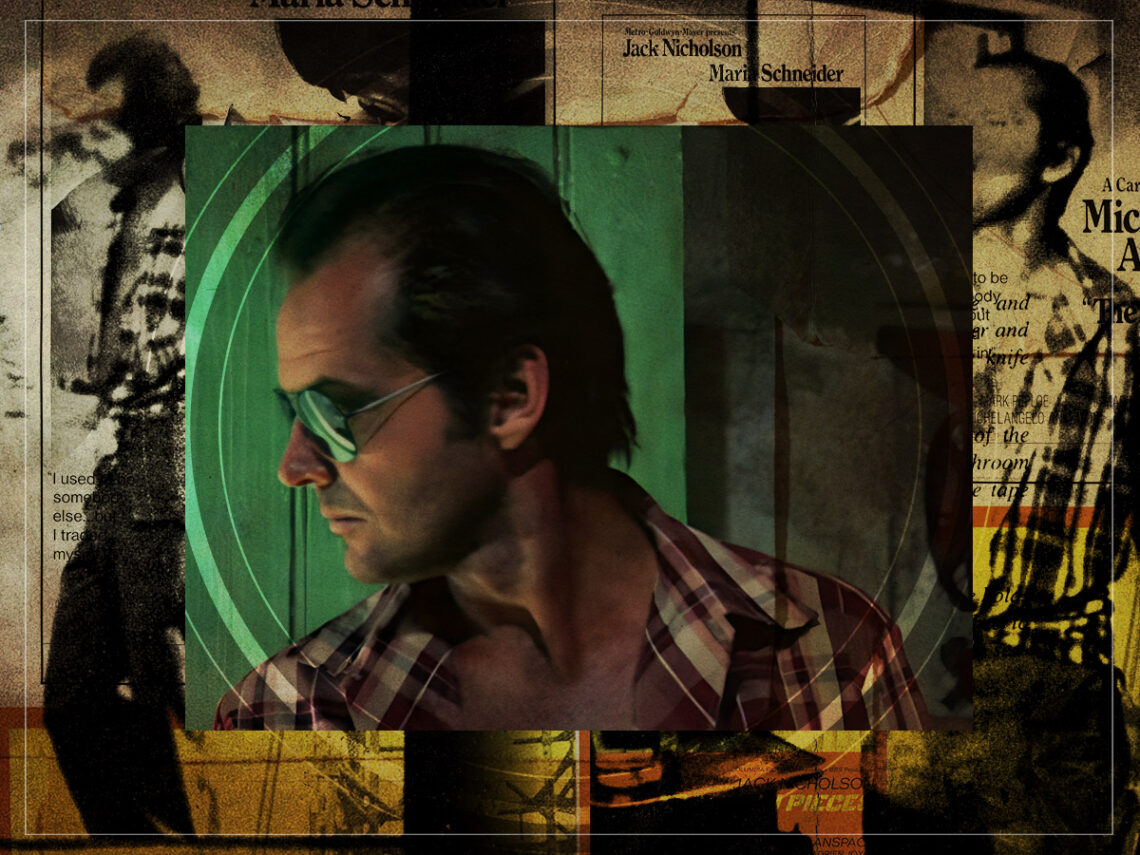
Privilege and aimlessness in ‘Five Easy Pieces’ and ‘The Passenger’

“Where are you going?
Barcelona.
For how long?
For the rest of my life.”
When faced with the overwhelming and murky prospect of our future, it can feel almost dizzying to comprehend, and the thought of which can become an act of avoidance. Some yearn for a feeling of complete escape and freedom, to be engulfed by possibilities and venture out onto an open road with nothing in their sights, to live in a constant state of reinvention as a way of never reaching a final destination. Perhaps what is more terrifying than reaching the end is trying your best and not quite ending up where you want to be, with the prospect of unfulfilled dreams and unexplored ideas becoming unbearable. And when this becomes an overwhelming thought, it can sometimes feel as though the best way forward is to not think at all – to plod onwards and embrace the supposed freedom of an aimless life. But when faced with a life without struggle, purpose and direction, are we truly free?
Five Easy Pieces, directed by Bob Rafelson in 1970, is concerned with exactly this matter, with the film following a man who drifts between meaningless affairs and jobs to avoid his potential as a classical musician. With Jack Nicholson in the lead role as Robert Dupea, it initially feels like a light-hearted comedy about a man who doesn’t take anything too seriously, with an iconic scene as he tinkers away at a piano atop a truck and argues with his (current) girlfriend as a result of his unpredictable behaviour. His lifestyle is erratic, but he convinces everyone that he is living the dream, charming his way out of any trouble along the way. He is free from routine, responsibility and relationships – a man who is tethered to no one and nothing.
The film’s pacing matches the meandering nature of Robert’s life, with mostly static camerawork that occasionally pans over barren landscapes and bleak interiors. However, the sparse landscapes and deliberate slowness create an unnerving undercurrent of emptiness and unease, and Robert is soon called home after his father falls ill. After returning to be with his family, we learn that he comes from an upper-class background, the rest of his family are successful musicians, and he hasn’t seen them in a very long time. His lifestyle doesn’t reflect the means and opportunities he grew up with, and we soon begin to see the shadow hanging over his seemingly carefree existence.
What’s interesting about his time at home is that we aren’t explicitly made aware of anything that pushed Robert away. We understand that his relationship with his father is fraught due to his leaving, but there wasn’t anything specific that led him to isolate himself from his family. Growing up with a seemingly endless amount of freedom and the possibility of success is what caused Robert to detach from reality completely. Extreme privilege came to be a curse that marked him with the pressure to be great, and his response was to pursue a polar opposite lifestyle to free himself of this burden.
However, we can also see the flip side of this narrative in The Passenger, Nicholson’s 1975 film directed by Michelangelo Antonioni. The movie follows a journalist named David, who is sent to cover a story in Northern Africa. He assumes the identity of a dead man and convinces his loved ones back home that he is dead. However, this becomes increasingly complicated after he discovers that the dead man is a notorious arms dealer and is chased by a group of criminals.
Both films are very similar in tone, demanding devastatingly vulnerable and fragile performances from Nicholson as he plays two men who have become completely disillusioned and burdened by the pressure of everyday life. Both characters are actively escaping the responsibilities that define the lives of most people, finding this almost impossible and seeking a life that is completely unburdened from the pains of existence as an avoidance tactic.
But as they live these deliberately uncomplicated lives, they inadvertently cause more pain and suffering by not allowing themselves to be touched by the pains of living. Suffering and struggle are the price that we pay to experience the highs of being alive; it is not possible to experience love without heartbreak and joy without sadness. But both characters cannot fathom that a darker spectrum of emotions could enrich life – they want to live in a constant state of hedonism, not realising that their quest for careless living only restricts their freedom. They aren’t open to the possibility of experiences that are beautiful because of their complexity and nuance, and because of this, they are trapped.
Both films are about crippling freedom, trapped by the possibilities of reinvention in the wake of who they really are, unable to fully escape the consequences of their old lives. Through the slow pacing and hauntingly empty natural landscapes, they reflect the central characters’ inner worlds and their attempts to live a blank existence, with the final shots of both films leaving us in the aftermath of their own destruction. The Passenger ends with a continuous and circular shot of the courtyard outside of David’s hotel as he lies dead in his room, the world silently moving around him, trapped in a perpetual loop of escape. Five Easy Pieces ends similarly, with Robert not learning anything from his time at home and abandoning his girlfriend at a gas station, too afraid to act on his potential and let people into his life, driving alone into the distance.
Their existence is only an illusion of choice. They drift between jobs, cities, and women, becoming passengers in their own lives. Because when constantly dreaming of a fresh start, the only person you are trying to escape is yourself.
