


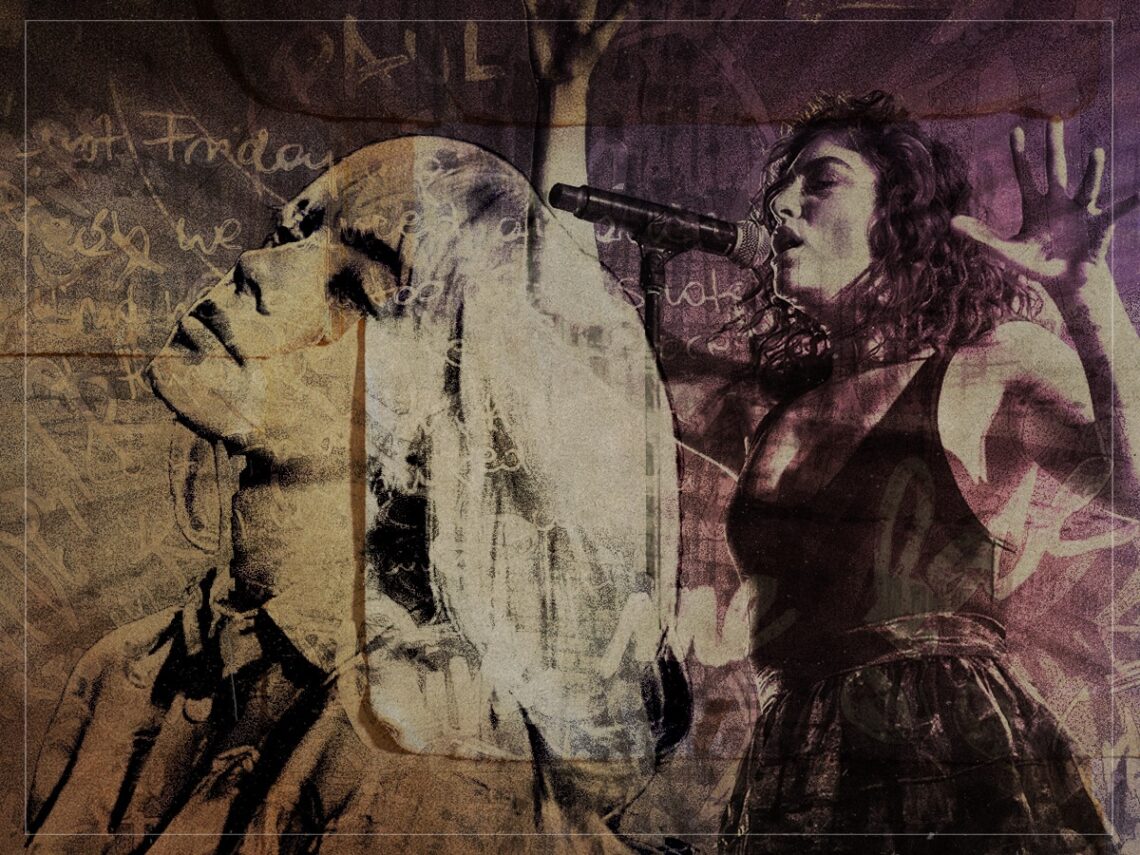
Is pop music finally shaking off the quiet, cursive vocal style?

In the 2000s, pop music was loud and brash. Lady Gaga wore meat dresses to award shows, Lily Allen boldly titled a song ‘Fuck You’, and Katy Perry enunciated every single word to ‘Hot ‘n’ Cold’ perfectly. Pop stars knew exactly what they were about, and they wanted us to know, too. It was never a difficult task to make out the lyrics to the songs playing on mainstream radio, but that all changed with the dawn of the 2010s.
Pop vocals morphed into something new, something quieter and quirkier, and something that was, more often than not, unintelligible. This notably showed up in artists who seemed to straddle the realms of mainstream appeal and more alternative forms of pop, such as Tumblr favourites Billie Eilish, Halsey and Lorde. Their enunciation was ever so slightly off, dragging out vowels without cause, whispering their words and curving their sentences into one another.
As bedroom pop, art pop and indie pop came to the fore, this style of singing became all the more prevalent. There are hints of it across the discographies of modern icons like Clairo, Lana Del Rey, and Willow. The trend stretched across mainstream radio, into playlists curated by online indie kids, and became inescapable. It also became known as “cursive”.
Though the thousands of tweets poking fun at the style may lead you to believe otherwise, there’s nothing inherently bad about cursive singing. It’s also not a new phenomenon. Elongated, unusually enunciated delivery existed long before Lorde hit the scene with ‘Royals’. Take Amy Winehouse, for example, one of the most acclaimed vocalists of all time, or the avant-garde stylings of Björk.
The style only became defined—and subsequently ridiculed—in the 2010s because of its increasing popularity. Indie pop became almost synonymous with pop as audiences became more interested in Gen Z-driven, internet-friendly genres, and the cursive style made sense within that genre. It was just weird and quirky enough to provide their style with a little edge without putting off wider audiences.

The vocal fry and vowel elongation endeared itself to audiences for a while, sending budding stars like Lorde and Eilish straight to the top, but it has since lost its charm through saturation. It felt impossible to hit play on an indie pop Spotify playlist or to flick through radio stations without stumbling upon some variation of cursive singing. It became, at best, predictable and, at worst, annoying.
But the cursive songs just kept coming. Art and alt-pop stars couldn’t keep themselves away from the sound, struggling to shake the comfort of slurred enunciation. But now, as we approach the midpoint of the 2020s, the decade-long tirade of cursive vocals on our airwaves seems to be coming to a long-awaited end.
Of course, there are still artists who rely on that sound. Billie Eilish’s enduring bedroom pop sound still falls into cursive sometimes, and Lorde still leant heavily on it in her last full-length offering, 2021’s Solar Power, while Faye Webster keeps the cursive tones alive in the sad girl indie realm. But a new crop of pop stars and indie pop artists seem to be pushing vocals towards clearer, crisper pastures.
The summer has, undoubtedly, belonged to Charli XCX, who is anything but quiet and cursive on her sixth album, Brat. She talk-sings her way through most of the record, ensuring you can hear every brag and every bratty statement that she makes. She plays with autotune, matches her delivery up to the pulsing club beats, and enunciates every word to album closer ‘365’.
This summer in mainstream pop has also brought us the breakthroughs of Sabrina Carpenter and Chappell Roan, neither of whom are shy with their vocal style or their approach to pop. Carpenter’s ‘Espresso’, which many might consider to be the song of the summer, may stretch out its words, but it’s never unclear. And Chappell Roan quite literally spells out her words on ‘HOT TO GO!’—she’s bold and purposeful, even when her vocals slide into stranger territory.
Perhaps this marks a general shift away from those genres that spawned from the 2010s, from bashful bedroom pop and edgy alt-pop, and a return to more jubilant forms of pop. But in current indie pop, too, artists and audiences seem to have tired of the cursive vocal style, seeking out new vocal styles to switch up their sound.
Mitski’s latest offering, the orchestral The Land Is Inhospitable And So Are We, propelled her to heights she had never seen before when ‘My Love Mine All Mine’ took off on Tiktok. It’s a song that takes its time, but it’s also a song that pronounces every declaration of love perfectly. Clairo’s sound is still born out of that bedroom pop era, but her vocals seem clearer than ever on Charm, leaning on new jazzier influences.
This isn’t necessarily a call for cursive singing to be laid to rest forever. There is a time and place for that style of singing — whether it’s 8-tracks in the early 2010s or sad girl Spotify playlists — but it is time that vocal style stops completely dominating pop. As mainstream pop returns to the heyday of stars, of properly pronounced words and all-encompassing artistry, and indie-poppers look to include new influences in their sound, perhaps cursive can take a backseat for now.
