


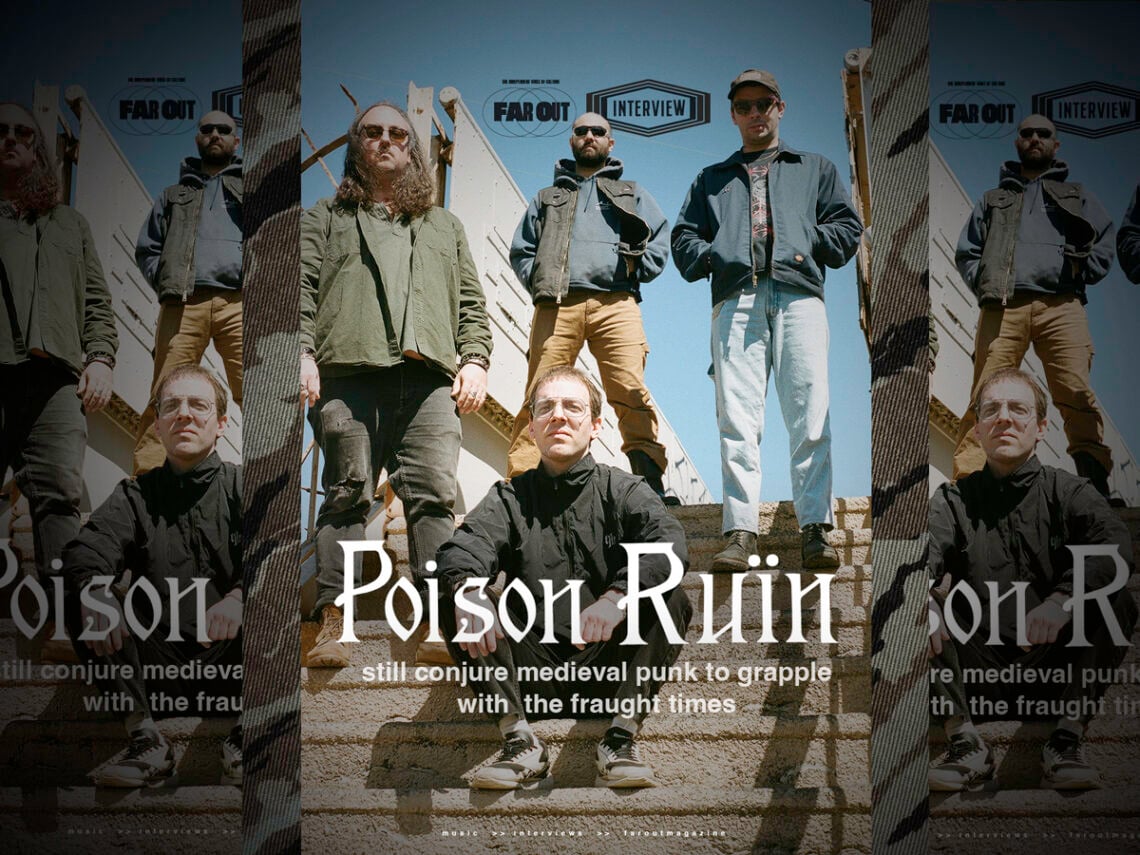
“It’s irresponsible to escape”: Poison Ruïn still conjure medieval punk to grapple with the fraught times

For the past six years, Philadelphia’s Poison Ruïn has authentically channelled a slice of the arcane into the world of punk.
There’s a heady brew burning away across their previous albums and EPs. Melodic hardcore wrestles with sleeveless NWOBHM muscle, the city’s industrial smog bleeds into terse respites of dungeon synth ambience, all corralled by frontman and founder Mac Kennedy’s lyrical canvas of medieval history and magical realism. Further illustrating such weathered tapestry are the motifs of chain-mail hooded knights and sword-wielding warriors that adorned Poison Ruïn’s eponymous debut and Harvest.
“I was just more that type of kid, a books and history type of kid,” Kennedy tells Far Out. A childhood fascination with historic maps and the old world, further fuelled by day trips to Civil War sites, sparked a lifelong interest in how the reverberations of the past hold resonance in the contemporary age, an edge that keeps Kennedy’s thematic footings away from mere fantasy whimsy.
“They become less connected to your actual life because the monuments and ruins aren’t around,” Kennedy muses on the historic terrain across Europe at odds with the US East Coast’s cultural heritage. “It didn’t have a dry reality to it.”
It’s the essential alchemy firing away in Poison Ruïn’s oeuvre, no less than the new album Hymns from the Hills. As ever, the urban streets are never too far away from Kennedy’s conjurings of the Middle Ages, both sonically amid its lo-fi punk grit and in the allegorical pertinence that imbues his lyrical pen.
“The fantasy stuff in the band is not an escape,” Kennedy asserts. “There’s a spiritual element. And I don’t mean like self-help or traditional religion, but I’m speaking to a sort of magical thing or an enchantment, which to me talks about the possibility for creating room for future change, that stew that things come out of.”
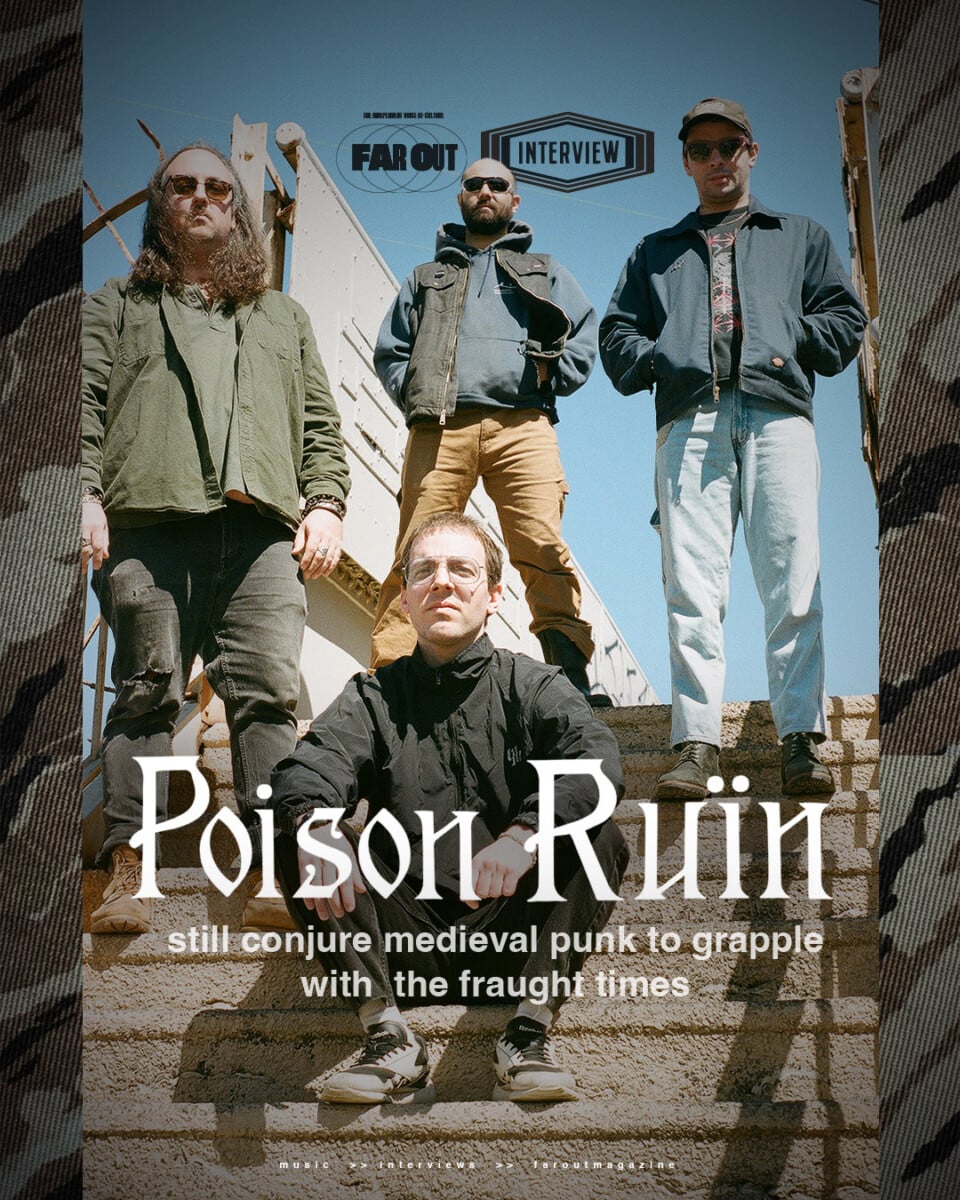
Kennedy quickly assures he’s not trying to be self-serious, but his assessments aren’t unfounded. Poison Ruïn have a knack for wresting historic and legendary tropes away from the hands of its self-appointed, conservative gatekeepers, instead spinning tales of feudal toil, lonely knights, corrupt barons, unforgiving winters, and peasant uprisings, gleaming a poetic outlay of the 21st century’s working class struggles as much as the 14th.
“Archetypes, folkloric heritage, symbols, I mean it in that more psychological tradition rather than ‘this is meant to represent this,’” Kennedy furthers. “I think that there are deep resonances within the human psyche and quite possibly beyond that’s usually tapping into something that, for lack of a better word, is a type of truth.”
Such a conceptual vision never got lost in lofty pretences, Poison Ruïn always scoring their fables with an urgent blast of punk swagger and arresting death rock with ephemeral fire in its belly. For Hymns From the Hills, however, Kennedy retreated to Clifton Heights’ Red Planet Recording studios for a lengthy block of time, soaking up the surrounding Delaware County creeks as much as the novel approach to recording without an imposing deadline stifling room for experimentation.
“I just want a space to be able to spread out and leave things set up, explore … try to push on ideas and let them take on interesting shapes.”
Mac Kennedy on Red Planet’s creative sanctuary.
Creative breathing space has coloured Hymns From the Hills’ artistic hinterland as well as its pastoral sensibility, a grab at the natural world’s intersection of wilderness and hidden doorways. “My main comfort place where I feel good in life and in the world often is nature, it’s like a great sort of healing experience,” Kennedy reveals, musing on the album’s title and its significance to him.
“I’m not speaking specifically about nature but more the absence of the areas where the sort of control apparatus of the power structures within humanity lose their power, the edge of their territory.” Kennedy adds, “It’s that area that’s right on the edge, where you can sort of step to one side away from all the harm and violence and horror in the world that bogs us down in our day-to-day.”
There he is again, wavering between the valour of lore and grim reality. With more time to immerse himself in Poison Ruïn’s gothic universe, Kennedy’s set to have uncovered a new pathway or darkened corner amid the cobwebbed corridors of his antiquated-hardcore project flickering torch in hand, Hymns From the Hills, learning crucial lessons against the tumultuous backdrop of today, as any good fable should, and scored by a Philly punk detonation still snarling with power six years on.
“I think it’s irresponsible to try to escape from the problems that plague us, not just on a personal level, but in a political and ethical sense too,” Kennedy concludes, truly quashing any idea Poison Ruïn peddles in larping cosplay.
“You can’t escape, and therefore, to try to is just a failure and a just fucking off really.”

Never Miss A Beat
The Far Out Punk Newsletter
All the latest Punk content from the independent voice of culture.
Straight to your inbox.