


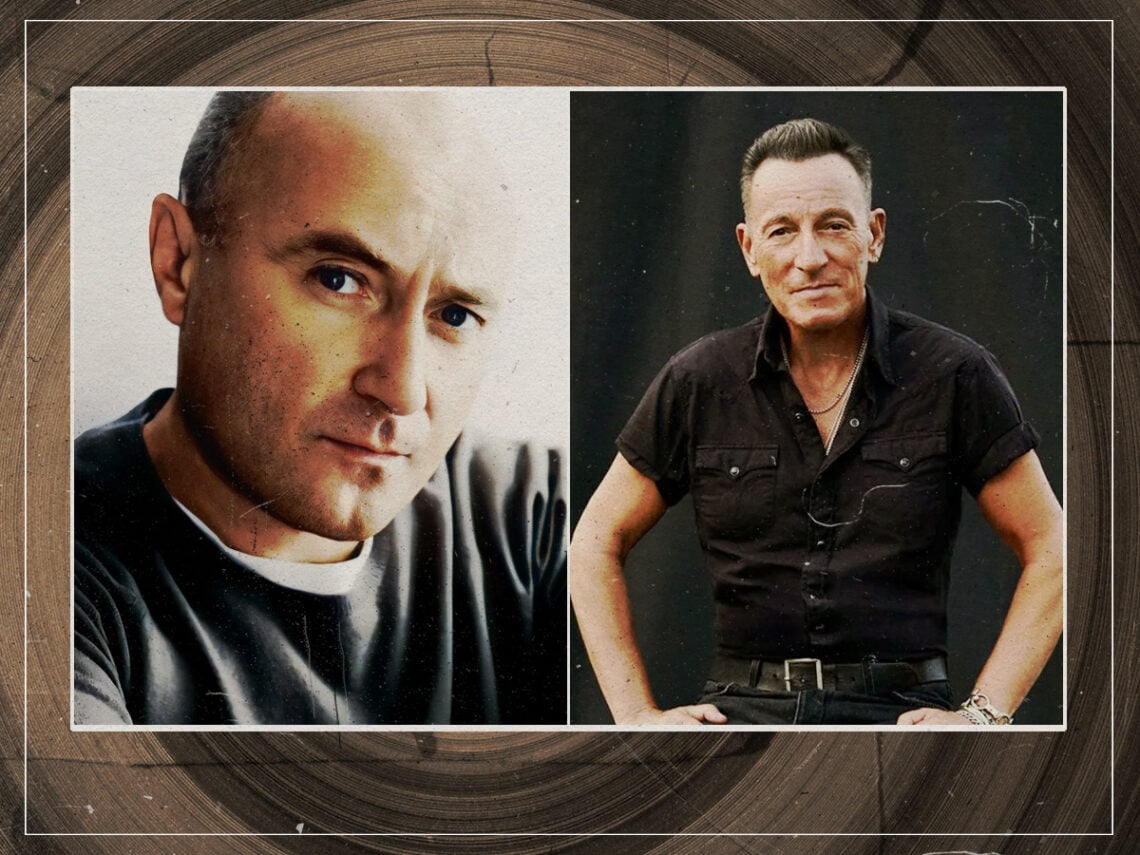
Phil Collins on the differences between him and Bruce Springsteen

It would be a stretch to call everything Phil Collins ever did as “boundary-pushing”. While he may have been able to push the needle forward for what progressive rock could do in Genesis, Collins was always into some lighthearted material in his solo career, making the kind of sentimental ballads that would make even the most sentimental aunts of the world telling him to turn it down. Although he had his own distinct style whenever he performed, he admitted that Bruce Springsteen’s rise to stardom was a bit standard compared to him.
Then again, comparing Bruce Springsteen and Phil Collins is like comparing a hotrod to a station wagon. Although Collins had his credentials as a songwriter years before Springsteen arrived on the scene, hearing ‘The Boss’ tell his stories about disgruntled kids hiding out in New Jersey was too perfect a scenario for rock and roll heaven.
Across his most celebrated albums like Born to Run and Darkness on the Edge of Town, Springsteen knew how to get into the hearts of the people that he wrote about every day. He sang about the trials and tribulations that go on behind closed doors when they got to the end of the night.
By the time that the 1980s rolled around, both Collins and Springsteen had taken things in a different direction. While Collins was channelling his pain over his recent divorce into his debut, Face Value, Springsteen was inhabiting the sounds of troubled people with no hope for a better life on the album Nebraska, which would be his first project without his E Street Band behind him.
Once Springsteen saw what could be done with the sounds of the time, Born in the USA became his introduction to the MTV generation of fans. Instead of the songs about the rough-and-tumble years of his youth, Springsteen was happy to play up the rock star angle, even banking on a strange sense of sex appeal by showing the album cover with a shot of his ass.
As Collins started to make his way back to Genesis, he also found time to make tracks that were far more radio-friendly than anyone was expecting. Compared to the amazing side-long epics that the band would make in the 1970s, it was a shock to the system to hear the same singer singing songs like ‘You Can’t Hurry Love’ in his solo catalogue.
For all of his pop appeal, Collins thought that the recent stuff that Springsteen was putting out was too standard for what he was known for, telling Rolling Stone, “To me, everything Bruce Springsteen does is very typical of him. Maybe people think the same thing about me. But I think I have too many styles to single one out.”
Despite their perceived differences, Collins still had the utmost respect for Springsteen’s music, later recalling to David Sheff, “I’ve always liked the idea of Springsteen–everyman’s music for everyman, you know; it captures the imagination of the workingman. Chuck Berry did the same thing. I don’t know that much about Springsteen’s older songs, but I like what he stands for.”
Even if Springsteen seemed typical, he was about to undergo a major shift in his writing style, trading in his patriotic sounds for deep emotional heartache on his divorce album Tunnel of Love. Springsteen may have seemed too typical for what Collins likes to listen to, but there’s a good chance that ‘The Boss’ was never going to put out something as poppy as ‘Sussudio’.
