


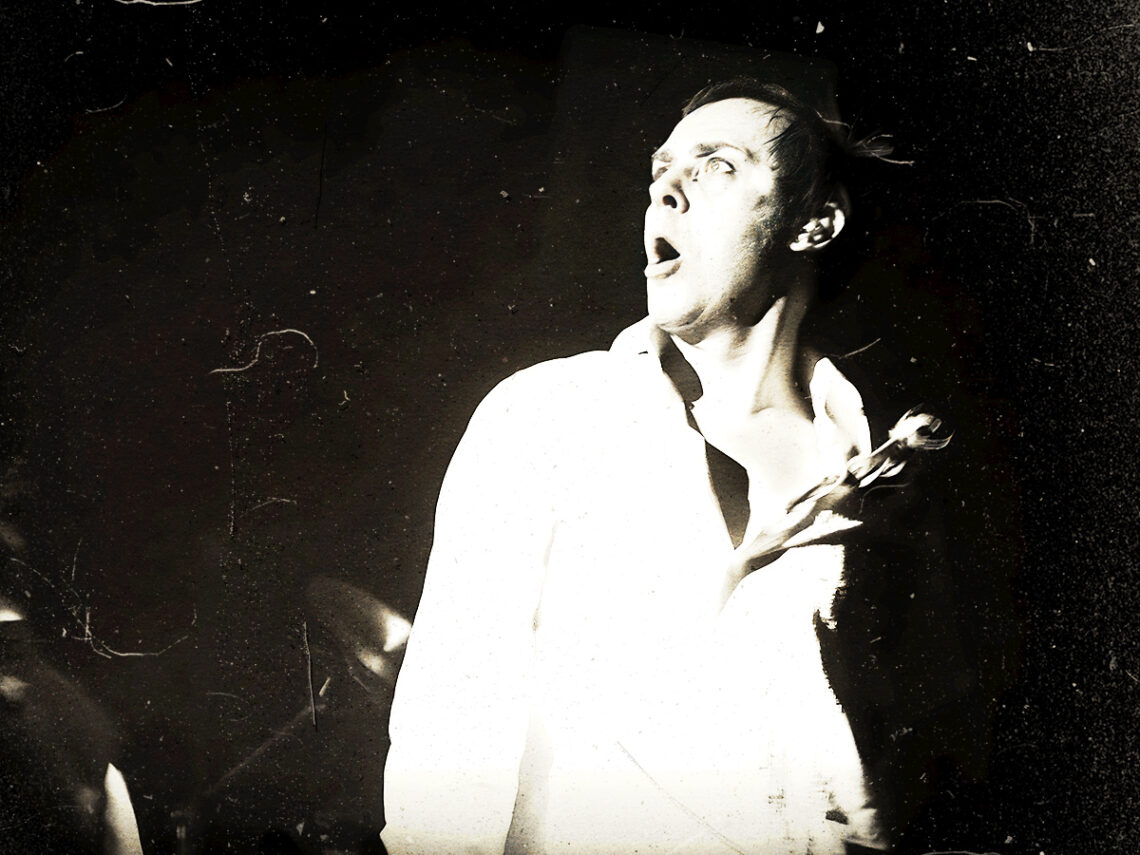
Peter Murphy remembers the powerful “pure decadence” of David Bowie

Even before Bauhaus covered ‘Ziggy Stardust’ in 1982, there were evident parallels between frontman Peter Murphy and David Bowie. A clear disciple of the Londoner, Murphy brought a much more gothic edge to his musical character, prowling the stage like a black cat, in a more ominous answer to the otherworldly essence of Bowie’s alien rock star, Ziggy Stardust.
Bauhaus’ performance of ‘The Spy In The Cab’ on The Old Grey Whistle Test in 1982 is one of the best exhibits of the parallels between Murphy and Bowie, with the former’s vocals and presence evoking images of Bowie’s most influential period ten years prior.
At the time, the ‘Ziggy Stardust’ musician was on the cusp of his adventure into the world of disco and at the top of the charts in America, thanks to 1983’s Let’s Dance. At this point, Bowie was far away from the era that inspired Murphy and his band.
Naturally, the world of 1970s glam rock – which spawned Bowie’s Ziggy Stardust – is something that Peter Murphy has addressed on various occasions. When speaking to Post-punk in 2014, before releasing his tenth solo album, Lion, Murphy was asked whether he thinks his music is “reflective” of the spirit of Bowie’s glam counterpart, T. Rex leader Marc Bolan. Their 1971 classic, ‘Cosmic Dancer’ was used as an example of this connection.
Murphy replied: “Right, yes, it is. ‘Hollow Hills’ and all of that sort of stuff. And ‘Indigo Eyes’ too…But yes, then I was at school and met Danny and Joseph, and they were artists, and I was arty too – I could draw well and stuff. Danny Ash and Joseph and I had a commonality.”
Continuing, Murphy remembered the time he saw David Bowie performing ‘Starman’ on television and how tremendously consequential the experience was. He said that Bowie’s asexuality was “pure decadence”, to the point that it was “just beauty”.
He said: “I remember I saw ‘Starman’ on Top of the Pops and was like, ‘What is that?’ Not ‘Who?’ It was this asexuality that was of pure decadence. That’s how I took it. It wasn’t homosexual or heterosexual; it was just beauty. And a male beauty. Almost better looking than any woman I had ever seen, with red hair and a beautiful voice. Then I saw a black and white photo of him doing a show at the Rainbow with Lindsay Camp, and there it was. There was a bit of a testicle showing through his mime outfit, and I went, ‘Woah!’ – there was this big pungent sexuality along with it. Theatre, you know?”
Comparing Bowie and Bolan, Murphy said: “So I bought Ziggy Stardust…but I was listening to Marc Bolan much more before that, and he was beauty and light, vanity and innocence really. But then I got this other thing from Bowie. I got The Man Who Sold the World and Ziggy Stardust, and that was our staple diet. Then Danny (Ash) showed me Roxy Music’s first album, especially the photographs. Danny was brave enough and had the money to go see Roxy and Bowie, but I wasn’t, I was just in my hometown, living off my imagination and photographs. Nothing else.”
Inspired by Bowie, Bolan and Roxy Music to create his own world, Murphy explained: “There was no MTV at that point. So, I created this world in my head, I projected what I thought was happening from the evidence of the photographs. That, I think, informed what I do. It was kind of my own thing, really. So when I met Bowie later, I thought, ‘I’ve now got to understand the relationship between the artist and audience.’ It was my creation. A fan creates his own world out of music and that is the power of music and that is power for yourself. They are right, too. Artists are what you think they are because they are characters.”
