


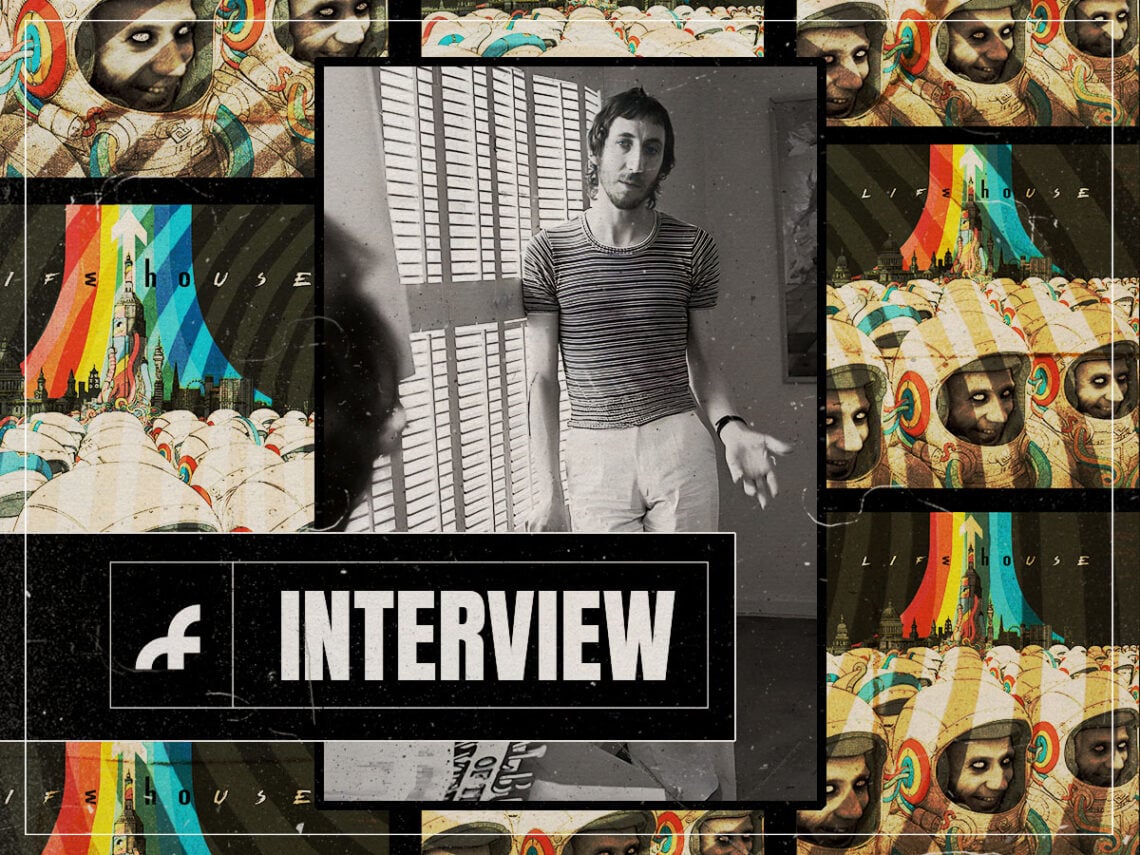
Pete Townshend: ‘Life House’ exposes the man behind blue eyes

On a late November afternoon, during the season’s first cold snap, I took a train to Sloane Square, London. In a private basement bar at The Sloane Club, I awaited Pete Townshend, the guitarist and creative lead of The Who, and his close friend, writer Peter Hogan.
Upon their arrival, we exchanged pleasantries before taking seats in a dimly lit booth. The table had been pre-stocked with all manner of reading material: a pile of Townshend’s favourite graphic novels, print-outs from Life House, and a batch of unbound note paper scribbled in Townshend’s sage, unruly hand.
With my own copy of Life House on the table, we began to discuss the project peripherally as I locked with Townshend’s piercing blue eyes for the first time; focused and enthusiastic, they led the charge for his captivating discourse. Throughout the conversation, he fidgeted frenetically with the notes and books before him, absently aligning them with the table’s edge. Ordinarily, this might be construed as a symptom of anxiety, but the musician was clearly at ease. Instead, this most legendary pair of hands portrayed a creative restlessness that remains unsatiated after six decades of eminence.
The new graphic novel Life House is based on a dystopian concept that has plagued Townshend’s mind since its inception in the late 1960s. Encouraged by the success of his first rock opera, Tommy, Townshend coaxed The Who towards a more audacious and complex follow-up titled Lifehouse. Following the band’s transformative experience playing to the masses on the Tommy tour of 1969-70, Lifehouse was conceived to celebrate the unifying power of rock music.
The initial idea was inspired by the Sufi musician Inayat Khan, who believed there was a universal note of music, “a keynote of the chord to which we all belong”.
“The essence of the storyline was a kind of futuristic scene,” Townshend explained in the Who’s Next liner notes. “It’s a fantasy set at a time when rock ‘n’ roll didn’t exist. The world was completely collapsing, and the only experience that anybody ever had was through test tubes.”
“In a way, they lived as if they were in television programmes,” he continued. “Everything was programmed. The enemies were people who gave us entertainment intravenously, and the heroes were savages who’d kept rock ‘n’ roll as a primitive force and had gone to live with it in the woods. The story was about these two sides coming together and having a brief battle.”
This ambitious rock opera famously drove Townshend to the verge of insanity and was ultimately abandoned. Much of the residual material, including ‘Baba O’Riley’, ‘Bargain’, ‘Love Ain’t for Keeping’ and ‘Behind Blue Eyes’, was repurposed for The Who’s masterpiece 1970 album, Who’s Next.
Townshend has now returned to the project, tying up loose ends across 150 pages of vibrant illustration. Respectfully tethered to the original concept and subsequent years of revision and evolution, writers James Harvey and David Hine marshalled Townshend’s crude materials into a coherent narrative. The final graphic novel was then scripted by David Hine and illustrated by Harvey and Max Prentis in association with Image Comics.
Townshend’s present companion, Hogan, wasn’t directly involved in creating Life House, but the book likely wouldn’t be here for our enjoyment were it not for their friendship. He introduced himself as a comic book author for the sake of our conversation, but he is also a distinguished journalist and former press officer for The Smiths and R.E.M.
Hogan’s first break came in 1978 when Townshend asked him to set up and manage his Magic Bus bookshop in Richmond. Just a couple of years later, he was appointed the commissioning editor for Townshend’s Eel Pie publishing house.
Like many children of his generation, Townshend was an avid comic book reader in his youth, but in adulthood, Hogan and the Magic Bus facilitated a reunion with the medium. “My sense that graphic novels – or comics – were worth looking at was when the Richmond bookshop was set up as a sort of Baba Centre,” Townshend explained.

Townshend and Hogan were, and remain, enlightened followers of Meher Baba’s famous spiritual teachings. “One of the main protagonists of the movement was an ageing actress called Delia De Leon,” Townshend remembered. “She wanted us to have a bookshop which presented Meher Baba’s writings but also the writings of other mystics, like Hazrat Inayat Khan, Hafez and Rumi, the poets. But we had a bookshop to fill!”
Townshend noted that the Theosophical material only took up a few shelves, so the shop would need to accommodate additional on-brand literature. “When I first went to look at it, it was divided pretty much into three: the esoteric stuff, the music stuff and the bits in the middle, which was all comics because of [Hogan’s] passion for it. I felt it was okay for me to not steal things but to borrow.”
Rousing anticipation with a foretelling chuckle, Townshend revealed that his “first arrest as a young boy was for shoplifting in a bookshop.” Naturally, I asked what book he had stolen. “I nicked Observer books of various sorts,” he replied. “I wanted the complete set, and I didn’t have enough money.”
At Magic Bus, Townshend “borrowed” some of Hogan’s collated comics and learnt that illustration could have a prominent role in adult literature. “I realised what I was reading was something more than the DC comics that I’d grown up with, and it made me review some of the comics that I had read as a kid,” he said. “So, the reason why I invited Pete [Hogan] is that I feel that he was my bridge to taking the idea of a graphic novel seriously.”
Prescient of The Matrix, the new graphic novel’s dystopian narrative is set around two centuries into the future. We find Earth shrouded by a toxic smog promising imminent climatic catastrophe; meanwhile, most of the British population lives in virtual reality, completing multiple dream lifetimes in just one day of induced sleep. The incarcerated bodies are wired into a central grid, allowing the tyrannical leader, Jumbo 7, to monitor and control these “lives”.
Crucially, the ails of this future are compounded by an absence of music. In 1977, the first Jumbo outlawed music, with a particularly fierce attack on rock ‘n’ roll. Hence, dreams are void of soundtracking, and musical instruments are incredibly scarce.
Of course, in reality, music wasn’t outlawed in 1977, but the revolutionary spirit of rock ‘n’ roll has been somewhat dismantled and diluted since the ’70s. “I think it’s probably not possible to ban any kind of music,” Townshend opined. “But I think there is a sense, with the current government of the UK, that they can control things which are completely out of their control.”
The catastrophic events of 1977 in Life House are, therefore, implicit and representative of a more insidious suppression of rock’s subversive spirit. The didactic story conjures several pertinent allusions, including the UK government’s recent legislation restricting the right to protest. “Immigration is a good example,” Townshend added. “They feel that they can change the world and, of course, they can’t.”
In Life House, a character named Veletania becomes Jumbo 7’s “silver child” after completing a series of successful lifetimes in the grid. As a highly evolved individual, Veletania is omniscient and enlightened in the government’s eyes. However, the government intends to exploit Veletania’s strengths for evil, and it becomes chillingly clear that her perfection is flawed.
Another philosophical allusion, therefore, is the question of perfectionism. Does perfection exist? Should it be striven for? The story implies that perfection can and should only be attained en masse, not by the individual. “I see perfectionism as an abstract state of mind – not a positive or a negative,” Townshend commented. “In a spiritual language, I would imagine that it was a state of nothingness. So, perfection would be to return to the infinite nature of the universe.”
“What was it that Meher Baba said? ‘Your job is to lose yourself in order to find yourself,'” Townshend pursued. “What we’re trapped with is consciousness, and that’s impossible to perfect, or even to modify one’s consciousness because it’s attached to the matter in which we live and the process in which we live.”
Just about avoiding the philosophical mire of moral responsibility, we averted our attention to Life House’s climax. Townshend’s skeletal concept of the “universal note” is exercised in a convergent composition that ironically relies on the government’s grid. This instance of unified “perfection” sees the musically inclined vanish to the heavens in a rapture of implicit spiritual enlightenment.
In 1970, The Who played a series of concerts at London’s Young Vic Theatre, where Townshend invited fans to find a role within the music. He intended to shoot Lifehouse as a pioneering concert film, encouraging the musical input of audience members. The final product would blend scripted elements with the raw authenticity of live performances, creating a storyline that evolved its personality with the music.
One would be forgiven for not understanding this early project; Townshend, himself, struggled to implement a coherent plan at the time and knew his bandmates didn’t have a clue because “they didn’t even get fucking Tommy” in 1969. “I knew I’d need a computer to make this work in a literal sense,” Townshend told me. “In other words, gathering data about an individual, talking to them about their preferences, their physical nature, their lives, their hopes, their beliefs, and turning that into data that will be turned into music.”
“But the computer hadn’t arrived,” he lamented. “I had synthesisers, but I didn’t have a computer. The only music computer I knew about was in France, and they wouldn’t give me access to it.”

Townshend chuckled to concede that even today’s computers would likely generate a cacophonous composition. The “universal note” appears to be much better suited to graphic novels and audacious concept albums.
Following the karmic rapture event, the spiritually enlightened enjoy nirvana while Jumbo 7 and her followers face nuclear annihilation. The story’s cataclysmic finale was undoubtedly a warning, but I was curious to see just how prophetic Townshend felt it was. Is self-destruction an inevitability for the human race?
“No, not at all,” Townshend opined. “I’ve grown up in a post-apocalyptic era. When I was two [1945], the bomb went off.” Still, he suggested that a software targeting magnet bomb would be more probable, with unimaginable consequences for advanced civilisation.
Hogan added: “People tend to think about the future as going in a straight line – it doesn’t because history doesn’t. History is a lightning bolt, and it goes all over the place. So, what will the future be like? Who the hell knows?”
In light of such optimism, Life House stands to highlight the value of unity. Following the rapture event, the competitive human ego is left dangerously to its own devices, no longer kept in check by its figurative boron control rods. Without the unifying power of music and other art media, would a compassionate majority lose their influence on an ego-driven minority? To quote Hogan again, “Who the hell knows?”
In Life House, Townshend has finally delivered a 50-year-old concept in an accessible, thought-provoking and entertaining package. Most satisfactorily of all, the graphic novel partly exposes the mystery “behind blue eyes”, celebrating Townshend’s long-lived passion for music, storytelling and spiritual philosophy.
As we shook hands in farewell, the conversation lingered in threads, among which Townshend reflected on his career, claiming to be a fortuitous “black swan”. Considering his prolonged success as the mastermind of one of Britain’s most celebrated rock bands, it was a difficult statement to understand. Still, most palpable in these humble words was gratitude.
Throughout the conversation, it became apparent that Townshend isn’t one to look back. References to modern artists were just as commonplace as those of yesteryear. With a finger on the pulse, he displayed great respect and belief in contemporary talent. Above all else, the Life House project exposes a man who is not preoccupied with his own ideas; he seeks to ignite discussion and inspire the best in everyone. Such curiosity is the key to true artistry, and for that reason, I cannot agree that Townshend is a “black swan”.
Copies of Life House were made available in September as part of the Who’s Next / Life House box set, but the novel is set to receive its official launch on December 19th. You can pre-order your copy here.
Far Out Magazine may earn from qualifying purchases.
